
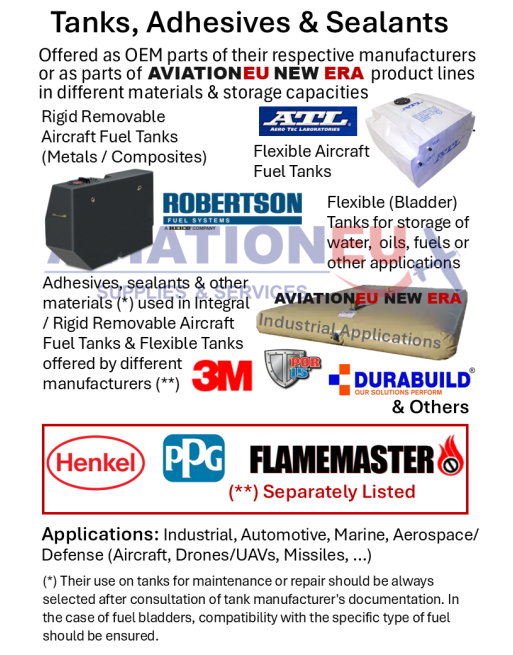

Integral fuel tanks in aircraft form part of their wing or fuselage structure and they are commonly met in high-performance aircraft as they are the lightest, with most space per unit of weight. Rigid removable aircraft fuel tanks are also used in some aircraft, typically made of stainless steel or aluminum alloy and riveted together. Flexible fuel tanks (aka fuel bladders) are fuel containers made of reinforced flexible materials. They share many characteristics with rigid tanks but they require a smaller opening in the aircraft to be installed. Also used in other sectors for rapid deployment of storage facilities or increase capacity of fuels (gasoline, diesel or jet fuel) but also for water, oils, or as emergency units. They are made of high-quality PVC, EVA, and TPU (Thermoplastic Polyurethane) coated fabrics, are fully UV resistant, and can operate at temperatures from -50°C to +90°C, ensuring durability and reliability under the most demanding conditions. Made by different manufacturers, these tanks conform to commercial standards while some of them are ballistic-tolerant or engineered for mission-critical military or aerospace uses, meeting respective commercial (such as TSO-C80 and 14 CFR Part 29) as well as military specifications like MIL-DTL-6396, MIL-DTL-5578, and MIL-DTL-27422.
Related materials such as tank cleaners/degreasers, adhesives & sealants are also offered and included in this presentation.
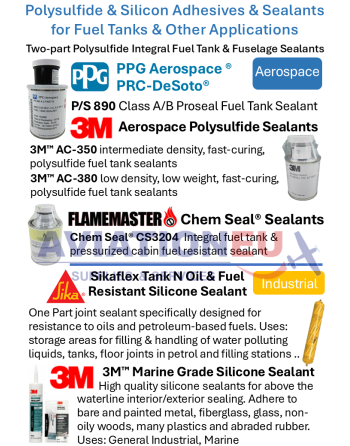
Tank adhesives/sealants come in different compounds (chemical composition) and respective prices, and their selection heavily depends the material of the tank they shall be applied and the sealing content (water, oil, fuel, etc). The selection and use of any sealant during tank construction, maintenance or repair should always ensure sealant's compatibility with tank composition and chemical resistance to fuels or other fluids to be sealed. Commonly used sealants for tanks span from PVC, the more cost-effective but with low temperature resistance & toxic when burned, to more expensive but safer Silicone ones, with excellent flexibility, high and low-temperature resistance and biocompatibility, to Polyurethane sealants, durable but not so chemically resistant as Polysulfide, and Polysulfide rubber sealants, flexible, and extremely resistant to gasoline, ethanol and many other chemicals.
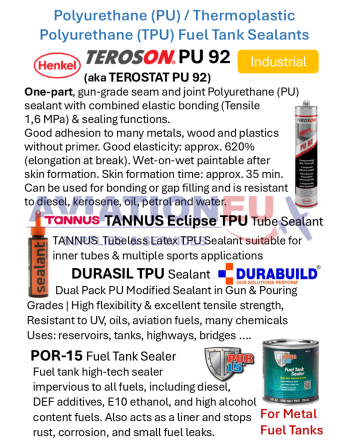
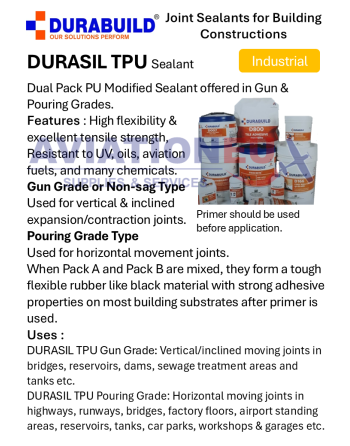
For aircraft integral fuel tanks and rigid removable fuel tanks made of metals, two-part Polysulfide sealants are often the preferred choice. For flexible Polyurethane/Thermoplastic Polyurethane (PU/TPU) fuel tanks (bladders) the bonding/sealing material itself is often a specialized PU/TPU formulation for enhanced flexibility and durability,chemical resistance to hydrocarbon fuels, solvents, and oils, impact resistance, and bonding strength compared to traditional formulations. Silicone sealants are also used depending on application requirements.
Supplied either as OEM parts or as parts of our own labelled (AVIATIONEU NEW ERA) product lines.
TANK ADHESIVES & SEALANTS
Tank adhesives and sealants are widely used both in Aerospace and many other industries, from automotive and industrial assemblies to footwear, construction, and protective coatings. Those designed for tanks storing fuels and other hazardous substances are applied to storage surfaces to create a resistance barrier preventing leaks. Fuel tank adhesives & sealants are typically used to create air-tight seals in fuel lines, seal the rivets and joints of fuel tanks, as a coating and sealant to protect station floors, on workshops and factory floors, etc.
Tank adhesives/sealants are based on different compounds (chemical composition) and respective prices. Their selection heavily relies on the material of the tank they shall be applied and the sealing content (water, oil, different fuels like gasoline, diesel, and jet fuels, etc).
For aircraft integral fuel tanks and rigid removable fuel tanks made of metals (typically stainless steel or aluminum alloy) and composites, two-part Polysulfide rubber sealants are often the preferred choice due to their flexibility, and extreme resistance to gasoline, ethanol and many other chemicals. Polysulfide sealants are not formulated and cannot generally be used on flexible tanks (bladders) made of plastic substrates (such as PU/TPU) as they lack good adhesion to most plastics. In this case, sealants, commonly based on Polyurethane (PU) formulations are selected, although not so chemically resistant as Polysulfide ones.
The selection and application of a sealant is further discussed below and should always conform to the tank material and the instructions of the respective tank manufacturer. Other factors such as sealant cost, weight (with some sealants being more lightweight than others) and other properties (such as their elasticity or temperature resistance, biocompatibility and others) also affect the selection of the sealant.
Sealant Compatibility with Tank material and appropriate surface treatment. Sealant must be compatible with aluminum, stainless steel, plastic or composite materials from which tanks are commonly made. Poor adhesion and sealant failure may result from poor tank surface treatment (e.g lack of use of clearing chemicals) prior to sealant application, and/or sealant/tank material incompatibility.
Sealant Application Tooling. Appropriate tools such as applicator guns, brushes and PPE should be used as per sealant producer's instructions.
Sealant Curing Time. Aircraft fuel tank sealants typically cure between 24 and 72 hours depending on the sealant type, ambedient temperature, humidity, and layer thickness.
Sealant Operating Temperatures. Applied sealant temperaures should be within the temperature range of their intended application. Many sealants operate between -65° F and 250° F (-54° C and 121° C). Extreme temperatures can affect sealant elasticity and adherence, causing leaks and failures.
Due to the high variety of adhesives and sealants that can be supplied and their respective documetation, certain products can be found under the respective listings of their manufacturers (as for example those offered by PPG Aerospace® / PRC-DeSoto®, FLAMEMASTER Chem Seal® ) while others are listed here. For additional information please contact us. Those listed in this presentation are briefly described below.
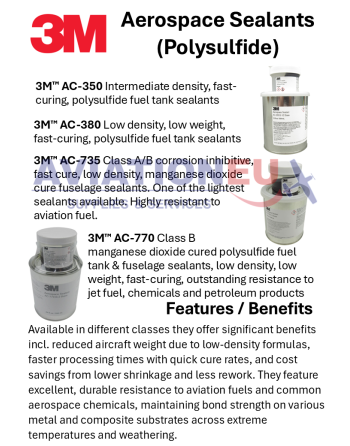
3M™ Aerospace Sealant AC-350 is a family of intermediate density, fast-curing, polysulfide fuel tank sealants that provides outstanding resistance to aviation fuels and petroleum chemicals. 3M™ AC-350 Class A and B variants maintain bond strength on many metal, composite and coated substrates and help meet a range of applications for integral fuel tank and fuselage sealing.
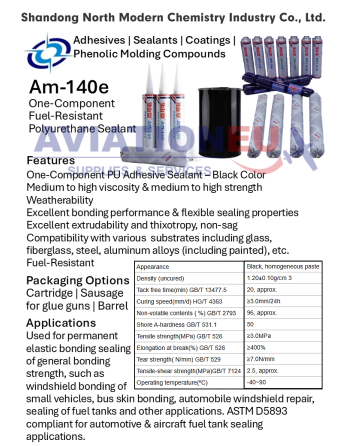
Am-140e by Shandong North Modern Chemical Industry Co., Ltd. is an one-component polyurethane adhesive with medium to high viscosity and medium to high strength. It has moderate viscosity and good thixotropy for easy construction. After curing, it has high bonding strength and good flexible sealing properties. Can be used for permanent elastic bonding sealing in a range of applications including windshield bonding of small vehicles, bus skin bonding, automobile windshield repair, etc. ASTM D5893 compliant for automotive & aircraft fuel tank sealing applications. Compatible with different substrates including glass, fiberglass, steel, aluminum alloy (including painted), etc.
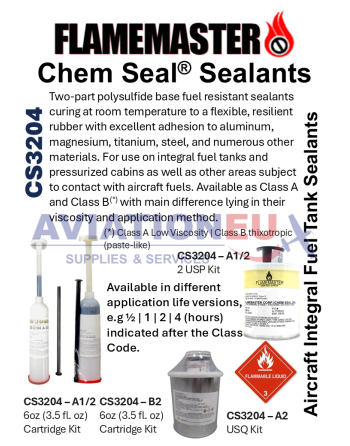
FLAMEMASTER® CHEMSEAL® range includes firewall, fuselage, fuel tank, windshield, access door and other specialty sealants and adhesives to cover a variety of aviation applications. For additional information please refer to the Product Description section and the supplied documentation. For non-listed products please contact us.

For more than 50 years, PPG AEROSPACE® – PRC-DeSoto® has been a leader in the development of products fundamental to aerospace manufacturing, maintenance, and repair. The company manufactures and provides a unique group of products including aircraft windshields and windows to the commercial, regional, military and general aviation segments as well as aircraft primers, coatings and sealants for aircraft structures used in aviation and milirary applications. In addition, high performance Industrial Adhesives and Sealants are also offered to provide protection from fuel and petroleum exposure as well as sealants for Telecom and Utility applications.
PPG AEROSPACE® – PRC-DeSoto® products are offered in different classes, specifications, application times and convenient container options including SEMCO Semkit® packages containing both the base and accelerator in one pack.
3 classes are generally used for the classification of sealants (A, B and C) although an S class does apply in some cases where a sealant can be sprayed.
Class A – Brush application, generally used on fasteners
Class B – Thicker consistency, used for fillet and injection seals
Class C – Thinner than Class B, used for fay sealing
Application times are expressed in hours (2 indicating 2 hours 1/2 indicating half an hour).
PPG AEROSPACE® integral fuel tank sealants for aerospace applications are high-performance products designed to provide long-lasting protection and sealing for aircraft fuel tanks. These sealants, such as the PR-1422 and Pro-Seal 890 were the first fully jet fuel resistant sealants. They offer excellent adhesion, flexibility, and resistance to fuels, oils, and other chemicals. They ensure leak-proof integrity under various temperature and pressure conditions, contributing to the overall safety and efficiency of aircraft operations.
PPG’s Aircraft Fuel Tank Sealants are included in this presentation while respective Aircraft Fuselage, Firewall Sealants and Corrosion Inhibitive Sealants and Coatings are separately presented.
For additional information on offered products please consult the Product Description Section and the supplied documentation.

HENKEL LOCTITE® is the world’s leading brand and trusted choice for high-performance adhesives, sealants and surface treatments for manufacturing applications worldwide, from aircraft to furniture. LOCTITE® product portfolios includes an extensive range of adhesives, sealants, surface treatments, and other industrial chemicals exploiting different technologies including acrylic, anaerobic, cyanoacrylate, epoxy, hot melt, silicone, urethane, and UV/light curing technologies.These technologies combined with innovations result in product solutions for adhesives, sealants and functional coatings that are essential to countless industrial applications.
HENKEL industrial sealant applications extend from automotive, electronics, aerospace, metal, and durable goods, to consumer goods, maintenance and repair, and packaging industries. In addition to LOCTITE® product lines, HENKEL also offers an extensive poduct portfolio under TEROSON® brand providing bonding, sealing, coating, acoustic, stiffening and reinforcing solutions for OEM transportation assembly, vehicle repair and maintenance (VRM) , industrial assemblies and building industry applications. The TEROSON® brand represents a global and scalable technology, offering extensive market and application competence for innovative, reliable and complete systems solutions tailored to customer needs, using a wide range of technologies in the form of foams, foils, tapes, patches, extrusions, baffles, membranes, and pumbable/sprayable gels and liquids.
In Aerospace, HENKEL LOCTITE® product portfolios (listed separately) include HYSOL® structural adhesives and film systems for aircraft and composite repair, aerospace potting solutions and Freketo mold release agents for the aerospace composites industry. LOCTITE® HYSOL® Aerospace adhesives are used by all major aerospace manufacturers including Boeing Commercial Aeroplanes Group and provide superior integrity to aircraft structures without added weight and ensure durable, tough bonding in composite and metal surfaces. Structural adhesive applications include joint sealing, magnet bonding, metal bonding, multiple surface bonding, noise, vibration, and harshness (NVH), plastic and composite bonding, potting and encapsulating and others.
Several HENKEL LOCTITE® and TEROSON® products are included in this listing and briefly described in the Product Description section. For LOCTITE® HYSOL® Aerospace products please refer to the respective product presenatation.
For additional information please consult the supplied documentation or contact us for non listed items.

SAE-AS5174/MS24392/AN815 series union, flared tube male to male hydraulic fittings are available as part of our own labelled (AVIATIONEU NEW ERA) product lines in different materials, tube outer diameters and thread sizes in inches. The AN815 series fittings are superseded by the respective fittings of Military Standard MS24392 which in turn are superseded by SAE International standard SAE-AS5174 series. Materials include: Carbon Steel, Aluminum Alloy, Corrosion Resistant Steel (CRES), Titanium Alloy. The 2 digits after the series code indicate the tubing outer diameter (O.D.) in inches. The following Material Code Letters in the part numbers indicate the composition of the fitting. Finish code “V” in the PN indicates high purity Aluminum coating for “W” or “D” fittings.
Depending on their Part Number they are sold in pieces but also in packs a with specified number of fittings indicated after the letters "PK" in the product reference number (SKU).
No code letter in part number for Carbon Steel
“D” for Aluminum Alloy (except 7075-T73)
“J” for CRES, type 304
“K” for CRES, type 316
“R” for CRES, type 321
“S” for CRES, type 347
“T” for Titanium Alloy 6AL-4V
“W” for Aluminum Alloy 7075-T73
“Z” for Carbon Steel, Zinc plated
For example, AS5174D0606 union fitting is made from Aluminum Alloy with a tubing outer diameter (O.D.) 3/8" and a 0.5625-18 UNJF thread. The corresponding union fitting in AN832 series would be AN815-6D.
Note: In SAE AS standards for new designs, Aluminum fittings with material code letter D in their Part or Identifying Number (PIN) are replaced by those with material code letter W for Aluminum Alloy 7075-T73 providing a higher tensile strength. In addition CRES fittings with material code letter S can be used for replacement parts. For new designs use of CRES fittings with material code letter R is recommended for applications requiring higher temperature.

The German DIN 3771 standard refers to all O-rings as sealing elements for fluid technology and identifies O-Ring sizes by their Inner Diameter (ID) &Cross Section (C/S). This standard has essentially been incorporated into the international standard ISO 3601 which sets the globally relevant O-ring dimensions and uniform rules for installation spaces and the properties of the O-rings. It defines metric O-rings according to the same dimension chart as DIN 3771 while it has been extended to include O-rings in imperial dimensions. ISO 3601 also goes beyond the German standard in the area of materials containing material requirements for O-rings that far exceed those of DIN 3771.
Elastomer materials suitable for certain sealing situations are referred to by their abbreviation according to DIN ISO 1629 and include:
Nitrile/Buna-N (NBR), presently the seal industry’s most widely used elastometer, Ethylene-Propylene (EPM/EPDM) used extensively for outdoor, weather-resistant uses and water applications,
Silicone (MQ, PMQ, VMQ, PVMQ) especially resistant to high, dry heat in primarily static applications,
Neoprene® (Chloroprene) (CR) developed as oil-resistant substitute for natural rubber with resistance to ammonia and Freon® and therefore a superior sealing material for the refrigeration industry,
Fluorocarbon compounds (FPM / Viton®) / (Fluorel®) (FKM) combining high-temperature toughness with wide chemical agent compatibility, and
Fluorosilicone (FVMQ) combining the good high and low temperature stability of silicones with the fuel, oil and solvent resistance of fluorocarbons.
ISO 3601 / DIN 3771 standard O-rings are offered as part of our own (AVIATIONEU NEW ERA) product lines. Sourced from quality manufactuurers they are supplied in competitively priced packs in different materials, sizes, and hardnesses as specified by a two-digit Shore A durometer number,ranging from 20 (soft) to 90 (hard), depending on the type of elastomer.
For additional information please consult the Product Description section or contact us.

CHAMPION AEROSPACE designs and manufactures CHAMPION-brand filters and piston-engine ignition components for both OEM and aftermarket for general aviation aircraft applications.
CHAMPION FAA/PMA Approved Spin-On Oil Filters replace oil filter elements. They are easy to install and save time and clean-up.
Their full-pleat, resin-impregnated micronic filter media traps all harmful particles, including metallic chips which result from abnormal engine wear. Because the oil flows through many layers of locked-in fibers, there is no migration of fiber material to clog engine oil passages or affect bearing surfaces. According to industry-approved tests, the CHAMPION oil filters trap and hold more dirt and harmful particles during their normal operating time than any other similar filters.
Product Features:
Replacement elements service engine-mounted or line-installed filter systems incorporating a permanent housing assembly.
All sizes of replacement elements are packed 12 per case of a single part number in heavy, re-shippable corrugated-board cartons
Modern spin-on oil filters contain the element, incorporating the anti-drain back valve mechanism (and internal bypass valve 48108-1/48109-1), and are sealed in a disposable housing.
All sizes of spin-on filters are packed 12 per case of a single part number in heavy, re-shippable corrugated-board cartons.
Silicone impregnated filter gasket aids in future removal.
Shorter stud length on CH 48110-1 for tight clearance applications.
Heavy, corrugated steel center tube supports each convoluted pleat of the filter element and produces a substantially higher collapse-pressure rating, twice that of other similar filters.
Maximum full-flow design, without interference from center-bolt oil filter assemblies, provides increased oil filtration each engine-operating hour.
Sold each or in packs of 12 filters per pack.

FACET® and PUROLATOR® are both brands of MOTOR COMPONENTS, LLC. a manufacturer of electronic fuel pumps and filtration products. The company is a global leader in the electronic fuel pump industry. FACET® and PUROLATOR® products are known for their high quality and dependability.
Starting with fuel filters, FACET® and PUROLATOR® filter range has expanded to include oil filters, hydraulic fluid filters, air filters and water filters to their lineup. FACET® and PUROLATOR® fuel and other aircraft filters have a pleated design to maximize the filtration surface for faster, more efficient filtration. They carry a FAA-PMA approval and can be used in a variety of aircraft applications providing reliable, long-lasting and proven to work filtration solutions. Sold in pieces or packs of 10 pieces each. They come with Certificate of Conformance as standard. If additional certification is needed, manufacturer's certification and a FAA Export 8130-3 form can be provided with any qualifying filter item at extral cost. In this case please select listed products with the extension "CERT" in the product reference code (SKU) from our offered items.

HONEYWELL AEROSPACE seals are engine parts widely used in aerospace applications. They are also available as FAA-PMA parts from other manufacturers. Supply of the specific parts can be effected either as OEM part numbers or any of respective FAA-PMA part numbers subject to their availability by our suppliers.
P/N: 2-300-778-01 Fuel Manifold Gasket Seal is used in combustor turbine modules. It is also available as FAA-PMA part with alternative P/N: DEC2-300-778-01 by HEICO AEROSPACE and P/N: NK1004054-10 by EATON CORPORATION.

Switches for different functions, inteneded for use in Piper aircraft. Information on their applicability to different Piper aircraft models and serial numbers is included. For additional information and/or non listed switches please contact us.

Tempest® Spin EZ® FAA PMA approved aviation oil filters are manufactured by Aero Accessories®, LLC. Apart Spin-EZ® gasket oil filters the company also manufactures other pneumatic products such as Tornado™ dry air pump.
Product Features:
Improved Nut Welds – Nut welds are so strong that the can will distort without breaking the welds.Tempest Original filters can be installed without the danger of installation nuts falling off.
Improved By-Pass Valve for Continental® Engines – Meets TCM by-pass specification of 12-14 psi, reducing risk of premature bypass that can result in unfiltered oil flowing to your engine.
PC Housing (Patent Pending) – the only filter to incorporate a housing for the by-pass valve to prevent the restriction of the oil outlet should a failure of the by-pass valve occur.
Burst strength of 600 psi – Significant improvements to the roll seam process used on the bottom of the can substantially improved the design burst strength of the Tempest Spin EZ oil filter to over 600 pounds per square inch, exceeding the ARP 1400 standard by 50 percent. Extra strength gives added assurance that Tempest oil filters are made to withstand the harshest operating conditions.
Full Pleat Media – The resin-impregnated, cellulosic, full pleat media is designed for uniform flow and collapse resistance. 312 square inches is the most in aviation oil filters.
Tempest® Spin EZ® oil filters are sold individualy but also offered as economical, convenient, and easy to handle six and twelve packs. Spin EZ® Solid Lubricant, aTempest Spin EZ oil filter’s proprietary solid lubricant is also available allowing for easy removal of the filter. Unlike oil, grease or DC4 compound that leave the filter seemingly “bonded” to the engines mount pad, making it nearly impossible to remove, Tempest® Spin EZ solid lubricant won't extrude or squirt out from under the seal.
PLease consult the supplied documentation for additional information.

TRONAIR® is a leading GSE manufacturer offering a diverse range of high-quality GSE product lines to support safe and efficient aircraft ground operations. Their product portfolio includes equipment for jacking & access, hydraulic & pressure testing, towing & taxiing, electrical power & air conditioning, and aircraft & engine servicing.
TRONAIR® ATA-29 Hydraulic Power Service Units (HPUs) are multipurpose equipment, used for loading hydraulic oil in the aircraft or engine tanks of commercial, regional, and business airlines or allowing the aircraft actuators to be moved through their equipped high-pressure pumps. Their filter lines ensure that the liquid is not contaminated while their use reduces aircraft filter changes and increases aircraft component life. TRONAIR® ATA 29 HPUs have the best high-grade filtration in the industry. TRONAIR® HPUs are available in different series and various configurations. Despite their differences all HPUs are powered by a motor (the primary source of power), which in turn powers the main pump to circulate hydraulic fluid from the reservoir throughout the entire system. Typically, motors are electrically powered. However, a few are gas and diesel-driven for outdoor usage. Other HPU components include the hydraulic pump which controls both the flow and the pressure within the unit, the reservoir (the storage area for the hydraulic fluid), the regulators which control or "regulate" the pressure lines and the relief and pressure supply lines which keep the pressure inside the hydraulic power unit level.
TRONAIR® Reservoir Service Units, under their Hydraulic Service Units product range, support control of contamination of hydraulic fluids from dirt, air, and water in aircraft hydraulic systems through the servicing process. Re-circulating the fluid, prior to servicing, removes particulate contamination from the servicing line and couplings through their 2 micron filter and air, visible in their transparent return hose. Pressure and vacuum valves in the reservoir fill cap minimize tank breathing and thereby control the entry of water into the fluid. TRONAIR® Reservoir Service Units feature a 2 gallon (7.6 liter) reservoir capacity and a maximum output pressure rating of 75 psi/5.2 bars or 200 psi/13.8 bars depending on the model. Units are shipped fully assembled with the exception of customer supplied quick-disconnect couplings.
For more information please consult the supplied documentation.
Note: TRONAIR® ATA-29 Hydraulic Power Service Units (HPUs) are offered with or without CE marking (*). Listed HPUs are non CE rated. For CE rated versions please specify during ordering.
(*) CE marking indicates that a product has been assessed by the manufacturer and deemed to meet EU safety, health and environmental protection requirements. It is required for products manufactured anywhere in the world that are marketed in the EU.

Non-latching automatic self-sealing and Thread-Lok Quick Disconnect (QD) valved hose couplings are manufactured by the Stratoflex Products Division of Parker Hannifin Corporation.
Automatic couplings are recommended for use with today's advanced precision fluid systems for space flight, aircraft, ground and undersea applications. Stratoflex non-latching automatic self-sealing couplings are designed for use in diverse applications like electronic cooling systems, hydraulic accumulators/cylinders, brake systems, manifolds, vapor cycle and cryogenic systems. Automatic couplings are best utilized where space is limited, and hands off operation is required. Small envelope, high performance and unsurpassed reliability are key features of Stratoflex non-latching couplings. Available in different tube sizes, from sub-miniature to one inch in aluminum alloy, stainless steel, titanium and other exotic materials. They meet SAE Aerospace Standards AS4251,AS5072/1/2/3.
The Parker Stratoflex’s Thread-Lok Quick Disconnect (QD) valved couplings provide a proven solution for fluid conveyance systems for aerospace and derivative markets when envelope and weight are important and robust performance is critical. Applications range from hydraulic, fuel, and cooling systems to pneumatic, air data systems, landing gears, wheel and brakes hydraulic fluid motors, military ground vehicles and space applications. Their respective Thread-Lok Ground Service Equipment (GSE) Quick Disconnect (QD) couplings are intended for use with fluid conveyance systems providing a robust connection for ground service equipment to the aircraft flight systems. The Thread-Lok QD is used in a wide range of pressure and temperature applications.
They integrate a highly reliable and robust positive locking mechanism to ensure the performance needed in difficult aircraft system environments such as the engine nacelle, landing gear and brake systems, and other QD demanding installations . The Thread-Lok QD couplings can be used in a wide range of pressure and temperature applications while they provide a simple one-hand operation to thread the QD halves together with a visual confirmation of proper and full coupling to improve both time and safety.
The Thread-Lok QDs incorporate tang and slot design, with QDs engaging and locking in one position when the coupling halves are threaded together and fully connected, providing both visual and touch indication of the fully connected position. They use Parker’s efficient, self-sealing valve design that permits fluid flow with minimum pressure loss and turbulence.
Available in different tube sizes, from ¼ to one inch. Their stainless steel construction meets typical electrical bonding requirements.They meet or exceed MIL-C-25427 and AS1709 specifications.
For additional information please consult the Product Description section, the supplied documentation or contact us.

SAE-AS1035/MS24402/AN824 series tee, flared tube fittings are available as part of our own labelled (AVIATIONEU NEW ERA) product lines in different materials, tube outer diameters and thread sizes in inches. The AN824 series tee fittings are superseded by the respective fittings of SAE-AS1035 series (SAE International, Standard SAE AS1035, FITTING, TEE, STANDARD AND REDUCER, FLARED). They are manufactured from Carbon Steel, Aluminum Alloy, Corrosion Resistant Steel (CRES), Titanium Alloy. The 2 digits after the series code indicate the tubing outer diameter (O.D.) in inches. The following Material Code Letters in the part numbers indicate the composition of the fitting. Finish code “V” in the PN indicates high purity Aluminum coating for “W” or “D” fittings.
Depending on their Part Number they are sold in pieces but also in packs a with specified number of fittings indicated after the letters "PK" in the product reference number (SKU).
No code letter in part number for Carbon Steel
“D” for Aluminum Alloy (except 7075-T73)
“J” for CRES, type 304
“K” for CRES, type 316
“R” for CRES, type 321
“S” for CRES, type 347
“T” for Titanium Alloy 6AL-4V
“W” for Aluminum Alloy 7075-T73
For example, AS1035D in the PN of the fitting indicates that these are made from Aluminum Alloy.
Note: In SAE AS standards for new designs, aluminum fittings with material code letter D in their Part or Identifying Number (PIN) are replaced by those with material code letter W for Aluminum Alloy 7075-T73 providing a higher tensile strength. In addition CRES fittings with material code letter S can be used for replacement parts. For new designs use of CRES fittings with material code letter R is recommended for applications requiring higher temperature.

CHALLENGER AVIATION PRODUCTS, Inc. manufactures high quality oil-impregnated, surgical cotton gauze-based aircraft air filters under FAA/PMA certification using K & N filter media. K&N Performance Filters have been well known in the automotive world for years, unsurpassed in airflow and filtering capability they are now one of the most used filters on the road today. Made of a woven cotton fabric instead of paper, the K&N filter medium offers superior filtering without the restriction of airflow presented with paper or foam filters. Fabric allows 50% more air to pass than paper, and almost 60% more than foam. This translates into more horsepower and improved fuel economy.
Based on K&N technology CHALENGER filters have been certified for most general aviation aircraft. Their pleated cotton/wire mesh filters are far less prone to being clogged than synthetic media or paper, and tests done by Challenger (at approximately 240 CFM air flow) show K&N filters typically flow 6.03 CFM as compared to 4.95 for the average pleated paper element and 4.93 CFM for the oil-coated foam variety.
CHALLENGER air filters can be used as replacement parts to other OEM products but an STC (available by CHALLENGER) is required. Air filters come with an application chart, instructions, warranty card and a STC request form which needs to be filled out for approval for the specific aircraft. The filters comes with a gasket, but do not include the grease which is sold separately, unless otherwise stated.
Product Features:
Can be washed & serviced up to 25 times
Increase horse power 2-4%
Fire Retardant
Save money & improve efficiency
FAA-PMA approved
Ecologically sound
Better take-off and climb-out performance
Faster airspeed and/or better fuel consumption
Accordion fold design provides up to 5 times filtering surface of non-pleated designs
Please refer to the attached documentation on the application of CHALLENGER filters in different aircraft/models.

The SWAGELOK® Company is a global supplier of a range of products including fittings, valves, hoses, regulators, medium- and high-pressure products, process instrumentation, quick-connects, measurement devices, tubing and tools, filters, sample cylinders, MPC modular systems, pre-engineered subsystems (PrESS), welding systems, leak detectors, lubricants, and sealants.For more information on SWAGELOK® products please refer to the supplied documentation.

ROTAX® aircraft engines form part of the product portfolio of BRP-Powertrain GmbH & Co. KG which develops and manufactures engines for snowmobiles, watercrafts, boats, roadsters, all-terrain and side-by-side vehicles, motorcycles, carts, and aircrafts.
BRP-ROTAX® product range includes certified and non certified internal combustion engines, parts and accessories for light and ultralight aircraft.
Different air filters are used in BRP-ROTAX® aircraft engines. They are offered as certified or non certified parts from the manufacturer. Non certified parts can be used in ultralights or other aircraft not requiring certification of parts for their installation. Certified parts are designated by the letters "CERT" in the product reference number (SKU).
Aircraft engine parts are subject to changes from time to time. Some parts may be no longer available or replaced by others with different part numbers. Listed BRP-ROTAX® engine parts do not imply their current availability or suitability for your engine application. Always consult the most recent Illustrated Part Catalogs (IPCs) or other documentation available from the manufacturer for the correct part number before ordering.

ARROW PNEUMATICS offers a complete line of filters, regulators, lubricators, desiccant and sintered bronze products which provide coverage for all markets – PBE, Industrial, Automotive Aftermarket, AG, Heavy Duty, etc. Coverage includes a complete line of desiccant products and air control units, not available through all competitors.
ARROW PNEUMATICS hydraulic in-line filters provide protection for small, high pressure systems up to 3,000 PSI.
Using these filters at the pressure side of a pump, foreign particles 25 microns and larger, such as those created by pump wear, are removed before damage can result to the valving in the system. A sintered bronze element ensures protection against crushing should dirt accumulate and increase pressure drop across the element. The unique construction features an anodized aluminum housing for light weight, and a conically shaped sintered bronze element positioned by a retaining spring to allow true, uninterrupted axial flow. Special viton O-rings are available for oil systems where chemical action may be a problem. The standard 25 micron bronze filter element can be easily cleaned or replaced. Nominal filtration ratings of 90, 40, or 10 microns available.
Available in different NPTF sizes.
Maximum operating pressure: 3000 PSI
Operating temperatures: 35 - 200 deg. F

The AN6298 bulkhead nuts are plain, hexagon nuts used in various aerospace applications. These have been superseded by respective part numbers of SAE International standard SAE-AS5178. Typically made from high-strength steel or corrosion-resistant alloys they are designed for use in high-stress environments such as aircraft assemblies. Sourced from quality manufacturers they are offered as part of our own labelled (AVIATIONEU NEW ERA) product lines in different materials and thread sizes. The fitting composition is designated by a code letter in the part number of the fitting (No code letter for Steel, “D” for Aluminum Alloy, “J” for 304 Stainless Steel (CRES), “K” for 316 Stainless Steel or “T” for Titanium Alloy. Depending on their Part Number they are sold in pieces but mostly in packs a with specified number of fittings indicated after the letters "PK" in the product reference number (SKU).

FACET FILTRATION GROUP® is the global leading manufacturer of filtration products and systems with an extensive range of products including filter cartidges, housings, water treatment equipment and complete systems. Group products are covering a wide range of applications from aviation fueling and onshore, offshore or onboard marine applications to protection from debris and water contamination of diesel fuel supply of heavy equipment and water treatment facilities. FACET® fuel pumps and filters for aviation uses are separately presented.

FILPRO CORPORATION manufactures a wide range of high quality industrial filter parts intended for use as replacements to respective OEM products meeting or exceeding their specifications. All FILPRO offered filters are direct replacements in form, fit and function for the respective reference numbers of OEM products. The company is also a distributor of OEM brands covering air, liquid and gas filtration needs.
Offered FILPRO product portfolio includes Air Filters, Compressor & Vacuum Pump Filters, Hydraulic & Oil Filters, Dust Collector Filters, Liquid Filter Cartridges, Liquid Filter Bags, Spilltech Sorbents as well as Custom Filter Designs. FILPRO filtration products are used worldwide by OEM’s and end users in virtually every industrial application. Some of the major industries served include: Agriculture, Air Conditioning, Automotive, Government, Aviation, Defense, Chemical Processing, Conveying, Food and Beverage Processing, HVAC, Hydraulics, Industrial Gas Production Irrigation, Medical, Metal Processing Packaging, Paint Processing, Petroleum, Pharmaceuticals, Plastics, Pneumatic, Printing, Pulp & Paper, Refrigeration, Tool & Machine, Transportation, Utilities, Vacuum Cleaner, Water Purification & Wastewater Treatment. For additional information on FILPRO filters please consult the supplied documentation or contact us.

Flared sleeve fittings are cylindrical metallic parts designed to be used on tubing to back up the flared end and provide a bearing surface for the coupling nut, thereby reducing wear on the tubing flare. The inside diameter of the flanged end is countersunk to form a seat for the flare when assembled to a mating fitting.
Coupling sleeves conforming to SAE International, standard AS5176 standard replace respective MS20819/AN819 sleeves and they are offered as part of our own (AVIATIONEU NEW ERA) product lines. Sourced from quality producers these fittings are manufactured in different materials including 4130 Steel, Copper, Corrosion Resistant Steel (CRES) and Aluminum & Titanium Alloys. Material Code Letters in the part numbers indicate the composition of the fitting.
Depending on their Part Number they are sold in pieces but also in packs a with specified number of fittings indicated after the letters "PK" in the product reference number (SKU).

SAE-AS5406/AN832 series union tube hydraulic fittings are available as part of our own labelled (AVIATIONEU NEW ERA) product lines in different materials, tube outer diameters and thread sizes in inches. The AN832 series fittings are superseded by the respective fittings of SAE International standard SAE-AS5406 series.
Like their SAE-AS5174/MS24392/AN815 union flared tube counterparts, SAE-AS5406/AN832 series fittings are manufactured from Carbon Steel, Aluminum Alloy, Corrosion Resistant Steel (CRES), Titanium Alloy. The 2 digits after the series code indicate the tubing outer diameter (O.D.) in inches. The following Material Code Letters in the part numbers indicate the composition of the fitting.
No code letter in part number for Carbon Steel
Code letter “D” for Aluminum Alloy (except 7075-T73)
Code letter “J” for CRES, type 304
Code letter “K” for CRES, type 316
Code letter “S” for CRES, type 347
Code letter “T” for Titanium Alloy 6AL-4V
Code letter “W” for Aluminum Alloy 7075-T73
For example, AS5406D06 union fitting is made from Aluminum Alloy with a tubing outer diameter (O.D.) 3/8". The corresponding union fitting in AN832 series would be AN832-6D.
Depending on their Part Number they are sold in pieces but also in packs a with specified number of fittings indicated after the letters "PK" in the product reference number (SKU).

FACET® and PUROLATOR® fuel pumps were manufactured and branded by MOTOR COMPONENTS, LLC. They were compatible with gasoline, diesel, biodiesel, blended alcohol fuels and fuel additives and capable of operation with 12/24V electric systems according to the selected model. These pumps have been discontinued although there is still a limited stock availability from stocks in various suppliers. Contact us for prices and availability.
The FACET® GOLD-FLO Solid State fuel pumps were enhanced versions of respective Interrupter models featuring a solid state circuitry and ease of installation and service. When properly installed, they assured a constant, smooth, dependable supply of fuel under pressure in the hottest weather or in high altitudes eliminating vapor lock. Key product features: State of the art and sealed electronics, self priming and regulating, corrosion resistant (over 100 hours of salt spray), built in anti-siphon valve (positive shut-off), replaceable 74 micron filter, built in magnet to collect metal particles for additional filtration, 12 - 24 inches dry lift, 20 - 45 GPH, 1 - 8 PSI, 1.6 amp average, transient protection (24 volt only), -40 to 180 deg. F operating temperature range, UL/VCA certification, compliance to Mil-std-461D
Although FACET® GOLD-FLO solid state fuel pumps were certified and often used on UL and VCA aircraft, they were not FAA approved and as per their manufacturer statement, they were not designed, tested or manufactured for aircraft applications. Tempest FAA-PMA approved Platinum Electronic Fluid Pumps (separately listed) can be used as Facet Gold-Flo fluid pump replacements in this case. Please refer to the respective correlation chart for additional information.
Integral fuel tanks in aircraft form part of their wing or fuselage structure and they are commonly met in high-performance aircraft as they are the lightest, with most space per unit of weight. Rigid removable aircraft fuel tanks are also used in some aircraft, typically made of stainless steel or aluminum alloy and riveted together. Flexible fuel tanks (aka fuel bladders) are fuel containers made of reinforced flexible materials. They share many characteristics with rigid tanks but they require a smaller opening in the aircraft to be installed. Also used in other sectors for rapid deployment of storage facilities or increase capacity of fuels (gasoline, diesel or jet fuel) but also for water, oils, or as emergency units. They are made of high-quality PVC, EVA, and TPU (Thermoplastic Polyurethane) coated fabrics, are fully UV resistant, and can operate at temperatures from -50°C to +90°C, ensuring durability and reliability under the most demanding conditions. Made by different manufacturers, these tanks conform to commercial standards while some of them are ballistic-tolerant or engineered for mission-critical military or aerospace uses, meeting respective commercial (such as TSO-C80 and 14 CFR Part 29) as well as military specifications like MIL-DTL-6396, MIL-DTL-5578, and MIL-DTL-27422.
Related materials such as tank cleaners/degreasers, adhesives & sealants are also offered and included in this presentation.
Tank adhesives/sealants come in different compounds (chemical composition) and respective prices, and their selection heavily depends the material of the tank they shall be applied and the sealing content (water, oil, fuel, etc). The selection and use of any sealant during tank construction, maintenance or repair should always ensure sealant's compatibility with tank composition and chemical resistance to fuels or other fluids to be sealed. Commonly used sealants for tanks span from PVC, the more cost-effective but with low temperature resistance & toxic when burned, to more expensive but safer Silicone ones, with excellent flexibility, high and low-temperature resistance and biocompatibility, to Polyurethane sealants, durable but not so chemically resistant as Polysulfide, and Polysulfide rubber sealants, flexible, and extremely resistant to gasoline, ethanol and many other chemicals.
For aircraft integral fuel tanks and rigid removable fuel tanks made of metals, two-part Polysulfide sealants are often the preferred choice. For flexible Polyurethane/Thermoplastic Polyurethane (PU/TPU) fuel tanks (bladders) the bonding/sealing material itself is often a specialized PU/TPU formulation for enhanced flexibility and durability,chemical resistance to hydrocarbon fuels, solvents, and oils, impact resistance, and bonding strength compared to traditional formulations. Silicone sealants are also used depending on application requirements.
Supplied either as OEM parts or as parts of our own labelled (AVIATIONEU NEW ERA) product lines.