
There are 57 products.


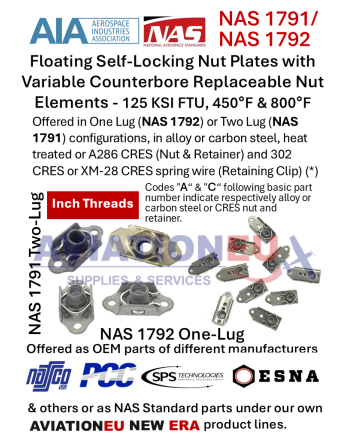
AIA NAS 1791/NAS 1792...
National Aerospace Standards (NAS) are voluntary standards developed and maintained by committees and working groups of subject matter experts from member companies of the U.S. Aerospace Industries Association (AIA). These standards have served as the foundation for the development of aircraft, spacecraft, watercraft, ground vehicles, machinery, and electronics.
NAS parts are most well-known for state-of-the-art, high-strength, precision fasteners, electrical connectors, splices and terminations, rod end bearings, and many other types of hardware and components. The NA prefix relates to metric standards.
NAS 1791 and 1792 Series fasteners are Floating Self-Locking Nut Plates(*) with variable counterbore replacement nut elements and as supplied in one-lug (NAS 1792) or two-Lug (NAS 1791) configurations. Both form part of NAS high-strength, precision fasteners. They are offered in alloy/carbon steel or corrosion resistant (CRES) materials, in different finishes, thread sizes and dimensions in inches. They can be used in applications with 450°F maximum temperature requirement while those from silver plated A286 Stainless Steel can withstand temperatures up to 800°F.
Sourced from quality manufacturers they are offered as OEM parts of their respective manufacturers or as parts of the respective Standard under our own labelled (AVIATIONEU NEW ERA) product lines. Sold in pieces or packs with specified number of anchor nuts per pack as indicated by the number after the letters "PK" in the product reference number (SKU).
For additional information please consult the supplied documentation or contact us.
(*) Also termed as plate nuts, anchor nuts or anchor plates. Appearing lengths in NAS 1791 nut pllates are distance between centers of mounting holes.

Aircraft General Standards...
Aircraft General Standards (AGS) were issued by the Directorate of Technical Development of the Air Ministry from the 1920’s and persist till today through substitutions to British Standards and AGS revisions. They relate to fasteners such as bolts, nuts, rivets, fork joints, taper pins, common to all types of aircraft. AGS fasteners are made in a range of sizes and different materials. In their identification system AGS parts are listed in sequential number, eg AGS 500, AGS 501 even though the number does not generally group common parts together nor does it follow a specific chronological order. Special parts made for specific aircraft have no marking to indicate size or material, but are marked with a part number.
Anchor nuts (aka nut plates) are designed for blind mounted applications where it is impractical to use hex nuts. Stiffnuts, in particular, feature a very high friction between the threads of the nut and the bolt so that the nut may be considered self-locking. Several types of stiffnuts have been designed for use on aircraft. AGS 2007 series relates to double lug anchor locking nuts (aka thick stiffnuts) while those in AGS 2008 and 2009 series relate to thin and countersunk stiffnuts.
AGS 2007 series anchor nuts are offered as nyloc (*) (with nylon-insert) or all-metal style. They can be furnished in different materials (aluminum, cadmium plated steel or corrosion resistant steel (CRES). Available with BA or BSF (**) threads as NEW OLD STOCK (NOS) items in limited quantities from stocks of our co-operating suppliers as special order non refundable and non-returnable items. Please refer to the supplied documentation or contact us.
(*) Nyloc nut (aka nylon-insert lock nut, polymer-insert lock nut, or elastic stop nut) is a kind of locknut with a nylon collar that increases friction on the screw thread.
(**) British Association (BA) Threads. small sized screw threads still used in some precision instruments, such as optics and moving-coil meters, relays as well as modelling applications. Recommended by the British Standards Institution for use instead of the smaller British Standard Whitworth (BSW) and British Standard Fine (BSF) thread screws (those below 1⁄4 inch).
British Standard Fine (BSF) Threads. Screw thread form, used as a fine-pitch alternative to British Standard Whitworth (BSW) threads. Common applications include British machine tool industry and cars. Superseded by the American UNF threads and later Metric standards.

DIN LN29673/LN 29692...
Anchor nuts (aka nutplates or anchor plates) are terms used interchangeably and relate to stamped sheet metal fasteners with an internally threaded tube and a plate with two clearance holes for rivets. Initially designed and still extensively used in aerospace applications, they are today also used in automotive, motorsports, and other industries in blind mounted panel applications where hex nuts cannot be used or an attached nut is required for ease of maintenance. They can be Fixed or Floating, the latter being easier to install due to their built-in nut (threaded hole) able to "float" slightly thus providing a convenient connection point for threaded rods, such as bolts, from the backside. In the case of Fixed anchor nuts, the built-in nut is static (i.e. without the capability to “float”) and the threaded bolt must be positioned perfectly over the hole. Self-locking anchor nuts are those with a built-in locking mechanism preventing them from loosening over time from vibrations.
Anchor nuts are offered in Imperial (in.) and Metric thread sizes, in different materials (e.g. Carbon Steel, Steel alloys, CRES), finishes such as Cadmium or Cadmium Free Zinc Nickel platings (compliant to EU Regulations) with or without dry film lubrication. They come in various styles/configurations (e.g. with one or two lugs, full size or miniatures, countersunk, corner, right-angled bodies, etc.). They conform to different U.S., European and international standards such as the US Military MS and NASM, German DIN LN, French AFNOR NF, British BS, ISO and others.
Depending on the selected nutplate, aerospace anchor nuts are produced by different manufacurers, such as HOWMET AEROSPACE (formerly ARCONIC) or PAOLO ASTORI, and others, and offered as respective OEM parts or as parts of our own labelled (AVIATIONEU NEW ERA) product lines in the case of those used in industrial applications. Sold in pieces or packs of specified number of anchor nuts per pack indicated after the letters "PK" in the product SKU.
Anchor nuts manufactured in accordance with DIN LN 29673 standard are Metric self-locking fixed one-lug anchor nuts designed with a single flange. Depending on the manufactuer, they are made from Carbon Steel / Steel Alloy termed as C1050, 25CrMo4, DIN 1.7220.3, 25CD4 with Cadmium plating & MoS2 low friction coating. Their counterparts of DIN LN29692 Standard are made from Incoloy Alloy® A-286 (also known as A286 Alloy Stainless Steel, a nickel and iron-based, austenitic superalloy) and can be used for temperatures up to 425 °C. Both feature a tensile strength of 900 MPa. Offered in different Metric thread sizes from HOWMET AEROSPACE (separately listed), PAOLO ASTORI and others as OEM parts. Depending on the part number they are sold mostly in pieces but also in packs where the number of anchor nuts per pack is indicated after the letters "PK" in the product SKU.
For additional information please refer to the supplied documentation or contact us.

DIN LN29681/LN29668...
Anchor nuts (aka nutplates or anchor plates) are terms used interchangeably and relate to stamped sheet metal fasteners with an internally threaded tube and a plate with two clearance holes for rivets. Initially designed and still extensively used in aerospace applications, they are today also used in automotive, motorsports, and other industries in blind mounted panel applications where hex nuts cannot be used or an attached nut is required for ease of maintenance. They can be Fixed or Floating, the latter being easier to install due to their built-in nut (threaded hole) able to "float" slightly thus providing a convenient connection point for threaded rods, such as bolts, from the backside. In the case of Fixed anchor nuts, the built-in nut is static (i.e. without the capability to “float”) and the threaded bolt must be positioned perfectly over the hole. Self-locking anchor nuts are those with a built-in locking mechanism preventing them from loosening over time from vibrations.
Anchor nuts are offered in Imperial (in.) and Metric thread sizes, in different materials (e.g. Carbon Steel, Steel alloys, CRES), finishes such as Cadmium or Cadmium Free Zinc Nickel platings (compliant to EU Regulations) with or without dry film lubrication. They come in various styles/configurations (e.g. with one or two lugs, full size or miniatures, countersunk, corner, right-angled bodies, etc.). They conform to different U.S., European and international standards such as the US Military MS and NASM, German DIN LN, French AFNOR NF, British BS, ISO and others.
Depending on the selected nutplate, aerospace anchor nuts are produced by different manufacurers, such as HOWMET AEROSPACE (formerly ARCONIC) or PAOLO ASTORI, and others, and offered as respective OEM parts or as parts of our own labelled (AVIATIONEU NEW ERA) product lines in the case of those used in industrial applications. Sold in pieces or packs of specified number of anchor nuts per pack indicated after the letters "PK" in the product SKU.
Anchor nuts manufactured i.a.w DIN LN 29681 standard are Metric self-locking floating one-lug anchor nuts. Depending on the manufactuer, they are made from Steel Alloys (25CrMo4,DIN 1.7214.4/1.7220.3, 25CD4, SAE 4135/ 4140, AISI 4135/4137) with Cadmium plating & MoS2 low friction coating. Suitable for use in temperatures up to 235°C. Their counterparts of DIN LN29668 Standard are made from Incoloy Alloy® A-286 (aka A286 Alloy Stainless Steel, an austenitic superalloy) and can be used for temperatures up to 425 °C. Both feature a tensile strength of 900 MPa. Offered in different Metric thread sizes from HOWMET AEROSPACE (separately listed), PAOLO ASTORI and others as OEM parts. Depending on the part number they are sold mostly in pieces but also in packs where the number of anchor nuts per pack is indicated after the letters "PK" in the product SKU.
For additional information please refer to the supplied documentation or contact us.

Aerospace Standard Metric...
Anchor nuts (aka nutplates or anchor plates) are terms used interchangeably and relate to stamped sheet metal fasteners with an internally threaded tube and a plate with two clearance holes for rivets. Initially designed and still extensively used in aerospace applications, they are today also used in automotive, motorsports, and other industries in blind mounted panel applications where hex nuts cannot be used or an attached nut is required for ease of maintenance. They can be Fixed or Floating, the latter being easier to install due to their built-in nut (threaded hole) able to "float" slightly thus providing a convenient connection point for threaded rods, such as bolts, from the backside. In the case of Fixed anchor nuts, the built-in nut is static (i.e. without the capability to “float”) and the threaded bolt must be positioned perfectly over the hole. Self-locking anchor nuts are those with a built-in locking mechanism preventing them from loosening over time from vibrations.
Anchor nuts are offered in Imperial (in.) and Metric thread sizes, in different materials (e.g. Carbon Steel, Steel alloys, CRES), finishes such as Cadmium or Cadmium Free Zinc Nickel platings (compliant to EU Regulations) with or without dry film lubrication. They come in various styles/configurations (e.g. with one or two lugs, full size or miniatures, countersunk, corner, right-angled bodies, etc.). They conform to different U.S., European and international standards such as the US Military MS and NASM, German DIN LN, French AFNOR NF, British BS, ISO and others.
Depending on the selected nutplate, aerospace anchor nuts are produced by different manufacurers, such as HOWMET AEROSPACE (formerly ARCONIC) or PAOLO ASTORI, and others, and offered as respective OEM parts or as parts of our own labelled (AVIATIONEU NEW ERA) product lines in the case of those used in industrial applications. Sold in pieces or packs of specified number of anchor nuts per pack indicated after the letters "PK" in the product SKU.
Anchor nuts manufactured i.a.w DIN LN 29679 standard are Metric self-locking floating two-lug low profile anchor nuts. Depending on the manufactuer, they are made from Steel Alloys (25CrMo4, DIN 1.7214.4/1.7220.3, 25CD4, SAE 4135/4140) with Cadmium or Zinc-Nickel plating & MoS2 low friction coating. Suitable for temperatures up to 235°C. Feature a tensile strength of 1100 MPa. Their counterparts of DIN LN 65016 & LN 29693 Standard Standard (*) are made from Incoloy Alloy® A-286 (aka A286 Alloy Stainless Steel, an austenitic superalloy) and can be used for temperatures up to 425 °C. Offered in different Metric thread sizes from HOWMET AEROSPACE (separately listed), PAOLO ASTORI and others as OEM parts. Depending on the part number they are sold mostly in pieces but also in packs.
(*) LN 65016/29693 Standard is inactive for new design.
For additional information please refer to the supplied documentation or contact us.

DIN LN9338/LN 9161...
DIN LN 9338 / LN 9161 Standard nuts are hexagon flanged self Locking nuts offered in Metric thread sizes. Also known as K-Nuts, these 6 point self locking nuts with integral washer are commonly used in aerospace and motorsport applications. Both are lightweight, with a reduced height for use in confined areas, a high mechanical resistance, corrosion resistance and a wide operating temperature range. DIN LN 9338 nuts are made of alloy steel (typically 35CrMo4 steel) and cadmium plated. They can be used for temperatures up to 235 °C. Their counterparts of the LN 9161 Standard are offered in Regular and High Temperature versions. The high temperature LN 9161 nuts differ from regular ones in terms of material, finish and temperature class. Regular LN 9161 nuts typically made of 35CrMo4 aerospace steel with cadmium plating are intended for use for temperatures up to 315 °C while high temperature LN 9161 nuts from Stainless A286 CRES with silver plating can cover temperature requirements of up to 425 °C.
Depending on the Standard, DIN LN 9338 / LN 9161 nuts are offered in different thread sizes from various manufacturers including HOWMET AEROSPACE (separately listed), PAOLO ASTORI, ECROU AVIATION and others.
For additional information please refer to the supplied documentation or contact us.

BAC (Boeing) & ASNA...
Boeing & Airbus, the two leading airframe builders, have developed specifications for fasteners, hardware and other parts manufactured by different companies. Compliance with Boeing (aka BAC) and Airbus (aka ASNA) Standards is a prerequisite for installation or use of these parts on their respective aircraft. In many cases, Boeing & Airbus fasteners and other parts have the same fit, form, and function and they are considered as alternatives or substitutes to the respective parts designed and/or manufactured by industry leaders such as HI-SHEAR or HOWMET in the case of fastening products.They also conform to widely accepted Military & Aerospace Standards such as AN, MS, NAS and others. However, caution is required as, depending on their series & conforming standard, fasteners are offered in Imperial (in.), Metric (mm) systems, or both, with resulting variations in their dimensions and units of measurement of their properties.
As a result of the extensive portfolio of fastening products (including screws and bolts, nuts, washers, pins, rivets, clamps, and many others) from different leading suppliers, and those falling under Boeing, Airbus, Military and Aerospace Standards, these are listed separately in our Web Platform for Supplies. It must be noted that, depending on the intended application, usually more than one options are available to prospective buyers and selection is finally made, apart from specifications, on the basis of price or lead time required for non-stock parts. Whenever possible,correlation tables and other information and documentation is provided to facilitate the users' awareness on interchangeability of offered fasteners and the selection of the right parts for their intended application. For additional information please contact us.

AIA NAS 577 Standard...
NAS 577 Standard specifies the dimensional and material requirements for a specific type of self-locking nut, which is designed with a built-in locking mechanism to resist loosening under vibration or other dynamic loads, unlike a standard, non-locking nuts which rely solely on the friction between the threads of the nut and bolt, and the clamping force generated by tightening, to prevent loosening.
Barrel nuts are used in different fastening applications as an alternative to traditional nuts. Due to their their aesthetically pleasing finish, barrel nuts are particularly common in furniture as connectors but also in aerospace manufacturing in aircraft landing gear and other components. Since their original form as a round bar stock with a transverse tapped hole their design has undergone many refinements with the elimination of material not contributing to their performance, the addition of a thread-locking option or a floating nut element to compensate for hole misalignment and so on.
Today NAS 577 Standard barrel nuts are produced by different manufacurers, such as HOWMET AEROSPACE (formerly ARCONIC) PAOLO ASTORI, or PCC SHUR-LOK. They are used in various aerospace and industrial applications requiring a secure and reliable, high strength fastening with resistance to fatigue failure. These nuts are offered in Imperial (in.) and Metric thread sizes, in different materials such as 8740 or 4340 alloy steel, 17-4PH stainless steel & A286 corrosion-resistant steel and finishes including cadmium plating, passivation with or without dry film lubrication. They can be supplied as respective OEM parts or as parts of our own labelled (AVIATIONEU NEW ERA) product lines. Sold in pieces or packs of specified number of anchor nuts per pack indicated after the letters "PK" in the product SKU.
For additional information please refer to the supplied documentation or contact us.

TINNERMAN® Fastening...
A. RAYMOND TINNERMAN® & PALNUT® (aka PAL) of TINNERMAN PALNUT ENGINEERED PRODUCTS, INC. are leading brands in specialty clip-type fasteners including the world's largest selection of spring steel, stainless steel, and plastic engineered fasteners. Their fasteners replace traditional fastening methods with innovative solutions combining aesthetics and functionality. They are quick and easy to install, and do not require mounting tools.
TINNERMAN® spring steel nuts (aka speed or sheet metal nuts) are self-retaining fasteners serving the functions of both a lock washer and a nut for an easy & fast attachment of mating panels. Offered in different shapes (e.g. Flat U, J) styles & finishes they can be used as both blind and front mounting attachments without required special tools, skills or equipment, removed and reused. Riveting, welding, clinching, staking and other secondary fastening devices are eliminated.
Flat type (NAS 446) TINNERMAN® nuts are used to replace threaded nuts, lock washers, and spanner washers weighting less than other types of self-locking aircraft fasteners. Designed to fit standard AN530-AN531 type B sheet metal screws only. Can be applied faster, easier, and are vibration resistant. Provide maximum holding power at minimum cost per fastener. Turned-up ends prevent scoring of surfaces.
J-type TINNERMAN® nuts press easily into self-retained position over panel edges or in center-panel locations. Ideally suited for blind assembly or hard-to-reach installations. Offer floating alignment to speed production and and lessen rejections. Can be applied after painting or porcelainizing panels eliminating the need for masking or retaping operations.
U-Type TINNERMAN® nuts (NAS396 Series), offered in U-Shaped and U-Nut Tapped Barrel styles, are made of spring steel with phosphate-coated with three coats of olive drab paint finish unless otherwise specified. Designed to fit standard AN530-AN531 type B sheet metal screws only. Available in different screw sizes & intended for use in many non-structural applications including appliances, panel assemblies, HVAC, automotive, electronics, aerospace, marine, utility vehicles & lighting equipment. Product Features: vibration proof, easy installation, no special tools, easily disassembled, reusable, used in place of clinch or weld nuts, correct misaligned mounting holes, no masking or retaping, retain holding power, corrosion proof, won’t freeze on threads.
Sourced from their respective manufacturers OEM parts of TINNERMAN® fasteners or their equivalents (separately listed) are offered in pieces but also in convenient packs as part of our own labelled (AVIATIONEU NEW ERA) product lines with a specified number of fasteners of the respective part number per pack indicated after the letters "PK" in our product reference number (SKU). Please refer to the Product Description Section for an indicative list of available packs.

AVIATIONEU NEW ERA...
AN316/NASM316 Series hexagonal steel cadmium plated thin non-locking check nuts are Military Specification versions of non-locking jam nuts used typically to lock in adjustments where a male threaded part screws only partway into a female threaded part (rod ends, grub screws, bulkhead fittings, etc). AN316/NASM316 Series jam nuts are thinner than the AN315 specification nuts for use in tighter installations but the AN316/NASM316 hex check nuts can carry half the tension load of the AN315 nuts.
Sourced from quality producers, the AN316/NASM316 Series check nuts are offered as part of AVIATIONEU NEW ERA product lines in steel cadmium plated or corrosion resistant steel (CRES) passivated (indicated by the letter "C" replacing the dash number) in different thicknesses and thread sizes in inches. Letters "R" and "L" after the dash number indicate a Right or Left Hand thread respectively. For additional information please consult the supplied documentation or contact us.
Certification Details:
AN316 (REV. 11)., AIR FORCE-NAVY AERONAUTICAL STANDARD: Nut, Jam, Hexagon (25 Feb 1991). Superseded by NASM316. The Part Identification Number (PIN) for AN316 and the part number for NASM316 are identical. The part numbers have not been changed.

AVIATIONEU NEW ERA...
AN315/NASM315 Series hex plain nuts are manufactured from steel and cadmium plated per QQ-P-416A, Type II, Class 3, corrosion resistance steel or aluminum alloys. The AN315 nuts have been superseded by NASM315 Series. Similar to common nuts but with a rugged construction they are designed and built with aviation grade materials and to specific aviation design specifications. They can carry the same high tension load as the AN310 castle nuts and require an auxiliary locking device such as a check nut or lock washer.
Sourced from quality producers, the AN315/NASM315 Series hex plain nuts are offered as part of AVIATIONEU NEW ERA product lines in different thicknesses and thread sizes in inches. The following letters are used to designate specific types of airframe nuts:
"C" before dash number for corrosion resistance steel nuts
"D" before dash number for aluminum-alloy nuts
"L" after dash number for left-hand thread
"R" after dash number for right-hand thread
For additional information please consult the supplied documentation or contact us.
Certification Details:
AN315 (REV. 10) (NOTICE 2)., AIR FORCE-NAVY AERONAUTICAL STANDARD: Nut, Plain, Castellated, Airframe (23 SEP 2002) [S/S BY NASM315]., AN315 REV. 10, dated 29 DECEMBER 1972, is hereby canceled and superseded by NASM315. The Part Identification Number (PIN) for AN315 REV. 10 and the part number for NASM315 are identical. The part numbers have not been changed.

AVIATIONEU NEW ERA...
Anchor nuts can be Fixed or Floating, the latter being easier to use due to their built-in nut (threaded hole) able to "float" slightly thus providing a convenient connection point for threaded rods, such as bolts, from the backside. In the case of Fixed anchor nuts, the built-in nut is static (i.e. without the capability to “float”) and the threaded rod must be positioned perfectly over the hole. Self-locking anchor nuts are those with a built-in locking mechanism preventing them from loosening over time from vibrations. They are extensively used in aerospace, automotive, and construction industries.
Depending on their intended application, nutplates conform to different military, aerospace, ISO or other industrial standards such as the German DIN, U.S. (ASME & ASTM, IFI, ANSI), British BS, Japanese JIS and others. They are offered as OEM parts under their respective brands or under our own labelled (AVIATIONEU NEW ERA) product lines intended as cost-effective alternatives to the respective OEM products. Listed in accordance with their standard of compliance, Fixed and Floating nutplates come in different materials (such as steel or CRES & finishes), in single/double lug configurations and Metric ISO οr Unified thread sizes. There is currently no U.S. Military Standard (MS) specification for Metric nutplates. Depending on the selected product and availability, nutplates can be supplied with a dry film lube specified by the letter "L" in the respective part number. Those with countersunk rivet holes are specified by the letter "K" at the end of the part number.
Sourced from quality manufacturers, AVIATIONEU NEW ERA MS21069/MS21070 series nutplates are fixed self-locking, two-lug, reduced rivet spacing low height miniature anchor nuts. MS21069 series nutplates are made from cadmium plated steel while those of MS21070 series from corrosion resistant steel (CRES). They come in different Unified Thread sizes with plain or countersunk rivet holes on each side, with or without a dry film lube. Sold in pieces but also in packs where the specified number of nuts per pack is indicated after the letters "PK" in the product reference number (SKU). Appearing prices are always for the units of measurement used each time. Matching rivets are sold separately.
For additional information please refer to the supplied documentation or contact us.

AVIATIONEU NEW ERA...
AN310/NASM310 and AN320/NASM320 Series castlellated nuts are manufactured from steel and cadmium plated. AN310/320 nuts have been superseded by NASM310/320 Series. The Part Identification Numbers (PIN) for AN310/AN320 and those for NASM310/NASM320 are identical.
Castellated nuts are of similar style and shape as castle nuts but they are not as thick (deep) as the castle nuts (they consist the thin version of standard castle nuts). The thin design makes castlellated nuts weaker than the castle nuts and are used only where shear stress forces are encountered. Fabricated from steel and cadmium plated per QQ-P-416A, Type II, Class 3. AN310/NASM310 castle nuts are used with drilled-shank bolts, clevis bolts, eye bolts and studs. The slots in the nut accommodate a cotter pin for safety purposes. The thinner AN320/NASM320 series castellated shear nuts, with half the tensile rating of the AN310/NASM310 series nuts, are used with clevis bolts and threaded taper pins which are subject to shearing stress only.
Both AN310/NASM310 and AN320/NASM320 Series castlellated nuts are sourced from quality producers and offered as part of AVIATIONEU NEW ERA product lines. For additional information please consult the supplied documentation or contact us.

AVIATIONEU NEW ERA...
The AN363 series regular height all-metal stop nuts are similar to those of MS21042 series except that MS21042 nuts are shorter than the AN363 but develop the same tensile strength. The AN363 series nuts are fabricated from carbon steel & cadmium plated as per specification QQ-P-416C or stainless steel, in which case the letter "C" is included after the series number (e.g. AN363 cadmium plated steel, AN363C stainless steel). Both are designed for use in high temp installations (AN363 up to 450°F, AN363C up to 800°F). The AN363/ AN363C series nuts have been replaced by those of MS21045/MS21046C respectively which in turn are superseded by NASM21045/NASM21046C. The Part Identification Number (PIN) for MS21045/MS21046C and the part number for NASM21045/NASM21046C nuts are identical. The part numbers have not been changed (eg. AN363-1032 to MS21045-3 to NASM21045-3).
Sourced from quality producers, MS21045/MS21046C all-metal stop nuts are offered as part of AVIATIONEU NEW ERA product lines which also include nuts from other AN, MS/NASM series (please refer to the individual product presentations). Sold in pieces. Please refer to product specifications or contact us.
Note: Depending on availability,these parts part may be supplied without or with Dry-Film Lubricant indicated by letter "L" in the SKU.
AVIATIONEU NEW ERA NASM/MS...
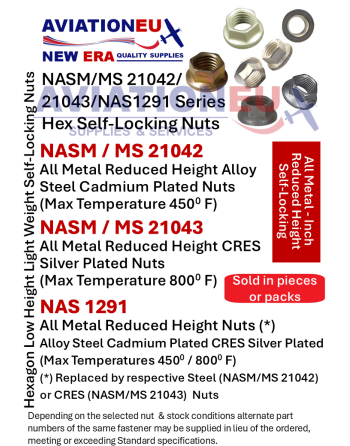
NAS1291 Series Nuts
The NAS1291 series lock-nuts are widely used throughout the aerospace industry. They are thin-walled, self-locking nuts with a reduced height and are made of silver plated corrosion resisting (stainless) steel for maximum temperatures 800°F or cadmium plated alloy steel for maximum temperatures 450°F, and offered with or without dry film lubricant The NAS1291 series of nuts ranges in size from 02 to 10 corresponding to thread diameters of .086 to .6250 inches. The following designators indicate the material and the dry film lubrication of these nuts:
- No letter after NAS1291 indicates nuts made of cadmium plated alloy steel with dry film lubrication,
- The letter "X" after NAS1291 is used to designate nuts made of cadmium plated alloy steel without dry film lubrication,
- The letter "C" after NAS1291 indicates nuts made of silver plated corrosion resisting steel (CRES) for use at max temperature 800°F.When the letter "M" is included in the end of the part number, dry film lubrication is included & max temperature is 450°F.
Nuts NAS1291-02 thru -6, NAS1291X02 thru X6, NAS1291C04 thru C6 are inactive for new design. They have been superseded by respective nuts of NASM21042/MS21042 and NASM21043/MS21043 series.
NASM21042/MS21042 and NASM21043/MS21043 Series Nuts
The MS21042 series (superseded by NASM21042 series) are all-metal hexagon reduced height self-locking nuts, rated at 160,000 psi tensile strength, made of cadmium plated steel. They are shorter than the AN363 nut but develop the same tensile strength. They are also lighter than AN365 nylon lock nuts (an average of 63% lighter for sizes -3 through -6).The NASM21042/MS21042 lock nuts are widely used throughout the aerospace industry together with those of MS21043 series (superseded by NASM21043) all-metal reduced hexagon, reduced height self-locking nuts with a ring base made of corrosion resistance steel and silver plated. Because of their reduced hex dimension, they are widely used in limited space applications where wrench access is a problem. Both are designed for use in high temperature installations (up to 450°F for MS21042 series and up to 800°F for MS21043 series nuts). They both come without or with or a dark grey dry film lubricant, indicated by the letter "L" in their part number.
Sourced from quality producers, NAS1291, NASM/MS 21042 and 21043 series nuts are offered as part of our AVIATIONEU NEW ERA product lines. Sold in pieces or packs with the number of nuts per pack indicated after the letters "PK" at the product reference code (SKU).
Depending on the selected nut & stock conditions alternate part numbers of the same fastener may be supplied in lieu of the ordered, meeting or exceeding standard specifications of ordered parts.
For more information please refer to the supplied documentation.

AVIATIONEU NEW ERA MS21078...
Anchor nuts (aka nutplates or anchor plates) are terms used interchangeably and relate to stamped sheet metal fasteners with an internally threaded tube and a plate with two clearance holes for rivets. They are used in blind mounted panel applications in aerospace and other industrial sectors where hex nuts cannot be used or an attached nut is required for ease of maintenance.
Anchor nuts can be Fixed or Floating, the latter being easier to use due to their built-in nut (threaded hole) able to "float" slightly thus providing a convenient connection point for threaded rods, such as bolts, from the backside. In the case of Fixed anchor nuts, the built-in nut is static (i.e. without the capability to “float”) and the threaded rod must be positioned perfectly over the hole. Self-locking anchor nuts are those with a built-in locking mechanism preventing them from loosening over time from vibrations. They are extensively used in aerospace, automotive, and construction industries.
Depending on their intended application, nutplates conform to different military, aerospace, ISO or other industrial standards such as the German DIN, U.S. (ASME & ASTM, IFI, ANSI), British BS, Japanese JIS and others. They are offered as OEM parts under their respective brands or under our own labelled (AVIATIONEU NEW ERA) product lines intended as cost-effective alternatives to the respective OEM products. Listed in accordance with their standard of compliance, Fixed and Floating nutplates come in different materials (such as steel or CRES & finishes), in single/double lug configurations and Metric ISO οr Unified thread sizes. There is currently no U.S. Military Standard (MS) specification for Metric nutplates. Depending on the selected product and availability, nutplates can be supplied with a dry film lube specified by the letter "L" in the respective part number. Those with countersunk rivet holes are specified by the letter "K" at the end of the part number.
Sourced from quality manufacturers, AVIATIONEU NEW ERA MS21078 series nutplates are fixed self-locking, two-lug nutplates with elastic insert and plain rivet holes. Made from cadmium plated steel they are available in different Unified thread sizes and replace respective AN366F series nutplates. Sold in pieces but also in packs where the specified number of nuts per pack is indicated after the letters "PK" in the product reference number (SKU). Appearing prices are always for the units of measurement used each time. Matching rivets are sold separately.
For additional information please refer to the supplied documentation or contact us.

AVIATIONEU NEW ERA DIN 982...
A nylon-insert lock nut (also referred to as elastic stop nut, nut with a non-metallic insert or nyloc nut) is a type of locknut with a nylon collar that increases friction on the screw thread. Nyloc nuts are widely used in products and structures subject to dynamic loads where motion or vibration can cause fasteners to become loose. Their design prevents the connection from loosening without the need for additional lock washers.The nylon insert is situated at the top of the nut and when tightened locks against the thread. The insert deforms elastically over the threads as tightening pressure is applied. The insert locks the nut against the screw as a result of friction, caused by the radial compressive force resulting from the deformation of the nylon. Nyloc nuts retain their locking ability up to 250 °F.
Metric hexagonal nylon-insert self-locking nuts are high anti vibration and anti loose fastening parts conforming to DIN 982 and DIN 985 standards. Different metric thread sizes are designated by the letter "M" indicating the nut's clearance diameter in mm. The main difference between DIN 982 & DIN 985 is the height of the nuts for same thread diameter. DIN 982 lock nuts (often termed as “P” Type) are taller than DIN 985 (aka “T” Type) ones. Lower profile DIN 985 are used in places where height is limited, while standard height DIN 982 nuts are used in connections where increased strength and fixation are required. In addition, the size range of DIN 985 nuts is wider than that of DIN 982. DIN 985 Nylon self-locking nuts can be used in various mechanical and electrical products with temperature from – 50 ℃ to 100 ℃. Due to their significantly higher anti vibration and anti loose performance than other anti loose devices, their application ranges from tanks, mining, agricultural, textile & various kinds of machinery to automobiles and aerospace.
Both DIN 982 and DIN 985 lock nuts are offered as part of our own (AVIATIONEU NEW ERA) product lines. Sourced from quality manufacturers they are competitively priced and can be supplied in different materials (Steel, Brass, Carbon Steel, Alloy Steel & Stainless Steel), grades (Class 5, 6, 8 or 10), metric thread diameters (typically M3/3 mm to M30/30 mm or up to 48 mm for DIN 985 nuts), thread pitches and finishes (natural, electro zinc-plated, chrome plated, black oxide and others). Sold in pieces or packs with number of pieces per pack indicated after "PK" designation in product SKU.
Notes:
Nut thread pitch indicates the distance between threads measured along the length of the nut expressed in mm.
In the case of stainless steel lock nuts, the stainless steel grades are denoted with codes such as A2 or A4 and dash numbers indicating the minimum tensile strength to be met by the material. For example, A2-70 relates to a nylon-insert lock nut made from 304 stainless steel with a minimum tensile strength of 700N/mm² (MPa).

AVIATIONEU NEW ERA ASTM...
These AVIATIONEU NEW ERA hexagon locking nuts comform with ASTM A194 standard specification for carbon, alloy and stainless steel nuts used in high pressure, temperature or other special-purpose applications. They can be indicatively used in the process industries, such as petroleum and chemicals for pressure vessels, valves, flanges, and fittings. Sourced by certified manufacturers these nuts are competitively priced and offered in metric (M3 - M36 diameter) or inch (3/16" - 1.1/2") sizes, different thread types and grade range to meet respective design, service conditions, mechanical properties, and high temperature requirements. Please refer to ASTM A194 specification table for additional information. Sold in packs of 100 pcs each. Appearing price is for reference only per pack. Please contact us for a quotation.

AVIATIONEU NEW ERA...
A wide range of Stainless Steel Hexagonal Nuts are offered as part of our own label (AVIATIONEU NEW ERA) product lines to meet diverse applications in aerospace and other industrial sectors. An overview of this product family structured in series is included below wihile additional information are included in the Product Description section. Sourced from quality manufacturers these nuts are available in different stainless steel materials, Metric or inch sizes, threads types and classes and comply with different standards/specifications depending on the selected product. Depending on selected nut size they are sold in pieces or convenient pacls of specified number of nuts per pack indicated after the letters "PK" in the product reference number (SKU). For further information please consult the supplied documentation or contact us.
AVIATIONEU NEW ERA AISI 304 Stainless Steel Nylon Insert Hex Lock (Elastic Stop) Nuts - Inch System. Retain locking ability up to 250 °F (121 °C).
AVIATIONEU NEW ERA AISI 304/316/667 Stainless Steel Hexagonal Lock Nuts - Metric System
AISI 304, 316 or 667 Stainless Steel. Meet DIN 985 standard. They feature a coarse thread type, bright finish and a strength class of A2-70.
AVIATIONEU NEW ERA AISI 304 Stainless Steel Hexagonal (Non Lock) Nuts - Metric System
AISI 304 Stainless Steel. Meet DIN 439 standard. They feature a coarse thread type, bright finish and a strength class of A2-70.
AVIATIONEU NEW ERA AISI 410 Stainless Steel Hexagonal (Non Lock) Nuts - Metric System
ASTM A193 Grade B6 Stainless Steel Hexagonal Nuts combining high tensile strength, excellent resistance to corrosion, durability and long service life. Used in different high tensile strength and corrosion resistance applications.
AVIATIONEU NEW ERA AISI 304 Stainless Steel Nylon Insert Hex Jam Lock Nuts - Inch System
Low profile lock nuts fromAISI 304 Stainless Steel. Suitable for corrosion resistance in applications exposed to fresh water.
AVIATIONEU NEW ERA 18-8 Stainless Steel Hex Jam Nuts - Inch System, UNEF Thread Type
Exhibit good chemical resistance and may be mildly magnetic. Used in low-clearance applications. Offered as RH or LH Threaded (UNEF Thread Type).
AVIATIONEU NEW ERA 18-8 / AISI 316 Stainless Steel Hex Panel Nuts - Inch System, UNEF Thread Type
Extremely thin nuts for tight spaces such as electrical panels. Can be furnished in 18-8 or AISI 316 Stainless Steel in different finishes. Those with a black-oxide finish have a dark surface color.

AVIATIONEU NEW ERA MS14144...
A castellated nut, also referred to as a castle nut or slotted nut, is a nut with slots (notches) cut into one end. Although castellated nuts are frequently referred to as slotted nuts, there are slight differences. Castellated nuts are formed with a round section at the top where the slots are located. Slotted nuts do not have this rounded modification. The flat sides of slotted nuts extend fully from the top to the bottom of the nut. Both castellated and slotted nuts are designed to use a pin (usually a split pin) that fits through the slots and through a hole in the screw to which the nut is attached. This pin prevents the nut from turning and loosening. Compared with slotted nuts, castellated nuts allow the cotter pin to be confined closer to the margins of the nut itself, providing added secureness.
MS14144 Series nuts are slotted hexagon style lightweight castellated self locking nuts manufactured from steel and cadmium plated. They are offered as part of our own labelled (AVIATIONEU NEW ERA) product lines in different sizes with right-hand thread direction and a dry film lubricant as applicable, specified by the letter "L" in the part number.
Note: Depending on availability,these parts part may be supplied without or with Dry-Film Lubricant indicated by letter "L" in the SKU.

AVIATIONEU NEW ERA MS17825...
A castellated nut, also referred to as a castle nut or slotted nut, is a nut with slots (notches) cut into one end. Although castellated nuts are frequently referred to as slotted nuts, there are slight differences. Castellated nuts are formed with a round section at the top where the slots are located. Slotted nuts do not have this rounded modification. The flat sides of slotted nuts extend fully from the top to the bottom of the nut. Both castellated and slotted nuts are designed to use a pin (usually a split pin) that fits through the slots and through a hole in the screw to which the nut is attached. This pin prevents the nut from turning and loosening. Compared with slotted nuts, castellated nuts allow the cotter pin to be confined closer to the margins of the nut itself, providing added secureness.
MS17825 Series nuts are slotted hexagon style lightweight castellated self locking nuts manufactured from cadmium plated steel to standard castle or shear nut specifications with a nylon insert added for positive safety. They are offered as part of our own labelled (AVIATIONEU NEW ERA) product lines and can be used throughout the control system. In case the cotter pin used with castle nuts is overlooked, the nut cannot work loose. The nylon insert will act as a stop nut.

AVIATIONEU NEW ERA MS17826...
A castellated nut, also referred to as a castle nut or slotted nut, is a nut with slots (notches) cut into one end. Although castellated nuts are frequently referred to as slotted nuts, there are slight differences. Castellated nuts are formed with a round section at the top where the slots are located. Slotted nuts do not have this rounded modification. The flat sides of slotted nuts extend fully from the top to the bottom of the nut. Both castellated and slotted nuts are designed to use a pin (usually a split pin) that fits through the slots and through a hole in the screw to which the nut is attached. This pin prevents the nut from turning and loosening. Compared with slotted nuts, castellated nuts allow the cotter pin to be confined closer to the margins of the nut itself, providing added secureness.
MS17826 Series nuts are slotted hexagon style lightweight castellated self locking nuts. They are similar to MS17825 Series nuts but they have a reduced height. They are manufactured from cadmium plated steel to standard castle or shear nut specifications with a nylon insert added for positive safety. They are offered as part of our own labelled (AVIATIONEU NEW ERA) product lines and can be used throughout the control system. In case the cotter pin used with castle nuts is overlooked, the nut cannot work loose. The nylon insert will act as a stop nut.

AVIATIONEU NEW ERA...
Anchor nuts (aka nutplates or anchor plates) are terms used interchangeably and relate to stamped sheet metal fasteners with an internally threaded tube and a plate with two clearance holes for rivets. They are used in blind mounted panel applications in aerospace and other industrial sectors where hex nuts cannot be used or an attached nut is required for ease of maintenance.
Anchor nuts can be Fixed or Floating, the latter being easier to use due to their built-in nut (threaded hole) able to "float" slightly thus providing a convenient connection point for threaded rods, such as bolts, from the backside. In the case of Fixed anchor nuts, the built-in nut is static (i.e. without the capability to “float”) and the threaded rod must be positioned perfectly over the hole. Self-locking anchor nuts are those with a built-in locking mechanism preventing them from loosening over time from vibrations. They are extensively used in aerospace, automotive, and construction industries.
Depending on their intended application, nutplates conform to different military, aerospace, ISO or other industrial standards such as the German DIN, U.S. (ASME & ASTM, IFI, ANSI), British BS, Japanese JIS and others. They are offered as OEM parts under their respective brands or under our own labelled (AVIATIONEU NEW ERA) product lines intended as cost-effective alternatives to the respective OEM products. Listed in accordance with their standard of compliance, Fixed and Floating nutplates come in different materials (such as steel or CRES & finishes), in single/double lug configurations and Metric ISO οr Unified thread sizes. There is currently no U.S. Military Standard (MS) specification for Metric nutplates. Depending on the selected product and availability, nutplates can be supplied with a dry film lube specified by the letter "L" in the respective part number. Those with countersunk rivet holes are specified by the letter "K" at the end of the part number.
Sourced from quality manufacturers, AVIATIONEU NEW ERA MS21048/NAS680 series nutplates are fixed self-locking, two-lug low height nutplates made from Corrosion Resistant Steel (CRES) A286 (UNS S66 286) in 450° & 800° F versions with a passivated finish. Same as those of MS21047series except that they are made from stainless steel and silver plated (800 ° F only). They have a nylon insert and are available in different Unified thread sizes, with plain rivet or countersunk rivet holes on each side and come with or without a dry film lubricant (450° F only). MS21048 nutplates supersede AN362, AN366, NAS680 and they are superseded by NASM21048 series. The Part Identification Number (PIN) for MS21048 and the part number for NASM21048 are identical & part numbers have not been changed. Sold in packs with a specified number of nuts per pack indicated after the letters "PK" in the product reference number (SKU). Matching rivets are sold separately. For additional information please contact us.

AVIATIONEU NEW ERA...
Anchor nuts can be Fixed or Floating, the latter being easier to use due to their built-in nut (threaded hole) able to "float" slightly thus providing a convenient connection point for threaded rods, such as bolts, from the backside. In the case of Fixed anchor nuts, the built-in nut is static (i.e. without the capability to “float”) and the threaded rod must be positioned perfectly over the hole. Self-locking anchor nuts are those with a built-in locking mechanism preventing them from loosening over time from vibrations. They are extensively used in aerospace, automotive, and construction industries.
Depending on their intended application, nutplates conform to different military, aerospace, ISO or other industrial standards such as the German DIN, U.S. (ASME & ASTM, IFI, ANSI), British BS, Japanese JIS and others. They are offered as OEM parts under their respective brands or under our own labelled (AVIATIONEU NEW ERA) product lines intended as cost-effective alternatives to the respective OEM products. Listed in accordance with their standard of compliance, Fixed and Floating nutplates come in different materials (such as steel or CRES & finishes), in single/double lug configurations and Metric ISO οr Unified thread sizes. There is currently no U.S. Military Standard (MS) specification for Metric nutplates.Depending on the selected product and availability, nutplates can be supplied with a dry film lube specified by the letter "L" in the respective part number. Those with countersunk rivet holes are specified by the letter "K" at the end of the part number.
Sourced from quality manufacturers, AVIATIONEU NEW ERA MS21051/MS21052 series nutplates are fixed self-locking, one-lug low height standard rivet spacing nutplates. MS21051 series nutplates are manufactured from cadmium plated steel while those in MS21052 series are produced from corrosion resistant steel (CRES). They are available in different Unified thread sizes, with plain or countersunk rivet holes on each side and come with or without a dry film lube. Sold in pieces but also in packs where the specified number of nuts per pack is indicated after the letters "PK" in the product reference number (SKU). Appearing prices are always for the units of measurement used each time. Matching rivets are sold separately.
For additional information please refer to the supplied documentation or contact us.

AVIATIONEU NEW ERA...
Anchor nuts (aka nutplates or anchor plates) are terms used interchangeably and relate to stamped sheet metal fasteners with an internally threaded tube and a plate with two clearance holes for rivets. They are used in blind mounted panel applications in aerospace and other industrial sectors where hex nuts cannot be used or an attached nut is required for ease of maintenance.
Anchor nuts can be Fixed or Floating, the latter being easier to use due to their built-in nut (threaded hole) able to "float" slightly thus providing a convenient connection point for threaded rods, such as bolts, from the backside. In the case of Fixed anchor nuts, the built-in nut is static (i.e. without the capability to “float”) and the threaded rod must be positioned perfectly over the hole. Self-locking anchor nuts are those with a built-in locking mechanism preventing them from loosening over time from vibrations. They are extensively used in aerospace, automotive, and construction industries.
Depending on their intended application, nutplates conform to different military, aerospace, ISO or other industrial standards such as the German DIN, U.S. (ASME & ASTM, IFI, ANSI), British BS, Japanese JIS and others. They are offered as OEM parts under their respective brands or under our own labelled (AVIATIONEU NEW ERA) product lines intended as cost-effective alternatives to the respective OEM products. Listed in accordance with their standard of compliance, Fixed and Floating nutplates come in different materials (such as steel or CRES & finishes), in single/double lug configurations and Metric ISO οr Unified thread sizes. There is currently no U.S. Military Standard (MS) specification for Metric nutplates. Depending on the selected product and availability, nutplates can be supplied with a dry film lube specified by the letter "L" in the respective part number. Those with countersunk rivet holes are specified by the letter "K" at the end of the part number.
Sourced from quality manufacturers, AVIATIONEU NEW ERA MS21049/MS21050 series nutplates are fixed self-locking, two-lug low height reduced rivet spacing nutplates. MS21049 series nutplates are manufactured from cadmium plated steel while those in MS21050 series are produced from corrosion resistant steel and silver plated. They are available in different Unified thread sizes, with plain or countersunk rivet holes on each side and come with or without a dry film lube. Sold in pieces but also in packs where the specified number of nuts per pack is indicated after the letters "PK" in the product reference number (SKU). Appearing prices are always for the units of measurement used each time. Matching rivets are sold separately.
For additional information please refer to the supplied documentation or contact us.

AVIATIONEU NEW ERA National...
National Aerospace Standards (NAS) are voluntary standards developed and maintained by committees and working groups of subject matter experts from member companies of the U.S. Aerospace Industries Association (AIA).
These standards have served as the foundation for the development of aircraft, spacecraft, watercraft, ground vehicles, machinery, and electronics.
NAS parts are most well-known for state-of-the-art, high-strength, precision fasteners, electrical connectors, splices and terminations, rod end bearings, and many other types of hardware and components. The NA prefix relates to metric standards.
NAS 1022 Series Hex Self-Locking Machine Nuts form part of NAS high-strength, precision fasteners. These low height and strength hexagon machine nuts are sourced from quality manufacturers and offered in different materials and finishes as part of our own labelled (AVIATIONEU NEW ERA) product lines in different thread sizes and dimensions in inches. Those from 450 deg. low strength steel are designated by the letter "A" after NAS1022. Similarly, the letter "C" designates nuts from corrosion resisting steel passivated while the letter "N" refers to steel cad plated nuts.
AVIATIONEU NEW ERA...
Anchor nuts (aka nutplates or anchor plates) are terms used interchangeably and relate to stamped sheet metal fasteners with an internally threaded tube and a plate with two clearance holes for rivets. They are used in blind mounted panel applications in aerospace and other industrial sectors where hex nuts cannot be used or an attached nut is required for ease of maintenance.
Anchor nuts can be Fixed or Floating, the latter being easier to use due to their built-in nut (threaded hole) able to "float" slightly thus providing a convenient connection point for threaded rods, such as bolts, from the backside. In the case of Fixed anchor nuts, the built-in nut is static (i.e. without the capability to “float”) and the threaded rod must be positioned perfectly over the hole. Self-locking anchor nuts are those with a built-in locking mechanism preventing them from loosening over time from vibrations. They are extensively used in aerospace, automotive, and construction industries.
Depending on their intended application, nutplates conform to different military, aerospace, ISO or other industrial standards such as the German DIN, U.S. (ASME & ASTM, IFI, ANSI), British BS, Japanese JIS and others. They are offered as OEM parts under their respective brands or under our own labelled (AVIATIONEU NEW ERA) product lines intended as cost-effective alternatives to the respective OEM products. Listed in accordance with their standard of compliance, Fixed and Floating nutplates come in different materials (such as steel or CRES & finishes), in single/double lug configurations and Metric ISO οr Unified thread sizes. There is currently no U.S. Military Standard (MS) specification for Metric nutplates. Depending on the selected product and availability, nutplates can be supplied with a dry film lube specified by the letter "L" in the respective part number. Those with countersunk rivet holes are specified by the letter "K" at the end of the part number.
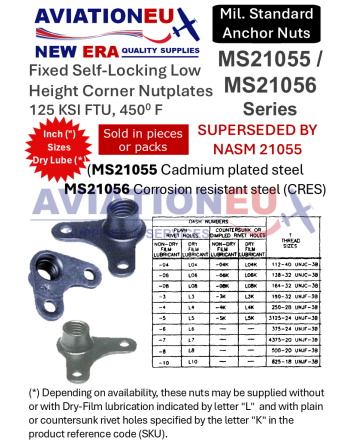
Sourced from quality manufacturers, AVIATIONEU NEW ERA MS21055/MS21056 series nutplates are fixed self-locking, low height corner nut plates. MS21055 series nutplates are manufactured from cadmium plated carbon steel while those in MS21056 series are produced from corrosion resistant steel (CRES). They are available in different Unified thread sizes, with plain or countersunk rivet holes on each side and come with or without a dry film lube. Sold in pieces but also in packs where the specified number of nuts per pack is indicated after the letters "PK" in the product reference number (SKU). Appearing prices are always for the units of measurement used each time. Matching rivets are sold separately.
For additional information please refer to the supplied documentation or contact us.

AVIATIONEU NEW ERA...
The NAS1423/NAS509 series hexagon nuts fall into the jam (aka check or thin) nut category. Jam nuts are a style of nut that features a low profile, typically half the height of standard nuts and diagonal drilled holes. Their minimal thickness allows them to fit in tight spaces where ordinary nuts might not fit. NAS1423 series jam nuts are manufactured from 4130/4340 cadmium plated steel alloy or unplated A 286 stainless steel (designated by the letter "C" in the part number). NAS509 series jam nuts NAS1423 series jam nuts are manufactured from 4130/4340 cadmium plated steel alloy or corrosion resistant steel passivated (designated by the letter "C" in the part number).
Sourced from quality producers, the NAS1423/NAS509 Series check nuts are offered as part of our own label (AVIATIONEU NEW ERA) product lines with Right or Left Hand threads in different sizes in inches. Letters "R" and "L" in the end of the product reference number (SKU) indicate a Right or Left Hand thread respectively. Sold in pieces or packs of specified nuts per pack indicated after the letters "PK" in the product reference number (SKU).
For additional information please consult the supplied documentation or contact us.
Steel Nut Specifications:
Material - 4130 Alloy Steel Per AMS-S-6758
Finish - Cad Type II, Class 2 Per AMS-QQ-P-416
Heat Treat- 150 KSI Min Per AMS2759
Hardness - 34-38 HRC
Thread Series & Class: UNJF 3B (Unified National Fine thread series with external thread controlled root radius)
Note: UNJ, UNJC, UNJF and UNJEF thread series are almost identical to the respective UN, UNC, UNF, and UNEF threads except that the external J thread has a much larger root radius than the standard UN threads and inspection must be performed on this element. The Special UNJ threads are designated by the nomenclature UNJS. J screw threads feature a root radius which improves the tensile stress area of the fastener and helps to reduce the stress concentration factor in the thread thus making the thread stronger. Additionally, the requirement for high strength is achieved with 3A and 3B classes of fit. All pitch diameters and tolerances are based on the Unified Inch Standard.
AVIATIONEU NEW ERA NASM/MS...
Anchor nuts (aka nutplates or anchor plates) are terms used interchangeably and relate to stamped sheet metal fasteners with an internally threaded tube and a plate with two clearance holes for rivets. They are used in blind mounted panel applications in aerospace and other industrial sectors where hex nuts cannot be used or an attached nut is required for ease of maintenance.
Anchor nuts can be Fixed or Floating, the latter being easier to use due to their built-in nut (threaded hole) able to "float" slightly thus providing a convenient connection point for threaded rods, such as bolts, from the backside. In the case of Fixed anchor nuts, the built-in nut is static (i.e. without the capability to “float”) and the threaded rod must be positioned perfectly over the hole. Self-locking anchor nuts are those with a built-in locking mechanism preventing them from loosening over time from vibrations. They are extensively used in aerospace, automotive, and construction industries.
Depending on their intended application, nutplates conform to different military, aerospace, ISO or other industrial standards such as the German DIN, U.S. (ASME & ASTM, IFI, ANSI), British BS, Japanese JIS and others. They are offered as OEM parts under their respective brands or under our own labelled (AVIATIONEU NEW ERA) product lines intended as cost-effective alternatives to the respective OEM products. Listed in accordance with their standard of compliance, Fixed and Floating nutplates come in different materials (such as steel or CRES & finishes), in single/double lug configurations and Metric ISO οr Unified thread sizes. There is currently no U.S. Military Standard (MS) specification for Metric nutplates.Depending on the selected product and availability, nutplates can be supplied with a dry film lube specified by the letter "L" in the respective part number. Those with countersunk rivet holes are specified by the letter "K" at the end of the part number.
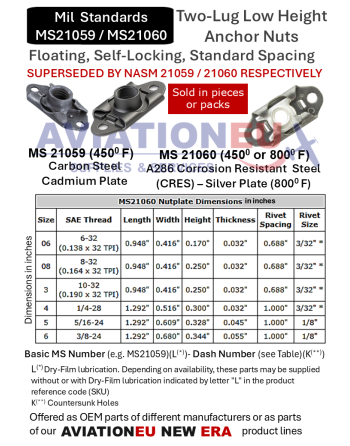
Sourced from quality manufacturers, AVIATIONEU NEW ERA floating self-locking, low height two-lug nutplates conform to NASM 21059/21060 Standards superseding the respective MS21059/MS21060 without change in part numbers. They can be riveted to the back of a stationary panel using pop rivets or solid matching rivets (sold separately) allowing for some misalignment in assembly. NASM 21059 nutplates are made of cadmium plated carbon steel & those of NASM 21060 from corrosion resistant steel (CRES).They feature 125 KSI ultimate tensile strength (Ftu) and can withstand temperatures of 450°F (NASM 21059/21060) or 800°F (NASM 21060 when silver plated). Offered in different dimensions & Unified thread sizes, with plain or countersunk rivet holes & with dry film lubrication for corrosion resistance or without. Supplied in pieces or packs with the number of nuts per pack indicated after the letters "PK" in the product SKU. Appearing prices are in the unit of measurement used each time.

AVIATIONEU NEW ERA...
Anchor nuts (aka nutplates or anchor plates) are terms used interchangeably and relate to stamped sheet metal fasteners with an internally threaded tube and a plate with two clearance holes for rivets. They are used in blind mounted panel applications in aerospace and other industrial sectors where hex nuts cannot be used or an attached nut is required for ease of maintenance.
Anchor nuts can be Fixed or Floating, the latter being easier to use due to their built-in nut (threaded hole) able to "float" slightly thus providing a convenient connection point for threaded rods, such as bolts, from the backside. In the case of Fixed anchor nuts, the built-in nut is static (i.e. without the capability to “float”) and the threaded rod must be positioned perfectly over the hole. Self-locking anchor nuts are those with a built-in locking mechanism preventing them from loosening over time from vibrations. They are extensively used in aerospace, automotive, and construction industries.
Depending on their intended application, nutplates conform to different military, aerospace, ISO or other industrial standards such as the German DIN, U.S. (ASME & ASTM, IFI, ANSI), British BS, Japanese JIS and others. They are offered as OEM parts under their respective brands or under our own labelled (AVIATIONEU NEW ERA) product lines intended as cost-effective alternatives to the respective OEM products. Listed in accordance with their standard of compliance, Fixed and Floating nutplates come in different materials (such as steel or CRES & finishes), in single/double lug configurations and Metric ISO οr Unified thread sizes. There is currently no U.S. Military Standard (MS) specification for Metric nutplates. Depending on the selected product and availability, nutplates can be supplied with a dry film lube specified by the letter "L" in the respective part number. Those with countersunk rivet holes are specified by the letter "K" at the end of the part number.
Sourced from quality manufacturers, AVIATIONEU NEW ERA MS21061/MS21062 series nutplates are floating self-locking, low height one-lug anchor nuts. Those included in MS21061 series are manufactured from cadmium plated carbon steel while the MS21062 nutplates are produced from corrosion resistant steel (CRES). They are available in different Unified thread sizes, with plain or countersunk rivet holes on each side and come with or without a dry film lube. Sold in pieces but also in packs where the specified number of nuts per pack is indicated after the letters "PK" in the product reference number (SKU). Appearing prices are always for the units of measurement used each time. Matching rivets are sold separately.
For additional information please refer to the supplied documentation or contact us.

AVIATIONEU NEW ERA...
A. RAYMOND TINNERMAN® & PALNUT® (aka PAL) of TINNERMAN PALNUT ENGINEERED PRODUCTS, INC. are leading brands in specialty clip-type fasteners including the world's largest selection of spring steel, stainless steel, and plastic engineered fasteners.Their fasteners replace traditional fastening methods with innovative solutions combining aesthetics and functionality. They are quick and easy to install, and do not require mounting tools.
TINNERMAN® & PALNUT® equivalent (style) fasteners, corresponding to respective OEM popular part numbers, and other specialty fastening products are sourced from different quality manufacturers and offered as part of our own labelled (AVIATIONEU NEW ERA) product lines (*). Depending on the selected products, they can be supplied in inch or metric systems in different design variations (impression types), materials, finishes and screw sizes to comply with panel thicknesses. Sold in pieces mostly in packs of specified number of fasteners according to the selected part number. The number of pieces per pack is indicated after the letters "PK" in the product SKU. Parts are all in NEW Condition unless otherwise specified and are accompanied by our own and Manufacturer's Certificate of Conformance.
For additional information please refer to the supplied documentation or contact us.
(*) TINNERMAN® & & PALNUT® are registered trademarks of A. RAYMOND & CIE and TINNERMAN PALNUT ENGINEERED PRODUCTS, INC. respectively. AVIATIONEU GROUP companies DO NOT manufacture these fasteners. They are sourced from their respective manufacturers and/or authorized distributors.

AVIATIONEU NEW ERA...
Anchor nuts (aka nutplates or anchor plates) are terms used interchangeably and relate to stamped sheet metal fasteners with an internally threaded tube and a plate with two clearance holes for rivets. They are used in blind mounted panel applications in aerospace and other industrial sectors where hex nuts cannot be used or an attached nut is required for ease of maintenance.
Anchor nuts can be Fixed or Floating, the latter being easier to use due to their built-in nut (threaded hole) able to "float" slightly thus providing a convenient connection point for threaded rods, such as bolts, from the backside. In the case of Fixed anchor nuts, the built-in nut is static (i.e. without the capability to “float”) and the threaded rod must be positioned perfectly over the hole. Self-locking anchor nuts are those with a built-in locking mechanism preventing them from loosening over time from vibrations. They are extensively used in aerospace, automotive, and construction industries.
Depending on their intended application, nutplates conform to different military, aerospace, ISO or other industrial standards such as the German DIN, U.S. (ASME & ASTM, IFI, ANSI), British BS, Japanese JIS and others. They are offered as OEM parts under their respective brands or under our own labelled (AVIATIONEU NEW ERA) product lines intended as cost-effective alternatives to the respective OEM products. Listed in accordance with their standard of compliance, Fixed and Floating nutplates come in different materials (such as steel or CRES & finishes), in single/double lug configurations and Metric ISO οr Unified thread sizes. There is currently no U.S. Military Standard (MS) specification for Metric nutplates.Depending on the selected product and availability, nutplates can be supplied with a dry film lube specified by the letter "L" in the respective part number. Those with countersunk rivet holes are specified by the letter "K" at the end of the part number.
Sourced from quality manufacturers, AVIATIONEU NEW ERA MS21071/MS21072 series nutplates are fixed self-locking, low height one-lug, reduced rivet spacing miniature anchor nuts. Those included in MS21071 series are manufactured from cadmium plated carbon steel while the MS21072 nutplates are produced from corrosion resistant steel (CRES). They are available in different Unified thread sizes, with plain or countersunk rivet holes on each side and come with or without a dry film lube. Sold in pieces but also in packs where the specified number of nuts per pack is indicated after the letters "PK" in the product reference number (SKU). Appearing prices are always for the units of measurement used each time. Matching rivets are sold separately.
For additional information please refer to the supplied documentation or contact us.

AVIATIONEU NEW ERA...
Anchor nuts (aka nutplates or anchor plates) are terms used interchangeably and relate to stamped sheet metal fasteners with an internally threaded tube and a plate with two clearance holes for rivets. They are used in blind mounted panel applications in aerospace and other industrial sectors where hex nuts cannot be used or an attached nut is required for ease of maintenance.
Anchor nuts can be Fixed or Floating, the latter being easier to use due to their built-in nut (threaded hole) able to "float" slightly thus providing a convenient connection point for threaded rods, such as bolts, from the backside. In the case of Fixed anchor nuts, the built-in nut is static (i.e. without the capability to “float”) and the threaded rod must be positioned perfectly over the hole. Self-locking anchor nuts are those with a built-in locking mechanism preventing them from loosening over time from vibrations. They are extensively used in aerospace, automotive, and construction industries.
Depending on their intended application, nutplates conform to different military, aerospace, ISO or other industrial standards such as the German DIN, U.S. (ASME & ASTM, IFI, ANSI), British BS, Japanese JIS and others. They are offered as OEM parts under their respective brands or under our own labelled (AVIATIONEU NEW ERA) product lines intended as cost-effective alternatives to the respective OEM products. Listed in accordance with their standard of compliance, Fixed and Floating nutplates come in different materials (such as steel or CRES & finishes), in single/double lug configurations and Metric ISO οr Unified thread sizes. There is currently no U.S. Military Standard (MS) specification for Metric nutplates. Depending on the selected product and availability, nutplates can be supplied with a dry film lube specified by the letter "L" in the respective part number. Those with countersunk rivet holes are specified by the letter "K" at the end of the part number.
Sourced from quality manufacturers, AVIATIONEU NEW ERA MS21073/MS21074 series nutplates are fixed self-locking, low height corner, miniature anchor nuts. Those included in MS21073 series are manufactured from cadmium plated carbon steel while the MS21074 nutplates are produced from corrosion resistant steel (CRES). They are available in different Unified thread sizes, with plain or countersunk rivet holes on each side and come with or without a dry film lube. Sold in pieces but also in packs where the specified number of nuts per pack is indicated after the letters "PK" in the product reference number (SKU). Appearing prices are always for the units of measurement used each time. Matching rivets are sold separately.
For additional information please refer to the supplied documentation or contact us.

AIA NAS1794 Self-Locking...
NAS parts are most well-known for state-of-the-art, high-strength, precision fasteners, electrical connectors, splices and terminations, rod end bearings, and many other types of hardware and components. The NA prefix relates to metric standards.
NAS 1794 Series self-locking counter bore replaceable nut elements are produced by various manufacturers. They are offered as OEM parts or parts falling under our own labelled (AVIATIONEU NEW ERA) product lines in different materials, finishes, thread sizes and dimensions in inches. Please refer to the supplied documentation.

AVIATIONEU NEW ERA...
Anchor nuts (aka nutplates or anchor plates) are terms used interchangeably and relate to stamped sheet metal fasteners with an internally threaded tube and a plate with two clearance holes for rivets. They are used in blind mounted panel applications in aerospace and other industrial sectors where hex nuts cannot be used or an attached nut is required for ease of maintenance.
Anchor nuts can be Fixed or Floating, the latter being easier to use due to their built-in nut (threaded hole) able to "float" slightly thus providing a convenient connection point for threaded rods, such as bolts, from the backside. In the case of Fixed anchor nuts, the built-in nut is static (i.e. without the capability to “float”) and the threaded rod must be positioned perfectly over the hole. Self-locking anchor nuts are those with a built-in locking mechanism preventing them from loosening over time from vibrations. They are extensively used in aerospace, automotive, and construction industries.
Depending on their intended application, nutplates conform to different military, aerospace, ISO or other industrial standards such as the German DIN, U.S. (ASME & ASTM, IFI, ANSI), British BS, Japanese JIS and others. They are offered as OEM parts under their respective brands or under our own labelled (AVIATIONEU NEW ERA) product lines intended as cost-effective alternatives to the respective OEM products. Listed in accordance with their standard of compliance, Fixed and Floating nutplates come in different materials (such as steel or CRES & finishes), in single/double lug configurations and Metric ISO οr Unified thread sizes. There is currently no U.S. Military Standard (MS) specification for Metric nutplates.Depending on the selected product and availability, nutplates can be supplied with a dry film lube specified by the letter "L" in the respective part number. Those with countersunk rivet holes are specified by the letter "K" at the end of the part number.
Sourced from quality manufacturers, AVIATIONEU NEW ERA MS21075/MS21076 series nutplates are floating self-locking, two lug, low height, reduced rivet spacing nutplates. Those included in MS21075 series are manufactured from cadmium plated carbon steel while the MS21076 nutplates are produced from corrosion resistant steel (CRES). They are available in different Unified thread sizes, with or without eyelets and come with or without a dry film lube. The letter “E” at the end of the part number denotes a nutplate with eyelets while the letter “N” denotes a nutplate without eyelets. Sold in pieces but also in packs where the specified number of nuts per pack is indicated after the letters "PK" in the product reference number (SKU). Appearing prices are always for the units of measurement used each time. Matching rivets are sold separately.
For additional information please refer to the supplied documentation or contact us.

Industrial Anchor Nuts (Nut...
Extending the range of nutplates (*) complying with different Military Specifications, anchor nuts for industrial (also known as commercial anchor nuts) for non military uses are offered as part of AVIATIONEU NEW ERA product lines. They are offered in Standard and Miniature versions, different types (fixed or floating, one lug, two lugs, corner, etc.) in both in Metric (M2 - M24 diameters) and Unified thread types (**).
Common materials used are Steel and Carbon Steel Alloys such as 30CrMnSiA high-strength, low-alloy structural steel, 42CrMo4 steel and C1050 heat treated carbon steel , CRES (stainless steel) A-286 alloy, Brass, Aluminum, INCONEL alloy or other alloys depending on the manufacturer.
Different offered surface finishes include anodizing, brushing, polishing, resin spraying, powder and black oxide coating, rust preventive oil, sandblasting, painting, different platings (laser engraving Zn, blue black Zn, Ni, Cr, Tin, Copper, titanium alloy galvanized, silver plating, electroplating, etc.)
Depending on the the anchor nut type and the manufacturer, the AVIATIONEU NEW ERA industrial anchor nuts meet ISO and different other standards such as the German DIN, U.S. (ASME & ASTM, IFI, ANSI), British BS, Chinese GB, Japanese JIS and others.
Competitively priced, AVIATIONEU NEW ERA industrial nutplates are cost effective alternatives to the respective OEM parts and commonly used in aerospace, automotive, machinery manufacturing and other industries but also in certain military equipment.
They are sold in pieces but packs are also used where the number of anchor nuts per pack is indicated after the letters "PK" in the product SKU. Appearing prices are always for the used units of measurement each time. Please refer to product specifications or contact us.
(*) Anchor nuts (aka nut plates or anchor plates) are stamped sheet metal fasteners used in blind mounted panel applications, where hex nuts cannot be used or an attached nut is required for ease of maintenance. They are usually riveted to a workpiece and have an internally threaded tube and a plate with two clearance holes for rivets. These terms are used interchangeably to describe the respective fasteners.
(**) Metric ISO thread used in Europe. Designated by the letter "M" followed by the value of the thread nominal diameter and pitch in millimeters. Unified form thread designations, such as UNC (unified coarse) or UNF (unified fine),have a fixed number of threads per inch with the thread major diameter preceding the designation.
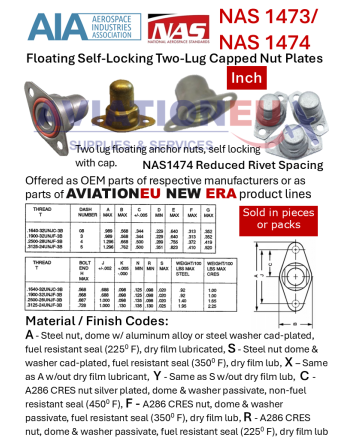
AIA NAS 1473/NAS 1474...
National Aerospace Standards (NAS) are voluntary standards developed and maintained by committees and working groups of subject matter experts from member companies of the U.S. Aerospace Industries Association (AIA). These standards have served as the foundation for the development of aircraft, spacecraft, watercraft, ground vehicles, machinery, and electronics.
NAS parts are most well-known for state-of-the-art, high-strength, precision fasteners, electrical connectors, splices and terminations, rod end bearings, and many other types of hardware and components. The NA prefix relates to metric standards.
NAS1473 Series Floating Self-Locking Two-Lug Capped Nut Plates (*) and their NAS1474 Series counterparts with reduced rivet spacing allow for a stronger, more secure hold when installing bolts on thin or unstable surfaces. These nut plates are capped, with the end of the bolt being fully protected. Both are are manufactured from cadmium plated steel or corrosion resistant (stainless) steel (CRES) by different manufacturers. They are offered in different materials, finishes, thread sizes and dimensions in inches either as OEM parts of their respective manufacturers or as parts of our own labelled (AVIATIONEU NEW ERA) product lines. They come with or without lubrication. Sold in pieces or packs of specified number of nut plates appearing in the product reference number (SKU) after the letters "PK".
The following code letters in their part numbers indicate the different materials and finishes used in their manufacturing ("K" indicates need for stiffening flange).
A -Steel nut & shell (dome) with Aluminum Alloy or Steel washer cad plated per AMS-QQ-P-416, type II, class 2. Fuel Resistant Seal MIL-PRF-6855 (225 deg. F),Dry film lubricant AS5272 over cad plate.
S - Steel nut, dome and washer cad plated per AMS-QQ-P-416, type II, class 2. Fuel Resistant Seal MIL-DTL-25988 (350 deg. F). Dry-film lubricant per AS5272 over cad plate.
X - Same as A without dry film lubricant.
Y - Same as S without dry film lubricant.
C - A286 CRES nut, dome and washer passivated per AMS2700. Nut silver plated per AMS2410. Non-fuel resistant AMS3304 seal (450 deg. F).
F - A286 CRES nut, dome and washer passivated per AMS2700. Fuel resistant seal MIL-DTL-25988 (350 deg. F), dry-film lubricant per AS5272. (350 deg. F).
R - A286 CRES nut, dome and washer passivated per AMS2700. Fuel resistant seal MIL-PRF-6855 (225 deg. F), dry-film lubricant per AS5272.
(*) also termed as plate nuts, anchor nuts or anchor plates. These terms are used interchangeably to describe the respective fasteners.

AVIATIONEU NEW ERA Titanium...
Titanium fasteners are best known for their strength, lightweight, and corrosion resistance. They feature an excellent strength to weight ratio and significant mechanical properties but perhaps their most notable attribute is their superior corrosion resistance to salt water / seawater operating conditions. Titanium fasteners are used in aerospace, automotive and motorsports but also in many other industries including chlor alkali, marine, off-shore oil & gas, desalination, medical, and pulp and paper. They come in different types (like bolts, screws and nuts), sizes, titanium grades and standards/specifications (e.g. ANSI/ASME, DIN/ISO, ASTM, ASME, MIL specifications etc.) to meet application requirements.
Compared to respective fasteners made of steel and aluminum, as a rule of thumb, titanium fasteners are about half the weight of their steel counterparts while aluminum fasteners are about half the weight of titanium ones.
Sourced from quality producers, a wide range of titanium fasteners are offered as part of AVIATIONEU NEW ERA product lines (please refer to the individual product presentations).
AVIATIONEU NEW ERA Titanium nuts are available in both inch and metric systems. Their typicals uses include aerospace, marine, motorsports and many other applications. Manufactured from aerospace grade titanium, CNC machined, heat treated with hexagonal heads and rolled threads these nuts come in diffrent types including locking and flange nuts, sizes, thread pitches, flange diameters and lengths. They are sold in pieces. For more information or unlisted fasteners please contact us.
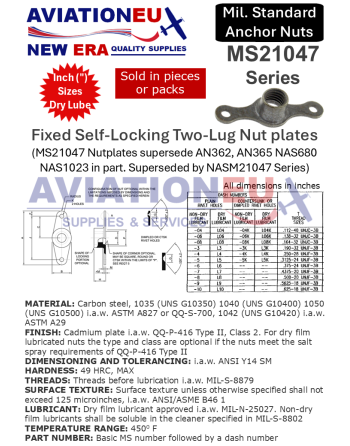
AVIATIONEU NEW ERA...
Anchor nuts (aka nutplates or anchor plates) are terms used interchangeably and relate to stamped sheet metal fasteners with an internally threaded tube and a plate with two clearance holes for rivets. They are used in blind mounted panel applications in aerospace and other industrial sectors where hex nuts cannot be used or an attached nut is required for ease of maintenance.
Anchor nuts can be Fixed or Floating, the latter being easier to use due to their built-in nut (threaded hole) able to "float" slightly thus providing a convenient connection point for threaded rods, such as bolts, from the backside. In the case of Fixed anchor nuts, the built-in nut is static (i.e. without the capability to “float”) and the threaded rod must be positioned perfectly over the hole. Self-locking anchor nuts are those with a built-in locking mechanism preventing them from loosening over time from vibrations. They are extensively used in aerospace, automotive, and construction industries.
Depending on their intended application, nutplates conform to different military, aerospace, ISO or other industrial standards such as the German DIN, U.S. (ASME & ASTM, IFI, ANSI), British BS, Japanese JIS and others. They are offered as OEM parts under their respective brands or under our own labelled (AVIATIONEU NEW ERA) product lines intended as cost-effective alternatives to the respective OEM products. Listed in accordance with their standard of compliance, Fixed and Floating nutplates come in different materials (such as steel or CRES & finishes), in single/double lug configurations and Metric ISO οr Unified thread sizes. There is currently no U.S. Military Standard (MS) specification for Metric nutplates.Depending on the selected product and availability, nutplates can be supplied with a dry film lube specified by the letter "L" in the respective part number. Those with countersunk rivet holes are specified by the letter "K" at the end of the part number.
Sourced from quality manufacturers, AVIATIONEU NEW ERA MS21047 series nutplates are fixed self locking elastic insert 2-lug anchor nuts made of cadmium plated steel with nylon insert and plain rivet holes. They replace those of AN366F series and are available in different Unified thread sizes to meet application requirements and replace respective nut plates. Sold in pieces but also in packs where the specified number of nuts per pack is indicated after the letters "PK" in the product reference number (SKU). Appearing prices are always for the units of measurement used each time. Matching rivets are sold separately.
For additional information please refer to the supplied documentation or contact us.

AVIATIONEU NEW ERA Titanium...
Titanium fasteners are best known for their strength, lightweight, and corrosion resistance. They feature an excellent strength to weight ratio and significant mechanical properties but perhaps their most notable attribute is their superior corrosion resistance to salt water / seawater operating conditions. Titanium fasteners are used in aerospace, automotive and motorsports but also in many other industries including chlor alkali, marine, off-shore oil & gas, desalination, medical, and pulp and paper. They come in different types (like bolts, screws and nuts), sizes, titanium grades and standards/specifications (e.g. ANSI/ASME, DIN/ISO, ASTM, ASME, MIL specifications etc.) to meet application requirements. Compared to respective fasteners made of steel and aluminum, as a rule of thumb, titanium fasteners are about half the weight of their steel counterparts while aluminum fasteners are about half the weight of titanium ones.
Sourced from quality producers, a wide range of titanium fasteners are offered as part of AVIATIONEU NEW ERA product lines (please refer to the individual product presentations).
AVIATIONEU NEW ERA Titanium nuts are available in both inch and metric systems. Their typicals uses include aerospace, marine, motorsports and many other applications. Manufactured from 6AL-4V grade titanium, CNC machined, heat treated with hexagonal heads and rolled threads these nuts come in diffrent types including locking and flange nuts(*), sizes, thread pitches, flange diameters and lengths. They are sold in pieces. For more information or unlisted fasteners please contact us.
(*) Appearing dimensions for Flange Nuts: Hex Size, Flange Diameter, Height (Hex or Total).
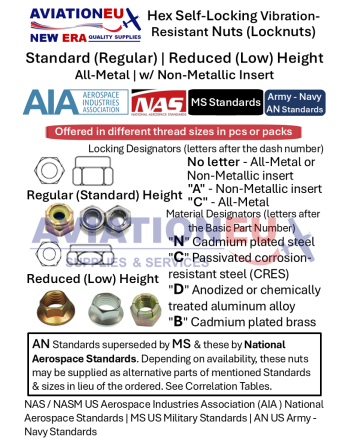
AVIATIONEU NEW ERA Military...
Nuts are extensively used in a wide range of aerospace and industrial applications. Self-locking nuts are those containing a locking feature as an integral part.
Hexagon self-locking nuts of both low (thin pattern) and regular height (pattern) used in aerospace and defense applications comform to different Standards and they are designed for use in high temp installations (up to 250°F or 1200°F for those from silver-plated stainless steel). Low height self-locking nuts complied with Army & Navy AN 364 superseded by Mil Standard MS 20364 which was in turn superseded by the newer Mil Standard MS 21083. Similarly, Army & Navy AN 365 Standard relating to regular height nuts was superseded by Mil Standard MS 20365 and this in turn by MS21044. Furthermore, MS Standards have been replaced by NASM National Aerospace Standards with their part identification numbers remaining the same. For example, nuts with PNs MS21083 and NASM21083 are identical.
Regular height NASM/MS 21044 self-locking nuts and their low-height NASM/MS 21083 counterparts replace the superseeded MS 20365 / AN 365 & MS 20364 / AN 364 for respective materials and sizes but their older Standard part numbers (although cancelled) are still commonly used in the market. Sourced from quality manufacturers, these nuts are offered as part of own labelled (AVIATIONEU NEW ERA) product lines in different materials and finishes (e.g. cadmium plated alloy steel, corrosion resistant steel passivated,copper cadmium plated, aluminum alloy anodized), and different dimensions and thread sizes in inches. Cadmium plated nuts are furnished to military specifications while stainless steel nuts are supplied to military specification and commercial grade. These nuts come either with all metal or non metallic inserts (often termed as fiberlock or elastic stop to create friction and prevent loosening from vibration) designated by the letters "C" and "A" respectively after the dash number. No letter indicates an all metal or a non metallic insert nut. They are reliable and economical fastening devices with their inserts providing a friction grip on the threads of the bolt holdsing it securely.
The following letters after the dash in their part number indicate their materials and finishes:
"B" Copper alloy - Cadmium plated
"C" Corrosion resistant steel (stainless steel) - passivated
"D" Aluminum alloy - Anodised
"N" Steel alloy - Cadmium plated
For example, MS21044C3 is a corrosion resistance steel self-locking nut with a thread size of 10-32, while MS21044N3 is a steel alloy nut with the same thread size.
Sold in pieces or packs.
For additional information please refer to the supplied documentation or contact us.

AIA NAS NA-0027/NA-0028...
National Aerospace Standards (NAS) are voluntary standards developed and maintained by committees and working groups of subject matter experts from member companies of the U.S. Aerospace Industries Association (AIA).
These standards have served as the foundation for the development of aircraft, spacecraft, watercraft, ground vehicles, machinery, and electronics.
NAS parts are most well-known for state-of-the-art, high-strength, precision fasteners, electrical connectors, splices and terminations, rod end bearings, and many other types of hardware and components. The NA prefix relates to metric standards.
NA-0027/NA-0028 Series Metric Self-Locking Floating Two-Lug Nutplates (*) form part of NAS high-strength, precision fasteners. Sourced from quality manufacturers they are offered as part of our own labelled (AVIATIONEU NEW ERA) product lines in different materials, finishes, thread sizes and dimensions in Metric system. Usually sold in pieces but packs are also used where the number of anchor nuts per pack is indicated after the letters "PK" in the product SKU. Appearing prices are always for the used units of measurement each time. For additional information, please refer to the product specifications or contact us.
(*) also termed as plate nuts, anchor nuts or anchor plates. These terms are used interchangeably to describe the respective fasteners.

AVIATIONEU NEW ERA DIN 980...
Self-locking nuts (aka lock nuts) are widely used in applications in which motion or vibration can cause fasteners to become loose. Lock nuts conforming to DIN 980 stanard are all metal prevailing torque, hexagonal nuts and they are available in two types, DIN 980 V-type (DIN980/V) with a distorted thread and DIN 980 M-type ((DIN980/M) with an embedded metal locking plate.
In DIN 980 V-type distorted thread nuts, certain teeth of the nut thread are deformed through die stamping resulting in the inner diameter of the nut thread being slightly smaller than the outer diameter of the bolt thread. Therefore, the friction force between the threads after the nut is tightened is far greater than that of the common thread, which can play an effective role in preventing loosing.
In DIN 980 M-type nuts, the nut is embedded with a metal locking plate after heat treatment. The inner diameter of the metal plate is slightly smaller than the outer diameter of the bolt thread. After the nut is tightened, the metal plate blocks the bolt thread, thus preventing loosening.
DIN 980 lock nuts must be tightened with tools (such as ratchet spanner) during installation. Although they can be can be used repeatedly, frequent disassemblies and installations are not recommended as the locking torque of the nut will decrease significantly.
Depending on the producer, DIN 980 lock nuts are manufactured in different metric thread sizes (M3 ~ M39) from carbon steel in various strength classes (such as 4, 6, 8, 10 and 12) or stainless steel in grades 70 and 80. They are offered in various finishes such as plain, black, zinc/yellow plated, H.D.G, and chrome plated.
Both DIN980/V and DIN980/M lock nuts are offered as part of our own (AVIATIONEU NEW ERA) product lines. Sourced from quality manufactuurers they are competitively priced and can be supplied in carbon steel or stainless steel, in different grades, metric thread sizes and finishes .
For additional information please consult the supplied documentation.
Notes:
Different metric thread sizes are designated by the letter "M" indicating the nut's clearance diameter in mm.
Nut thread pitch indicates the distance between threads measured along the length of the nut expressed in mm.
In the case of stainless steel lock nuts, the stainless steel grades are denoted with codes such as A2 or A4 and dash numbers indicating the minimum tensile strength to be met by the material. For example, A2-70 relates to a lock nut made from 304 stainless steel with a minimum tensile strength of 700N/mm² (MPa).

Internal Wrenching (Allen)...
Screws, bolts and nuts are standard fastening hardware widely used in a range of applications.
Internal wrenching (also known as Allen) fasteners are threaded fasteners. Screws and bolts have a drive recess within the head allowing the insertion of an internal wrench for their installation or removal. Allen socket set screws are blind (headless) fasteners with an internal hex drive offered in different styles (regular cap screw and flat and button type) while Allen nuts are cylindrical nuts internally threaded on one side with an Allen socket on the other. These fasteners are produced by different manufacturers and come in different styles, inch or Metric sizes, materials, finishes, and coarse or fine threadings. They are offered as OEM parts or parts of AVIATIONEU NEW ERA product lines. Sold in pieces or packs of specified number of pieces per pack as designated by the number after the letters "PK" in the product reference code (SKU).
Internal wrenching fasteners for aerospace applications are designed and intended for use in aircraft construction and repair and conform to Military or Aerospace Standards. Aerospace Industries Association Standard NASM 20004 through 20024 internal wrenching bolts supersede respective part numbers of MS 20004 through 20024 which in turn have superseeded those of older National Aerospace Standard NAS NAS 144 to 158 series. Fabricated from 160-180 ksi high-strength steel they are intended for use in both tension and shear applications.
Socket screws for aerospace and military uses come in different sizes and meet aerospace/military standards including AN565 (superseded by NASM565), NAS1081, MS18063, MS18064, MS51021, MS51023, MS51029, MS51031, MS51038, MS51045, MS51963, MS51964, MS51965, MS51966. Those of AN565 (NASM565) standard are headless hex and fluted socket set screws while their MS51963 standard counterparts are cup point hex socket set screws. Both are made of high-quality steel and they are designed to deliver maximum holding pressure Typically used to bind parts onto shafts. Available in cup or cone point styles, in different thread sizes and lengths in inches.
81791 internal wrenching nuts are self-locking, high-strength, corrosion and oxidation resistant nuts made of nickel-chromium alloy with cadmium plating. These nuts are catalogued and supplied in different sizes as part numbers of TEXTRON AVIATION (separately listed).
For more information, please refer to the Product Description section, the supplied documentation or contact us.
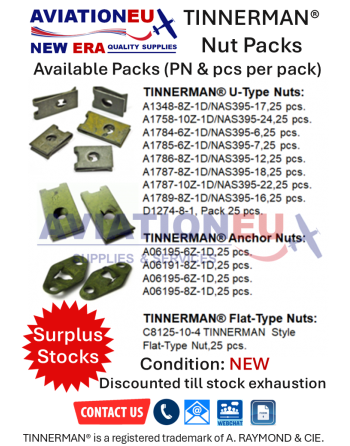
AVIATIONEU NEW ERA...
AVIATIONEU NEW ERA TINNERMAN® NUT PACKS
A. RAYMOND TINNERMAN® & PALNUT® (aka PAL) of TINNERMAN PALNUT ENGINEERED PRODUCTS, INC. are leading brands in specialty clip-type fasteners including the world's largest selection of spring steel, stainless steel, and plastic engineered fasteners. They consist innovative solutions to traditional fasteners combining aesthetics and functionality. They are quick and easy to install, and do not require mounting tools.
TINNERMAN® spring steel nuts (aka speed or sheet metal nuts) are self-retaining fasteners serving the functions of both a lock washer and a nut for an easy & fast attachment of mating panels. Offered in different shapes (e.g. Flat U, J) styles & finishes they can be used as both blind and front mounting attachments without required special tools, skills or equipment, removed and reused. Riveting, welding, clinching, staking and other secondary fastening devices are eliminated.
Sourced from quality suppliers, A.RAYMOND/TINNERMAN® popular OEM nuts or their equivalents (TINNERMAN® Style) are offered in convenient Nut Packs as part of our own labelled (AVIATIONEU NEW ERA) product lines to serve different aerospace, automotive, appliance assembly HVAC and other application requirements. They include U or Flat-Type and anchor nuts under different A.RAYMOND/TINNERMAN® brands. Made from spring steel, resistant to vibrational loosening to prevent the need for a lock washer, these fasteners are available in a variety of finishes including: phosphate, zinc or plain. These packs are sold individually and include a specified number of fasteners of the respective TINNERMAN® part number per pack indicated after the letters "PK" in our product reference number (SKU).
Our current surplus stock of TINNERMAN® Nut Packs is now offered at discounted prices and available for immediate shipping till their stock exhaustion. Parts are accompanied by our Certificate of Conformance. Shipping to customer destination can be arranged at additional charge.
Surplus stock packs currently include the following nuts:
TINNERMAN® U-Type Nuts: A1348-8Z-1D/NAS395-17 (repl. D1274-8-1, A1758-10Z-1D/NAS395-24, A1784-6Z-1D/NAS395-6, A1785-6Z-1D/NAS395-7 (same as A1785-6Z1), A1786-8Z-1D/NAS395-12, A1787-8Z-1D/NAS395-18, A1787-10Z-1D/NAS395-22, A1789-8Z-1D/NAS395-16, D1274-8-1
TINNERMAN® Anchor Nuts: A06191-6Z-1D (repl. PN. A6191-6Z1D), A06191-8Z-1D (repl. PN. A6191-8Z1D), A06195-6Z-1D (repl. PN. A6195-6Z1D), A06195-8Z-1D (repl. PN. A6195-8Z1D)
TINNERMAN® SPEED NUTS® Flat Type Nuts of various screw sizes and finishes: #4A P.O (FN7-4A-PO), #6A P.O ( FN7-6A-PO), #8A P.O (FN7-8A-PO), #10A P.O (FN7-10A-PO), C8125-10-4 TINNERMAN Style Flat-Type Nut
For additional information please refer to the respective product presentations or contact us.
(*) TINNERMAN® is a registered trademark of A. RAYMOND & CIE. AVIATIONEU SUPPLIES & SERVICES DOES NOT manufacture these nuts. They are sourced from their respective suppliers.

HOWMET® AEROSPACE (ARCONIC)...
Anchor nuts (aka nutplates or anchor plates) are terms used interchangeably and relate to stamped sheet metal fasteners with an internally threaded tube and a plate with two clearance holes for rivets. They are used in blind mounted panel applications in aerospace and other industrial sectors where hex nuts cannot be used or an attached nut is required for ease of maintenance.
Anchor nuts can be Fixed or Floating, the latter being easier to use due to their built-in nut (threaded hole) able to "float" slightly thus providing a convenient connection point for threaded rods, such as bolts, from the backside. In the case of Fixed anchor nuts, the built-in nut is static (i.e. without the capability to “float”) and the threaded rod must be positioned perfectly over the hole. Self-locking anchor nuts are those with a built-in locking mechanism preventing them from loosening over time from vibrations. They are extensively used in aerospace, automotive, and construction industries.
HOWMET® AEROSPACE Inc. ((HOWMET FASTENING SYSTEMS), formerly ARCONIC Inc., develops & manufactures high performance, engineered products & solutions for the aerospace, industrial gas turbine, commercial transportation and oil and gas markets. ALCOA FASTENING SYSTEMS (ALCOA), now a business unit of HOWMET® AEROSPACE is one of the largest manufacturers of aerospace hardware in the world. SIMMONDS®, a HOWMET AEROSPACE® business unit, specialises on self-locking & special nuts. Their self locking nuts come in different types (series) offered in different materials and sizes, and can be reused at least 15 times without affecting the nut's performance. Born for the world of aviation, SIMMONDS® self-locking nuts are lightweight and extremely durable, exhibit a very strong locking performance, resistance to heat and corrosion & can be used in a wide temperature range in demanding aerospace, rally & other applications.
HOWMET AEROSPACE® manufactures and offers through their different business units a wide range of anchor nuts, fixed or floating, in various types (styles), such as one or two-lug, corner or others, different materials, finishes, and sizes. They are intended for use in different aerospace and industrial applications. Some of HOWMET AEROSPACE® nutplates are listed and many more (not currently listed) can be offered through our network of co-operating suppliers. Sold in pieces or in packs where the number of anchor nuts per pack is indicated after the letters "PK" in the product SKU.
For more information on HOWMET® AEROSPACE nutplates please consult the Product Description section or contact us.