

There are 26 products.

AIA NAS 1791/NAS 1792...
National Aerospace Standards (NAS) are voluntary standards developed and maintained by committees and working groups of subject matter experts from member companies of the U.S. Aerospace Industries Association (AIA). These standards have served as the foundation for the development of aircraft, spacecraft, watercraft, ground vehicles, machinery, and electronics.
NAS parts are most well-known for state-of-the-art, high-strength, precision fasteners, electrical connectors, splices and terminations, rod end bearings, and many other types of hardware and components. The NA prefix relates to metric standards.
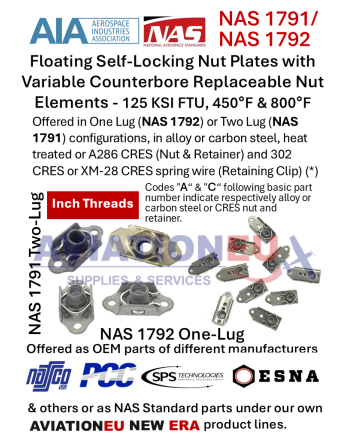
NAS 1791 and 1792 Series fasteners are Floating Self-Locking Nut Plates(*) with variable counterbore replacement nut elements and as supplied in one-lug (NAS 1792) or two-Lug (NAS 1791) configurations. Both form part of NAS high-strength, precision fasteners. They are offered in alloy/carbon steel or corrosion resistant (CRES) materials, in different finishes, thread sizes and dimensions in inches. They can be used in applications with 450°F maximum temperature requirement while those from silver plated A286 Stainless Steel can withstand temperatures up to 800°F.
Sourced from quality manufacturers they are offered as OEM parts of their respective manufacturers or as parts of the respective Standard under our own labelled (AVIATIONEU NEW ERA) product lines. Sold in pieces or packs with specified number of anchor nuts per pack as indicated by the number after the letters "PK" in the product reference number (SKU).
For additional information please consult the supplied documentation or contact us.
(*) Also termed as plate nuts, anchor nuts or anchor plates. Appearing lengths in NAS 1791 nut pllates are distance between centers of mounting holes.


Aircraft General Standards...
Aircraft General Standards (AGS) were issued by the Directorate of Technical Development of the Air Ministry from the 1920’s and persist till today through substitutions to British Standards and AGS revisions. They relate to fasteners such as bolts, nuts, rivets, fork joints, taper pins, common to all types of aircraft. AGS fasteners are made in a range of sizes and different materials. In their identification system AGS parts are listed in sequential number, eg AGS 500, AGS 501 even though the number does not generally group common parts together nor does it follow a specific chronological order. Special parts made for specific aircraft have no marking to indicate size or material, but are marked with a part number.
Anchor nuts (aka nut plates) are designed for blind mounted applications where it is impractical to use hex nuts. Stiffnuts, in particular, feature a very high friction between the threads of the nut and the bolt so that the nut may be considered self-locking. Several types of stiffnuts have been designed for use on aircraft. AGS 2007 series relates to double lug anchor locking nuts (aka thick stiffnuts) while those in AGS 2008 and 2009 series relate to thin and countersunk stiffnuts.
AGS 2007 series anchor nuts are offered as nyloc (*) (with nylon-insert) or all-metal style. They can be furnished in different materials (aluminum, cadmium plated steel or corrosion resistant steel (CRES). Available with BA or BSF (**) threads as NEW OLD STOCK (NOS) items in limited quantities from stocks of our co-operating suppliers as special order non refundable and non-returnable items. Please refer to the supplied documentation or contact us.
(*) Nyloc nut (aka nylon-insert lock nut, polymer-insert lock nut, or elastic stop nut) is a kind of locknut with a nylon collar that increases friction on the screw thread.
(**) British Association (BA) Threads. small sized screw threads still used in some precision instruments, such as optics and moving-coil meters, relays as well as modelling applications. Recommended by the British Standards Institution for use instead of the smaller British Standard Whitworth (BSW) and British Standard Fine (BSF) thread screws (those below 1⁄4 inch).
British Standard Fine (BSF) Threads. Screw thread form, used as a fine-pitch alternative to British Standard Whitworth (BSW) threads. Common applications include British machine tool industry and cars. Superseded by the American UNF threads and later Metric standards.

BAC (Boeing) & ASNA...
Boeing & Airbus, the two leading airframe builders, have developed specifications for fasteners, hardware and other parts manufactured by different companies. Compliance with Boeing (aka BAC) and Airbus (aka ASNA) Standards is a prerequisite for installation or use of these parts on their respective aircraft. In many cases, Boeing & Airbus fasteners and other parts have the same fit, form, and function and they are considered as alternatives or substitutes to the respective parts designed and/or manufactured by industry leaders such as HI-SHEAR or HOWMET in the case of fastening products.They also conform to widely accepted Military & Aerospace Standards such as AN, MS, NAS and others. However, caution is required as, depending on their series & conforming standard, fasteners are offered in Imperial (in.), Metric (mm) systems, or both, with resulting variations in their dimensions and units of measurement of their properties.
As a result of the extensive portfolio of fastening products (including screws and bolts, nuts, washers, pins, rivets, clamps, and many others) from different leading suppliers, and those falling under Boeing, Airbus, Military and Aerospace Standards, these are listed separately in our Web Platform for Supplies. It must be noted that, depending on the intended application, usually more than one options are available to prospective buyers and selection is finally made, apart from specifications, on the basis of price or lead time required for non-stock parts. Whenever possible,correlation tables and other information and documentation is provided to facilitate the users' awareness on interchangeability of offered fasteners and the selection of the right parts for their intended application. For additional information please contact us.

DIN LN29673/LN 29692...
Anchor nuts (aka nutplates or anchor plates) are terms used interchangeably and relate to stamped sheet metal fasteners with an internally threaded tube and a plate with two clearance holes for rivets. Initially designed and still extensively used in aerospace applications, they are today also used in automotive, motorsports, and other industries in blind mounted panel applications where hex nuts cannot be used or an attached nut is required for ease of maintenance. They can be Fixed or Floating, the latter being easier to install due to their built-in nut (threaded hole) able to "float" slightly thus providing a convenient connection point for threaded rods, such as bolts, from the backside. In the case of Fixed anchor nuts, the built-in nut is static (i.e. without the capability to “float”) and the threaded bolt must be positioned perfectly over the hole. Self-locking anchor nuts are those with a built-in locking mechanism preventing them from loosening over time from vibrations.
Anchor nuts are offered in Imperial (in.) and Metric thread sizes, in different materials (e.g. Carbon Steel, Steel alloys, CRES), finishes such as Cadmium or Cadmium Free Zinc Nickel platings (compliant to EU Regulations) with or without dry film lubrication. They come in various styles/configurations (e.g. with one or two lugs, full size or miniatures, countersunk, corner, right-angled bodies, etc.). They conform to different U.S., European and international standards such as the US Military MS and NASM, German DIN LN, French AFNOR NF, British BS, ISO and others.
Depending on the selected nutplate, aerospace anchor nuts are produced by different manufacurers, such as HOWMET AEROSPACE (formerly ARCONIC) or PAOLO ASTORI, and others, and offered as respective OEM parts or as parts of our own labelled (AVIATIONEU NEW ERA) product lines in the case of those used in industrial applications. Sold in pieces or packs of specified number of anchor nuts per pack indicated after the letters "PK" in the product SKU.
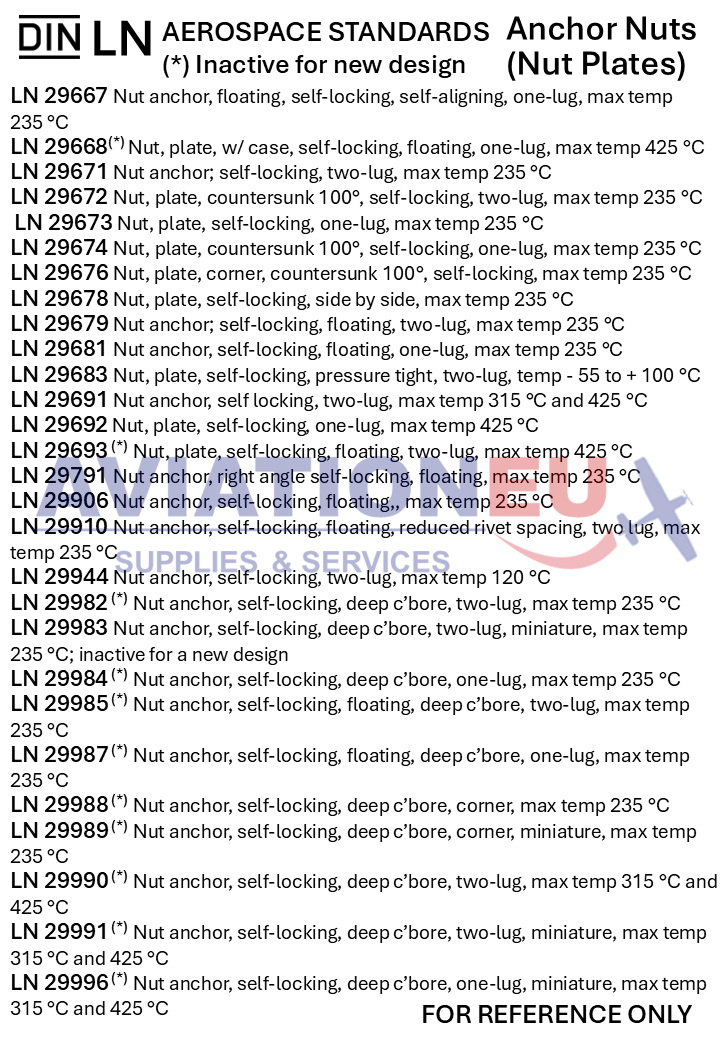
Anchor nuts manufactured in accordance with DIN LN 29673 standard are Metric self-locking fixed one-lug anchor nuts designed with a single flange. Depending on the manufactuer, they are made from Carbon Steel / Steel Alloy termed as C1050, 25CrMo4, DIN 1.7220.3, 25CD4 with Cadmium plating & MoS2 low friction coating. Their counterparts of DIN LN29692 Standard are made from Incoloy Alloy® A-286 (also known as A286 Alloy Stainless Steel, a nickel and iron-based, austenitic superalloy) and can be used for temperatures up to 425 °C. Both feature a tensile strength of 900 MPa. Offered in different Metric thread sizes from HOWMET AEROSPACE (separately listed), PAOLO ASTORI and others as OEM parts. Depending on the part number they are sold mostly in pieces but also in packs where the number of anchor nuts per pack is indicated after the letters "PK" in the product SKU.
For additional information please refer to the supplied documentation or contact us.

DIN LN29681/LN29668...
Anchor nuts (aka nutplates or anchor plates) are terms used interchangeably and relate to stamped sheet metal fasteners with an internally threaded tube and a plate with two clearance holes for rivets. Initially designed and still extensively used in aerospace applications, they are today also used in automotive, motorsports, and other industries in blind mounted panel applications where hex nuts cannot be used or an attached nut is required for ease of maintenance. They can be Fixed or Floating, the latter being easier to install due to their built-in nut (threaded hole) able to "float" slightly thus providing a convenient connection point for threaded rods, such as bolts, from the backside. In the case of Fixed anchor nuts, the built-in nut is static (i.e. without the capability to “float”) and the threaded bolt must be positioned perfectly over the hole. Self-locking anchor nuts are those with a built-in locking mechanism preventing them from loosening over time from vibrations.
Anchor nuts are offered in Imperial (in.) and Metric thread sizes, in different materials (e.g. Carbon Steel, Steel alloys, CRES), finishes such as Cadmium or Cadmium Free Zinc Nickel platings (compliant to EU Regulations) with or without dry film lubrication. They come in various styles/configurations (e.g. with one or two lugs, full size or miniatures, countersunk, corner, right-angled bodies, etc.). They conform to different U.S., European and international standards such as the US Military MS and NASM, German DIN LN, French AFNOR NF, British BS, ISO and others.
Depending on the selected nutplate, aerospace anchor nuts are produced by different manufacurers, such as HOWMET AEROSPACE (formerly ARCONIC) or PAOLO ASTORI, and others, and offered as respective OEM parts or as parts of our own labelled (AVIATIONEU NEW ERA) product lines in the case of those used in industrial applications. Sold in pieces or packs of specified number of anchor nuts per pack indicated after the letters "PK" in the product SKU.
Anchor nuts manufactured i.a.w DIN LN 29681 standard are Metric self-locking floating one-lug anchor nuts. Depending on the manufactuer, they are made from Steel Alloys (25CrMo4,DIN 1.7214.4/1.7220.3, 25CD4, SAE 4135/ 4140, AISI 4135/4137) with Cadmium plating & MoS2 low friction coating. Suitable for use in temperatures up to 235°C. Their counterparts of DIN LN29668 Standard are made from Incoloy Alloy® A-286 (aka A286 Alloy Stainless Steel, an austenitic superalloy) and can be used for temperatures up to 425 °C. Both feature a tensile strength of 900 MPa. Offered in different Metric thread sizes from HOWMET AEROSPACE (separately listed), PAOLO ASTORI and others as OEM parts. Depending on the part number they are sold mostly in pieces but also in packs where the number of anchor nuts per pack is indicated after the letters "PK" in the product SKU.
For additional information please refer to the supplied documentation or contact us.

Aerospace Standard Metric...
Anchor nuts (aka nutplates or anchor plates) are terms used interchangeably and relate to stamped sheet metal fasteners with an internally threaded tube and a plate with two clearance holes for rivets. Initially designed and still extensively used in aerospace applications, they are today also used in automotive, motorsports, and other industries in blind mounted panel applications where hex nuts cannot be used or an attached nut is required for ease of maintenance. They can be Fixed or Floating, the latter being easier to install due to their built-in nut (threaded hole) able to "float" slightly thus providing a convenient connection point for threaded rods, such as bolts, from the backside. In the case of Fixed anchor nuts, the built-in nut is static (i.e. without the capability to “float”) and the threaded bolt must be positioned perfectly over the hole. Self-locking anchor nuts are those with a built-in locking mechanism preventing them from loosening over time from vibrations.
Anchor nuts are offered in Imperial (in.) and Metric thread sizes, in different materials (e.g. Carbon Steel, Steel alloys, CRES), finishes such as Cadmium or Cadmium Free Zinc Nickel platings (compliant to EU Regulations) with or without dry film lubrication. They come in various styles/configurations (e.g. with one or two lugs, full size or miniatures, countersunk, corner, right-angled bodies, etc.). They conform to different U.S., European and international standards such as the US Military MS and NASM, German DIN LN, French AFNOR NF, British BS, ISO and others.
Depending on the selected nutplate, aerospace anchor nuts are produced by different manufacurers, such as HOWMET AEROSPACE (formerly ARCONIC) or PAOLO ASTORI, and others, and offered as respective OEM parts or as parts of our own labelled (AVIATIONEU NEW ERA) product lines in the case of those used in industrial applications. Sold in pieces or packs of specified number of anchor nuts per pack indicated after the letters "PK" in the product SKU.
Anchor nuts manufactured i.a.w DIN LN 29679 standard are Metric self-locking floating two-lug low profile anchor nuts. Depending on the manufactuer, they are made from Steel Alloys (25CrMo4, DIN 1.7214.4/1.7220.3, 25CD4, SAE 4135/4140) with Cadmium or Zinc-Nickel plating & MoS2 low friction coating. Suitable for temperatures up to 235°C. Feature a tensile strength of 1100 MPa. Their counterparts of DIN LN 65016 & LN 29693 Standard Standard (*) are made from Incoloy Alloy® A-286 (aka A286 Alloy Stainless Steel, an austenitic superalloy) and can be used for temperatures up to 425 °C. Offered in different Metric thread sizes from HOWMET AEROSPACE (separately listed), PAOLO ASTORI and others as OEM parts. Depending on the part number they are sold mostly in pieces but also in packs.
(*) LN 65016/29693 Standard is inactive for new design.
For additional information please refer to the supplied documentation or contact us.

Industrial Anchor Nuts (Nut...
Extending the range of nutplates (*) complying with different Military Specifications, anchor nuts for industrial (also known as commercial anchor nuts) for non military uses are offered as part of AVIATIONEU NEW ERA product lines. They are offered in Standard and Miniature versions, different types (fixed or floating, one lug, two lugs, corner, etc.) in both in Metric (M2 - M24 diameters) and Unified thread types (**).
Common materials used are Steel and Carbon Steel Alloys such as 30CrMnSiA high-strength, low-alloy structural steel, 42CrMo4 steel and C1050 heat treated carbon steel , CRES (stainless steel) A-286 alloy, Brass, Aluminum, INCONEL alloy or other alloys depending on the manufacturer.
Different offered surface finishes include anodizing, brushing, polishing, resin spraying, powder and black oxide coating, rust preventive oil, sandblasting, painting, different platings (laser engraving Zn, blue black Zn, Ni, Cr, Tin, Copper, titanium alloy galvanized, silver plating, electroplating, etc.)
Depending on the the anchor nut type and the manufacturer, the AVIATIONEU NEW ERA industrial anchor nuts meet ISO and different other standards such as the German DIN, U.S. (ASME & ASTM, IFI, ANSI), British BS, Chinese GB, Japanese JIS and others.
Competitively priced, AVIATIONEU NEW ERA industrial nutplates are cost effective alternatives to the respective OEM parts and commonly used in aerospace, automotive, machinery manufacturing and other industries but also in certain military equipment.
They are sold in pieces but packs are also used where the number of anchor nuts per pack is indicated after the letters "PK" in the product SKU. Appearing prices are always for the used units of measurement each time. Please refer to product specifications or contact us.
(*) Anchor nuts (aka nut plates or anchor plates) are stamped sheet metal fasteners used in blind mounted panel applications, where hex nuts cannot be used or an attached nut is required for ease of maintenance. They are usually riveted to a workpiece and have an internally threaded tube and a plate with two clearance holes for rivets. These terms are used interchangeably to describe the respective fasteners.
(**) Metric ISO thread used in Europe. Designated by the letter "M" followed by the value of the thread nominal diameter and pitch in millimeters. Unified form thread designations, such as UNC (unified coarse) or UNF (unified fine),have a fixed number of threads per inch with the thread major diameter preceding the designation.
AIA NAS 1473/NAS 1474...
National Aerospace Standards (NAS) are voluntary standards developed and maintained by committees and working groups of subject matter experts from member companies of the U.S. Aerospace Industries Association (AIA). These standards have served as the foundation for the development of aircraft, spacecraft, watercraft, ground vehicles, machinery, and electronics.
NAS parts are most well-known for state-of-the-art, high-strength, precision fasteners, electrical connectors, splices and terminations, rod end bearings, and many other types of hardware and components. The NA prefix relates to metric standards.
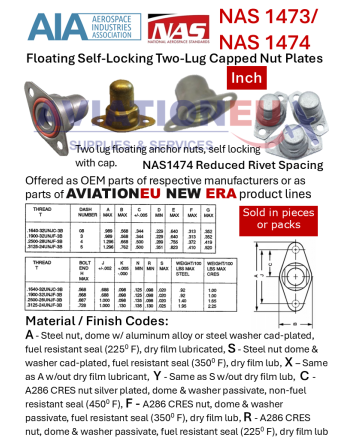
NAS1473 Series Floating Self-Locking Two-Lug Capped Nut Plates (*) and their NAS1474 Series counterparts with reduced rivet spacing allow for a stronger, more secure hold when installing bolts on thin or unstable surfaces. These nut plates are capped, with the end of the bolt being fully protected. Both are are manufactured from cadmium plated steel or corrosion resistant (stainless) steel (CRES) by different manufacturers. They are offered in different materials, finishes, thread sizes and dimensions in inches either as OEM parts of their respective manufacturers or as parts of our own labelled (AVIATIONEU NEW ERA) product lines. They come with or without lubrication. Sold in pieces or packs of specified number of nut plates appearing in the product reference number (SKU) after the letters "PK".
The following code letters in their part numbers indicate the different materials and finishes used in their manufacturing ("K" indicates need for stiffening flange).
A -Steel nut & shell (dome) with Aluminum Alloy or Steel washer cad plated per AMS-QQ-P-416, type II, class 2. Fuel Resistant Seal MIL-PRF-6855 (225 deg. F),Dry film lubricant AS5272 over cad plate.
S - Steel nut, dome and washer cad plated per AMS-QQ-P-416, type II, class 2. Fuel Resistant Seal MIL-DTL-25988 (350 deg. F). Dry-film lubricant per AS5272 over cad plate.
X - Same as A without dry film lubricant.
Y - Same as S without dry film lubricant.
C - A286 CRES nut, dome and washer passivated per AMS2700. Nut silver plated per AMS2410. Non-fuel resistant AMS3304 seal (450 deg. F).
F - A286 CRES nut, dome and washer passivated per AMS2700. Fuel resistant seal MIL-DTL-25988 (350 deg. F), dry-film lubricant per AS5272. (350 deg. F).
R - A286 CRES nut, dome and washer passivated per AMS2700. Fuel resistant seal MIL-PRF-6855 (225 deg. F), dry-film lubricant per AS5272.
(*) also termed as plate nuts, anchor nuts or anchor plates. These terms are used interchangeably to describe the respective fasteners.

AVIATIONEU NEW ERA...
Anchor nuts can be Fixed or Floating, the latter being easier to use due to their built-in nut (threaded hole) able to "float" slightly thus providing a convenient connection point for threaded rods, such as bolts, from the backside. In the case of Fixed anchor nuts, the built-in nut is static (i.e. without the capability to “float”) and the threaded rod must be positioned perfectly over the hole. Self-locking anchor nuts are those with a built-in locking mechanism preventing them from loosening over time from vibrations. They are extensively used in aerospace, automotive, and construction industries.
Depending on their intended application, nutplates conform to different military, aerospace, ISO or other industrial standards such as the German DIN, U.S. (ASME & ASTM, IFI, ANSI), British BS, Japanese JIS and others. They are offered as OEM parts under their respective brands or under our own labelled (AVIATIONEU NEW ERA) product lines intended as cost-effective alternatives to the respective OEM products. Listed in accordance with their standard of compliance, Fixed and Floating nutplates come in different materials (such as steel or CRES & finishes), in single/double lug configurations and Metric ISO οr Unified thread sizes. There is currently no U.S. Military Standard (MS) specification for Metric nutplates.Depending on the selected product and availability, nutplates can be supplied with a dry film lube specified by the letter "L" in the respective part number. Those with countersunk rivet holes are specified by the letter "K" at the end of the part number.
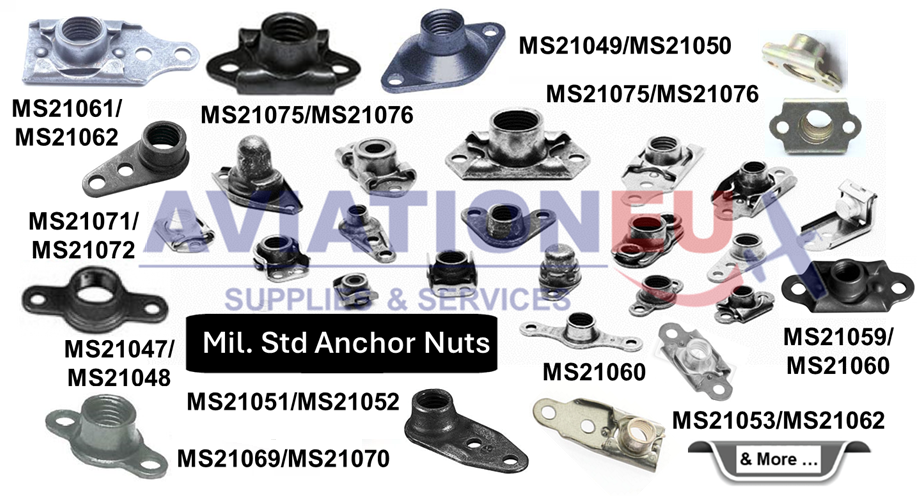
Sourced from quality manufacturers, AVIATIONEU NEW ERA MS21051/MS21052 series nutplates are fixed self-locking, one-lug low height standard rivet spacing nutplates. MS21051 series nutplates are manufactured from cadmium plated steel while those in MS21052 series are produced from corrosion resistant steel (CRES). They are available in different Unified thread sizes, with plain or countersunk rivet holes on each side and come with or without a dry film lube. Sold in pieces but also in packs where the specified number of nuts per pack is indicated after the letters "PK" in the product reference number (SKU). Appearing prices are always for the units of measurement used each time. Matching rivets are sold separately.
For additional information please refer to the supplied documentation or contact us.

AVIATIONEU NEW ERA...
Anchor nuts (aka nutplates or anchor plates) are terms used interchangeably and relate to stamped sheet metal fasteners with an internally threaded tube and a plate with two clearance holes for rivets. They are used in blind mounted panel applications in aerospace and other industrial sectors where hex nuts cannot be used or an attached nut is required for ease of maintenance.
Anchor nuts can be Fixed or Floating, the latter being easier to use due to their built-in nut (threaded hole) able to "float" slightly thus providing a convenient connection point for threaded rods, such as bolts, from the backside. In the case of Fixed anchor nuts, the built-in nut is static (i.e. without the capability to “float”) and the threaded rod must be positioned perfectly over the hole. Self-locking anchor nuts are those with a built-in locking mechanism preventing them from loosening over time from vibrations. They are extensively used in aerospace, automotive, and construction industries.
Depending on their intended application, nutplates conform to different military, aerospace, ISO or other industrial standards such as the German DIN, U.S. (ASME & ASTM, IFI, ANSI), British BS, Japanese JIS and others. They are offered as OEM parts under their respective brands or under our own labelled (AVIATIONEU NEW ERA) product lines intended as cost-effective alternatives to the respective OEM products. Listed in accordance with their standard of compliance, Fixed and Floating nutplates come in different materials (such as steel or CRES & finishes), in single/double lug configurations and Metric ISO οr Unified thread sizes. There is currently no U.S. Military Standard (MS) specification for Metric nutplates.Depending on the selected product and availability, nutplates can be supplied with a dry film lube specified by the letter "L" in the respective part number. Those with countersunk rivet holes are specified by the letter "K" at the end of the part number.
Sourced from quality manufacturers, AVIATIONEU NEW ERA MS21075/MS21076 series nutplates are floating self-locking, two lug, low height, reduced rivet spacing nutplates. Those included in MS21075 series are manufactured from cadmium plated carbon steel while the MS21076 nutplates are produced from corrosion resistant steel (CRES). They are available in different Unified thread sizes, with or without eyelets and come with or without a dry film lube. The letter “E” at the end of the part number denotes a nutplate with eyelets while the letter “N” denotes a nutplate without eyelets. Sold in pieces but also in packs where the specified number of nuts per pack is indicated after the letters "PK" in the product reference number (SKU). Appearing prices are always for the units of measurement used each time. Matching rivets are sold separately.
For additional information please refer to the supplied documentation or contact us.

AVIATIONEU NEW ERA...
Anchor nuts can be Fixed or Floating, the latter being easier to use due to their built-in nut (threaded hole) able to "float" slightly thus providing a convenient connection point for threaded rods, such as bolts, from the backside. In the case of Fixed anchor nuts, the built-in nut is static (i.e. without the capability to “float”) and the threaded rod must be positioned perfectly over the hole. Self-locking anchor nuts are those with a built-in locking mechanism preventing them from loosening over time from vibrations. They are extensively used in aerospace, automotive, and construction industries.
Depending on their intended application, nutplates conform to different military, aerospace, ISO or other industrial standards such as the German DIN, U.S. (ASME & ASTM, IFI, ANSI), British BS, Japanese JIS and others. They are offered as OEM parts under their respective brands or under our own labelled (AVIATIONEU NEW ERA) product lines intended as cost-effective alternatives to the respective OEM products. Listed in accordance with their standard of compliance, Fixed and Floating nutplates come in different materials (such as steel or CRES & finishes), in single/double lug configurations and Metric ISO οr Unified thread sizes. There is currently no U.S. Military Standard (MS) specification for Metric nutplates. Depending on the selected product and availability, nutplates can be supplied with a dry film lube specified by the letter "L" in the respective part number. Those with countersunk rivet holes are specified by the letter "K" at the end of the part number.
Sourced from quality manufacturers, AVIATIONEU NEW ERA MS21069/MS21070 series nutplates are fixed self-locking, two-lug, reduced rivet spacing low height miniature anchor nuts. MS21069 series nutplates are made from cadmium plated steel while those of MS21070 series from corrosion resistant steel (CRES). They come in different Unified Thread sizes with plain or countersunk rivet holes on each side, with or without a dry film lube. Sold in pieces but also in packs where the specified number of nuts per pack is indicated after the letters "PK" in the product reference number (SKU). Appearing prices are always for the units of measurement used each time. Matching rivets are sold separately.
For additional information please refer to the supplied documentation or contact us.

AVIATIONEU NEW ERA...
Anchor nuts (aka nutplates or anchor plates) are terms used interchangeably and relate to stamped sheet metal fasteners with an internally threaded tube and a plate with two clearance holes for rivets. They are used in blind mounted panel applications in aerospace and other industrial sectors where hex nuts cannot be used or an attached nut is required for ease of maintenance.
Anchor nuts can be Fixed or Floating, the latter being easier to use due to their built-in nut (threaded hole) able to "float" slightly thus providing a convenient connection point for threaded rods, such as bolts, from the backside. In the case of Fixed anchor nuts, the built-in nut is static (i.e. without the capability to “float”) and the threaded rod must be positioned perfectly over the hole. Self-locking anchor nuts are those with a built-in locking mechanism preventing them from loosening over time from vibrations. They are extensively used in aerospace, automotive, and construction industries.
Depending on their intended application, nutplates conform to different military, aerospace, ISO or other industrial standards such as the German DIN, U.S. (ASME & ASTM, IFI, ANSI), British BS, Japanese JIS and others. They are offered as OEM parts under their respective brands or under our own labelled (AVIATIONEU NEW ERA) product lines intended as cost-effective alternatives to the respective OEM products. Listed in accordance with their standard of compliance, Fixed and Floating nutplates come in different materials (such as steel or CRES & finishes), in single/double lug configurations and Metric ISO οr Unified thread sizes. There is currently no U.S. Military Standard (MS) specification for Metric nutplates. Depending on the selected product and availability, nutplates can be supplied with a dry film lube specified by the letter "L" in the respective part number. Those with countersunk rivet holes are specified by the letter "K" at the end of the part number.
Sourced from quality manufacturers, AVIATIONEU NEW ERA MS21073/MS21074 series nutplates are fixed self-locking, low height corner, miniature anchor nuts. Those included in MS21073 series are manufactured from cadmium plated carbon steel while the MS21074 nutplates are produced from corrosion resistant steel (CRES). They are available in different Unified thread sizes, with plain or countersunk rivet holes on each side and come with or without a dry film lube. Sold in pieces but also in packs where the specified number of nuts per pack is indicated after the letters "PK" in the product reference number (SKU). Appearing prices are always for the units of measurement used each time. Matching rivets are sold separately.
For additional information please refer to the supplied documentation or contact us.

AVIATIONEU NEW ERA...
Anchor nuts (aka nutplates or anchor plates) are terms used interchangeably and relate to stamped sheet metal fasteners with an internally threaded tube and a plate with two clearance holes for rivets. They are used in blind mounted panel applications in aerospace and other industrial sectors where hex nuts cannot be used or an attached nut is required for ease of maintenance.
Anchor nuts can be Fixed or Floating, the latter being easier to use due to their built-in nut (threaded hole) able to "float" slightly thus providing a convenient connection point for threaded rods, such as bolts, from the backside. In the case of Fixed anchor nuts, the built-in nut is static (i.e. without the capability to “float”) and the threaded rod must be positioned perfectly over the hole. Self-locking anchor nuts are those with a built-in locking mechanism preventing them from loosening over time from vibrations. They are extensively used in aerospace, automotive, and construction industries.
Depending on their intended application, nutplates conform to different military, aerospace, ISO or other industrial standards such as the German DIN, U.S. (ASME & ASTM, IFI, ANSI), British BS, Japanese JIS and others. They are offered as OEM parts under their respective brands or under our own labelled (AVIATIONEU NEW ERA) product lines intended as cost-effective alternatives to the respective OEM products. Listed in accordance with their standard of compliance, Fixed and Floating nutplates come in different materials (such as steel or CRES & finishes), in single/double lug configurations and Metric ISO οr Unified thread sizes. There is currently no U.S. Military Standard (MS) specification for Metric nutplates.Depending on the selected product and availability, nutplates can be supplied with a dry film lube specified by the letter "L" in the respective part number. Those with countersunk rivet holes are specified by the letter "K" at the end of the part number.
Sourced from quality manufacturers, AVIATIONEU NEW ERA MS21071/MS21072 series nutplates are fixed self-locking, low height one-lug, reduced rivet spacing miniature anchor nuts. Those included in MS21071 series are manufactured from cadmium plated carbon steel while the MS21072 nutplates are produced from corrosion resistant steel (CRES). They are available in different Unified thread sizes, with plain or countersunk rivet holes on each side and come with or without a dry film lube. Sold in pieces but also in packs where the specified number of nuts per pack is indicated after the letters "PK" in the product reference number (SKU). Appearing prices are always for the units of measurement used each time. Matching rivets are sold separately.
For additional information please refer to the supplied documentation or contact us.

AIA NAS NA-0027/NA-0028...
National Aerospace Standards (NAS) are voluntary standards developed and maintained by committees and working groups of subject matter experts from member companies of the U.S. Aerospace Industries Association (AIA).
These standards have served as the foundation for the development of aircraft, spacecraft, watercraft, ground vehicles, machinery, and electronics.
NAS parts are most well-known for state-of-the-art, high-strength, precision fasteners, electrical connectors, splices and terminations, rod end bearings, and many other types of hardware and components. The NA prefix relates to metric standards.
NA-0027/NA-0028 Series Metric Self-Locking Floating Two-Lug Nutplates (*) form part of NAS high-strength, precision fasteners. Sourced from quality manufacturers they are offered as part of our own labelled (AVIATIONEU NEW ERA) product lines in different materials, finishes, thread sizes and dimensions in Metric system. Usually sold in pieces but packs are also used where the number of anchor nuts per pack is indicated after the letters "PK" in the product SKU. Appearing prices are always for the used units of measurement each time. For additional information, please refer to the product specifications or contact us.
(*) also termed as plate nuts, anchor nuts or anchor plates. These terms are used interchangeably to describe the respective fasteners.

AVIATIONEU NEW ERA...
Anchor nuts (aka nutplates or anchor plates) are terms used interchangeably and relate to stamped sheet metal fasteners with an internally threaded tube and a plate with two clearance holes for rivets. They are used in blind mounted panel applications in aerospace and other industrial sectors where hex nuts cannot be used or an attached nut is required for ease of maintenance.
Anchor nuts can be Fixed or Floating, the latter being easier to use due to their built-in nut (threaded hole) able to "float" slightly thus providing a convenient connection point for threaded rods, such as bolts, from the backside. In the case of Fixed anchor nuts, the built-in nut is static (i.e. without the capability to “float”) and the threaded rod must be positioned perfectly over the hole. Self-locking anchor nuts are those with a built-in locking mechanism preventing them from loosening over time from vibrations. They are extensively used in aerospace, automotive, and construction industries.
Depending on their intended application, nutplates conform to different military, aerospace, ISO or other industrial standards such as the German DIN, U.S. (ASME & ASTM, IFI, ANSI), British BS, Japanese JIS and others. They are offered as OEM parts under their respective brands or under our own labelled (AVIATIONEU NEW ERA) product lines intended as cost-effective alternatives to the respective OEM products. Listed in accordance with their standard of compliance, Fixed and Floating nutplates come in different materials (such as steel or CRES & finishes), in single/double lug configurations and Metric ISO οr Unified thread sizes. There is currently no U.S. Military Standard (MS) specification for Metric nutplates. Depending on the selected product and availability, nutplates can be supplied with a dry film lube specified by the letter "L" in the respective part number. Those with countersunk rivet holes are specified by the letter "K" at the end of the part number.
Sourced from quality manufacturers, AVIATIONEU NEW ERA MS21061/MS21062 series nutplates are floating self-locking, low height one-lug anchor nuts. Those included in MS21061 series are manufactured from cadmium plated carbon steel while the MS21062 nutplates are produced from corrosion resistant steel (CRES). They are available in different Unified thread sizes, with plain or countersunk rivet holes on each side and come with or without a dry film lube. Sold in pieces but also in packs where the specified number of nuts per pack is indicated after the letters "PK" in the product reference number (SKU). Appearing prices are always for the units of measurement used each time. Matching rivets are sold separately.
For additional information please refer to the supplied documentation or contact us.
AVIATIONEU NEW ERA NASM/MS...
Anchor nuts (aka nutplates or anchor plates) are terms used interchangeably and relate to stamped sheet metal fasteners with an internally threaded tube and a plate with two clearance holes for rivets. They are used in blind mounted panel applications in aerospace and other industrial sectors where hex nuts cannot be used or an attached nut is required for ease of maintenance.
Anchor nuts can be Fixed or Floating, the latter being easier to use due to their built-in nut (threaded hole) able to "float" slightly thus providing a convenient connection point for threaded rods, such as bolts, from the backside. In the case of Fixed anchor nuts, the built-in nut is static (i.e. without the capability to “float”) and the threaded rod must be positioned perfectly over the hole. Self-locking anchor nuts are those with a built-in locking mechanism preventing them from loosening over time from vibrations. They are extensively used in aerospace, automotive, and construction industries.
Depending on their intended application, nutplates conform to different military, aerospace, ISO or other industrial standards such as the German DIN, U.S. (ASME & ASTM, IFI, ANSI), British BS, Japanese JIS and others. They are offered as OEM parts under their respective brands or under our own labelled (AVIATIONEU NEW ERA) product lines intended as cost-effective alternatives to the respective OEM products. Listed in accordance with their standard of compliance, Fixed and Floating nutplates come in different materials (such as steel or CRES & finishes), in single/double lug configurations and Metric ISO οr Unified thread sizes. There is currently no U.S. Military Standard (MS) specification for Metric nutplates.Depending on the selected product and availability, nutplates can be supplied with a dry film lube specified by the letter "L" in the respective part number. Those with countersunk rivet holes are specified by the letter "K" at the end of the part number.
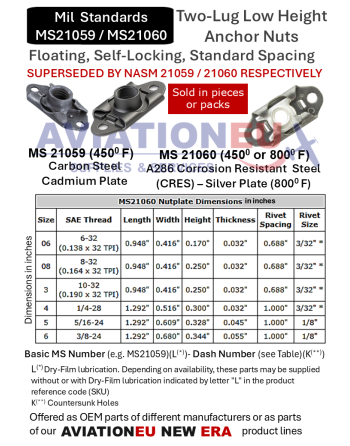
Sourced from quality manufacturers, AVIATIONEU NEW ERA floating self-locking, low height two-lug nutplates conform to NASM 21059/21060 Standards superseding the respective MS21059/MS21060 without change in part numbers. They can be riveted to the back of a stationary panel using pop rivets or solid matching rivets (sold separately) allowing for some misalignment in assembly. NASM 21059 nutplates are made of cadmium plated carbon steel & those of NASM 21060 from corrosion resistant steel (CRES).They feature 125 KSI ultimate tensile strength (Ftu) and can withstand temperatures of 450°F (NASM 21059/21060) or 800°F (NASM 21060 when silver plated). Offered in different dimensions & Unified thread sizes, with plain or countersunk rivet holes & with dry film lubrication for corrosion resistance or without. Supplied in pieces or packs with the number of nuts per pack indicated after the letters "PK" in the product SKU. Appearing prices are in the unit of measurement used each time.

AIA NAS1794 Self-Locking...
NAS parts are most well-known for state-of-the-art, high-strength, precision fasteners, electrical connectors, splices and terminations, rod end bearings, and many other types of hardware and components. The NA prefix relates to metric standards.
NAS 1794 Series self-locking counter bore replaceable nut elements are produced by various manufacturers. They are offered as OEM parts or parts falling under our own labelled (AVIATIONEU NEW ERA) product lines in different materials, finishes, thread sizes and dimensions in inches. Please refer to the supplied documentation.
AVIATIONEU NEW ERA...
Anchor nuts (aka nutplates or anchor plates) are terms used interchangeably and relate to stamped sheet metal fasteners with an internally threaded tube and a plate with two clearance holes for rivets. They are used in blind mounted panel applications in aerospace and other industrial sectors where hex nuts cannot be used or an attached nut is required for ease of maintenance.
Anchor nuts can be Fixed or Floating, the latter being easier to use due to their built-in nut (threaded hole) able to "float" slightly thus providing a convenient connection point for threaded rods, such as bolts, from the backside. In the case of Fixed anchor nuts, the built-in nut is static (i.e. without the capability to “float”) and the threaded rod must be positioned perfectly over the hole. Self-locking anchor nuts are those with a built-in locking mechanism preventing them from loosening over time from vibrations. They are extensively used in aerospace, automotive, and construction industries.
Depending on their intended application, nutplates conform to different military, aerospace, ISO or other industrial standards such as the German DIN, U.S. (ASME & ASTM, IFI, ANSI), British BS, Japanese JIS and others. They are offered as OEM parts under their respective brands or under our own labelled (AVIATIONEU NEW ERA) product lines intended as cost-effective alternatives to the respective OEM products. Listed in accordance with their standard of compliance, Fixed and Floating nutplates come in different materials (such as steel or CRES & finishes), in single/double lug configurations and Metric ISO οr Unified thread sizes. There is currently no U.S. Military Standard (MS) specification for Metric nutplates. Depending on the selected product and availability, nutplates can be supplied with a dry film lube specified by the letter "L" in the respective part number. Those with countersunk rivet holes are specified by the letter "K" at the end of the part number.
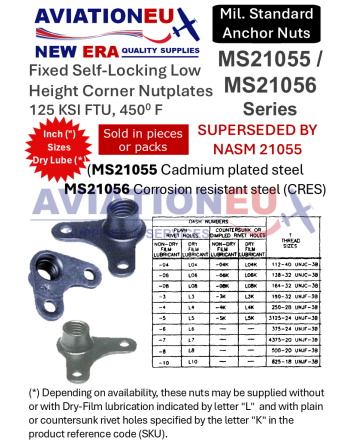
Sourced from quality manufacturers, AVIATIONEU NEW ERA MS21055/MS21056 series nutplates are fixed self-locking, low height corner nut plates. MS21055 series nutplates are manufactured from cadmium plated carbon steel while those in MS21056 series are produced from corrosion resistant steel (CRES). They are available in different Unified thread sizes, with plain or countersunk rivet holes on each side and come with or without a dry film lube. Sold in pieces but also in packs where the specified number of nuts per pack is indicated after the letters "PK" in the product reference number (SKU). Appearing prices are always for the units of measurement used each time. Matching rivets are sold separately.
For additional information please refer to the supplied documentation or contact us.

AVIATIONEU NEW ERA...
Anchor nuts (aka nutplates or anchor plates) are terms used interchangeably and relate to stamped sheet metal fasteners with an internally threaded tube and a plate with two clearance holes for rivets. They are used in blind mounted panel applications in aerospace and other industrial sectors where hex nuts cannot be used or an attached nut is required for ease of maintenance.
Anchor nuts can be Fixed or Floating, the latter being easier to use due to their built-in nut (threaded hole) able to "float" slightly thus providing a convenient connection point for threaded rods, such as bolts, from the backside. In the case of Fixed anchor nuts, the built-in nut is static (i.e. without the capability to “float”) and the threaded rod must be positioned perfectly over the hole. Self-locking anchor nuts are those with a built-in locking mechanism preventing them from loosening over time from vibrations. They are extensively used in aerospace, automotive, and construction industries.
Depending on their intended application, nutplates conform to different military, aerospace, ISO or other industrial standards such as the German DIN, U.S. (ASME & ASTM, IFI, ANSI), British BS, Japanese JIS and others. They are offered as OEM parts under their respective brands or under our own labelled (AVIATIONEU NEW ERA) product lines intended as cost-effective alternatives to the respective OEM products. Listed in accordance with their standard of compliance, Fixed and Floating nutplates come in different materials (such as steel or CRES & finishes), in single/double lug configurations and Metric ISO οr Unified thread sizes. There is currently no U.S. Military Standard (MS) specification for Metric nutplates. Depending on the selected product and availability, nutplates can be supplied with a dry film lube specified by the letter "L" in the respective part number. Those with countersunk rivet holes are specified by the letter "K" at the end of the part number.
Sourced from quality manufacturers, AVIATIONEU NEW ERA MS21049/MS21050 series nutplates are fixed self-locking, two-lug low height reduced rivet spacing nutplates. MS21049 series nutplates are manufactured from cadmium plated steel while those in MS21050 series are produced from corrosion resistant steel and silver plated. They are available in different Unified thread sizes, with plain or countersunk rivet holes on each side and come with or without a dry film lube. Sold in pieces but also in packs where the specified number of nuts per pack is indicated after the letters "PK" in the product reference number (SKU). Appearing prices are always for the units of measurement used each time. Matching rivets are sold separately.
For additional information please refer to the supplied documentation or contact us.

AVIATIONEU NEW ERA...
Anchor nuts (aka nutplates or anchor plates) are terms used interchangeably and relate to stamped sheet metal fasteners with an internally threaded tube and a plate with two clearance holes for rivets. They are used in blind mounted panel applications in aerospace and other industrial sectors where hex nuts cannot be used or an attached nut is required for ease of maintenance.
Anchor nuts can be Fixed or Floating, the latter being easier to use due to their built-in nut (threaded hole) able to "float" slightly thus providing a convenient connection point for threaded rods, such as bolts, from the backside. In the case of Fixed anchor nuts, the built-in nut is static (i.e. without the capability to “float”) and the threaded rod must be positioned perfectly over the hole. Self-locking anchor nuts are those with a built-in locking mechanism preventing them from loosening over time from vibrations. They are extensively used in aerospace, automotive, and construction industries.
Depending on their intended application, nutplates conform to different military, aerospace, ISO or other industrial standards such as the German DIN, U.S. (ASME & ASTM, IFI, ANSI), British BS, Japanese JIS and others. They are offered as OEM parts under their respective brands or under our own labelled (AVIATIONEU NEW ERA) product lines intended as cost-effective alternatives to the respective OEM products. Listed in accordance with their standard of compliance, Fixed and Floating nutplates come in different materials (such as steel or CRES & finishes), in single/double lug configurations and Metric ISO οr Unified thread sizes. There is currently no U.S. Military Standard (MS) specification for Metric nutplates. Depending on the selected product and availability, nutplates can be supplied with a dry film lube specified by the letter "L" in the respective part number. Those with countersunk rivet holes are specified by the letter "K" at the end of the part number.
Sourced from quality manufacturers, AVIATIONEU NEW ERA MS21048/NAS680 series nutplates are fixed self-locking, two-lug low height nutplates made from Corrosion Resistant Steel (CRES) A286 (UNS S66 286) in 450° & 800° F versions with a passivated finish. Same as those of MS21047series except that they are made from stainless steel and silver plated (800 ° F only). They have a nylon insert and are available in different Unified thread sizes, with plain rivet or countersunk rivet holes on each side and come with or without a dry film lubricant (450° F only). MS21048 nutplates supersede AN362, AN366, NAS680 and they are superseded by NASM21048 series. The Part Identification Number (PIN) for MS21048 and the part number for NASM21048 are identical & part numbers have not been changed. Sold in packs with a specified number of nuts per pack indicated after the letters "PK" in the product reference number (SKU). Matching rivets are sold separately. For additional information please contact us.
AVIATIONEU NEW ERA...
Anchor nuts (aka nutplates or anchor plates) are terms used interchangeably and relate to stamped sheet metal fasteners with an internally threaded tube and a plate with two clearance holes for rivets. They are used in blind mounted panel applications in aerospace and other industrial sectors where hex nuts cannot be used or an attached nut is required for ease of maintenance.
Anchor nuts can be Fixed or Floating, the latter being easier to use due to their built-in nut (threaded hole) able to "float" slightly thus providing a convenient connection point for threaded rods, such as bolts, from the backside. In the case of Fixed anchor nuts, the built-in nut is static (i.e. without the capability to “float”) and the threaded rod must be positioned perfectly over the hole. Self-locking anchor nuts are those with a built-in locking mechanism preventing them from loosening over time from vibrations. They are extensively used in aerospace, automotive, and construction industries.
Depending on their intended application, nutplates conform to different military, aerospace, ISO or other industrial standards such as the German DIN, U.S. (ASME & ASTM, IFI, ANSI), British BS, Japanese JIS and others. They are offered as OEM parts under their respective brands or under our own labelled (AVIATIONEU NEW ERA) product lines intended as cost-effective alternatives to the respective OEM products. Listed in accordance with their standard of compliance, Fixed and Floating nutplates come in different materials (such as steel or CRES & finishes), in single/double lug configurations and Metric ISO οr Unified thread sizes. There is currently no U.S. Military Standard (MS) specification for Metric nutplates.Depending on the selected product and availability, nutplates can be supplied with a dry film lube specified by the letter "L" in the respective part number. Those with countersunk rivet holes are specified by the letter "K" at the end of the part number.
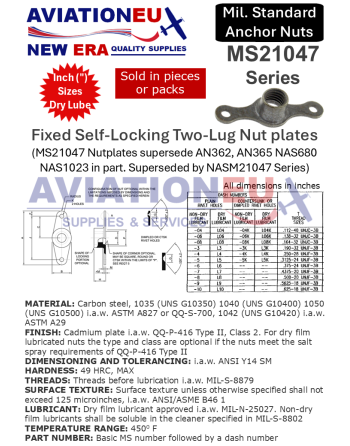
Sourced from quality manufacturers, AVIATIONEU NEW ERA MS21047 series nutplates are fixed self locking elastic insert 2-lug anchor nuts made of cadmium plated steel with nylon insert and plain rivet holes. They replace those of AN366F series and are available in different Unified thread sizes to meet application requirements and replace respective nut plates. Sold in pieces but also in packs where the specified number of nuts per pack is indicated after the letters "PK" in the product reference number (SKU). Appearing prices are always for the units of measurement used each time. Matching rivets are sold separately.
For additional information please refer to the supplied documentation or contact us.

AVIATIONEU NEW ERA MS21078...
Anchor nuts (aka nutplates or anchor plates) are terms used interchangeably and relate to stamped sheet metal fasteners with an internally threaded tube and a plate with two clearance holes for rivets. They are used in blind mounted panel applications in aerospace and other industrial sectors where hex nuts cannot be used or an attached nut is required for ease of maintenance.
Anchor nuts can be Fixed or Floating, the latter being easier to use due to their built-in nut (threaded hole) able to "float" slightly thus providing a convenient connection point for threaded rods, such as bolts, from the backside. In the case of Fixed anchor nuts, the built-in nut is static (i.e. without the capability to “float”) and the threaded rod must be positioned perfectly over the hole. Self-locking anchor nuts are those with a built-in locking mechanism preventing them from loosening over time from vibrations. They are extensively used in aerospace, automotive, and construction industries.
Depending on their intended application, nutplates conform to different military, aerospace, ISO or other industrial standards such as the German DIN, U.S. (ASME & ASTM, IFI, ANSI), British BS, Japanese JIS and others. They are offered as OEM parts under their respective brands or under our own labelled (AVIATIONEU NEW ERA) product lines intended as cost-effective alternatives to the respective OEM products. Listed in accordance with their standard of compliance, Fixed and Floating nutplates come in different materials (such as steel or CRES & finishes), in single/double lug configurations and Metric ISO οr Unified thread sizes. There is currently no U.S. Military Standard (MS) specification for Metric nutplates. Depending on the selected product and availability, nutplates can be supplied with a dry film lube specified by the letter "L" in the respective part number. Those with countersunk rivet holes are specified by the letter "K" at the end of the part number.
Sourced from quality manufacturers, AVIATIONEU NEW ERA MS21078 series nutplates are fixed self-locking, two-lug nutplates with elastic insert and plain rivet holes. Made from cadmium plated steel they are available in different Unified thread sizes and replace respective AN366F series nutplates. Sold in pieces but also in packs where the specified number of nuts per pack is indicated after the letters "PK" in the product reference number (SKU). Appearing prices are always for the units of measurement used each time. Matching rivets are sold separately.
For additional information please refer to the supplied documentation or contact us.

HOWMET® AEROSPACE (ARCONIC)...
Anchor nuts (aka nutplates or anchor plates) are terms used interchangeably and relate to stamped sheet metal fasteners with an internally threaded tube and a plate with two clearance holes for rivets. They are used in blind mounted panel applications in aerospace and other industrial sectors where hex nuts cannot be used or an attached nut is required for ease of maintenance.
Anchor nuts can be Fixed or Floating, the latter being easier to use due to their built-in nut (threaded hole) able to "float" slightly thus providing a convenient connection point for threaded rods, such as bolts, from the backside. In the case of Fixed anchor nuts, the built-in nut is static (i.e. without the capability to “float”) and the threaded rod must be positioned perfectly over the hole. Self-locking anchor nuts are those with a built-in locking mechanism preventing them from loosening over time from vibrations. They are extensively used in aerospace, automotive, and construction industries.
HOWMET® AEROSPACE Inc. ((HOWMET FASTENING SYSTEMS), formerly ARCONIC Inc., develops & manufactures high performance, engineered products & solutions for the aerospace, industrial gas turbine, commercial transportation and oil and gas markets. ALCOA FASTENING SYSTEMS (ALCOA), now a business unit of HOWMET® AEROSPACE is one of the largest manufacturers of aerospace hardware in the world. SIMMONDS®, a HOWMET AEROSPACE® business unit, specialises on self-locking & special nuts. Their self locking nuts come in different types (series) offered in different materials and sizes, and can be reused at least 15 times without affecting the nut's performance. Born for the world of aviation, SIMMONDS® self-locking nuts are lightweight and extremely durable, exhibit a very strong locking performance, resistance to heat and corrosion & can be used in a wide temperature range in demanding aerospace, rally & other applications.
HOWMET AEROSPACE® manufactures and offers through their different business units a wide range of anchor nuts, fixed or floating, in various types (styles), such as one or two-lug, corner or others, different materials, finishes, and sizes. They are intended for use in different aerospace and industrial applications. Some of HOWMET AEROSPACE® nutplates are listed and many more (not currently listed) can be offered through our network of co-operating suppliers. Sold in pieces or in packs where the number of anchor nuts per pack is indicated after the letters "PK" in the product SKU.
For more information on HOWMET® AEROSPACE nutplates please consult the Product Description section or contact us.

NAFCO USA Stress-Relieving...
NAFCO USA is a manufacturer of self-locking nuts as well as different types of nutplates and press-in inserts and dome nuts. Their fasteners conform with National Aerospace Standards (NAS) developed and maintained by the U.S. Aerospace Industries Association (AIA) and served as the foundation for the development of aircraft, spacecraft, watercraft, ground vehicles, machinery, and electronics. The NA prefix in the part numbers of the fasteners relates to metric standards.
In the world of aerospace fasteners NAFCO USA has built a reputation for quality, affordable, and innovative products. NAFCO USA’s stressnut rivetless nutplates, are no exception. Their stressnut rivetless nutplates meet and exceed the requirements of aerospace standard NASM25027 and offer high resistance to push-out and torque. In addition, the rivetless design eliminates the need for additional drilled holes and rivet installation, allowing faster installation times. Time savings on installation translates into reduced labor costs. Other Features Include:
Increase substrate fatigue life up to 300%.
Installed with convenient split sleeve tooling.
Replaceable nut elements (NAS1794 standard).
Inch or metric unit versions.
Sealed or unsealed versions.
Do not require gang channels.
Reduced profile/weight versions available.