



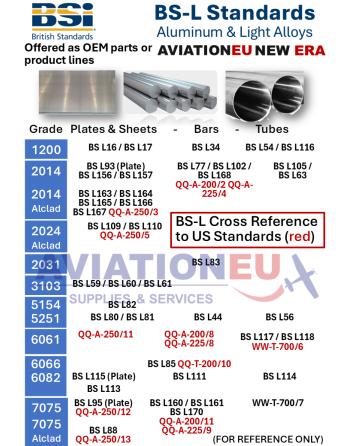
The British Standards Institution (BSI) administers British Standards as the UK's National Standards body. British Standards L (BS-L) relate to different grades of aluminium alloys and light alloy materials such as magnesium and apply to different product forms (shapes) such as sheets/plates, bars and tubes.
Sourced from different manufacturers they are offered as their OEM parts or as parts of our own labelled (AVIATIONEU NEW ERA) product lines. They can be supplied in different Metric pre-cut ot cut-to-order (CTO) dimensions and heat treatments (tempers) and they are sold in pieces or bulk (tons). A brief overview of offered BS-L metal products commonly used in Aerospace with reference to the commercial (trade) name of the respective aluminum alloy, and their correlation to their US Standards' counterparts is included below (see table). Depending on application requirements, certain US Standard metals can be used as alternatives to their BS-L counterparts.
Applicable forms: plates, sheets and strips, bars, tubes as per respective BS-L Standards.
The 2014 aluminum alloy is high-strength aerospace alluminum alloy alloyed with copper (3.90-5.00%). Often includes cladding with 1050A aluminium and heat treated to T3 or T4 conditions, as in the case of sheets, to meet respective BS L163, and BS L164 Standard specifications. Clad sheets are typically used in aerospace and defense components, structural and high technology applications. Use of copper enables them to retain their high strength after their heat treatment while cladding, as part of the mill production process, enhances their corrosion resistance capabilities.
Applicable forms: sheets.
The 2024 aluminum alloy (with copper as the primary alloying element) is also known as aerospace grade aluminum. It is commonly used in aircraft structural applications due to its high strength and fatigue resistance and those requiring high stress & strain resistance in aviation and industrial applications. This alloy is stronger but less versatile than 6061, which is more corrosion resistant, easier to weld, and more suited to machining, but less strong than the 7075. 2024A 1050A Alclad sheets relate to BS-L Standards BS L109 and BS L110.
Applicable forms: plates, sheets and strips, bars.
7075 aluminium alloy is an aluminium alloy with zinc as the primary alloying element. It is one of the most commonly used aluminium alloys for highly stressed structural applications such as aircraft structural parts. Respective BS-L Standards for different forms of 7075 aluminum include BS 2 L95 for T651 plates, BS 2 L88 for T6 clad sheets and strips, BS L160, BS L161, and BS L70 for bars.
For additional information, please refer to the supplied documentation or contact us for a quotation.
(*) The letter "A" in the alloy classification system indicates a modified version of the respective standard alloy with generally no distinction in material properties or performance betwwen the two.

HI-SHEAR Fasteners are patented fasteners of HI-SHEAR CORPORATION (Patent Holder), subsidiary of LISI AEROSPACE, a manufacturer of advanced aerospace fasteners and installation equipment used in space, military and commercial vehicles. Depending on the fastener, they are made by quality fastener manufacturers (licensees) in different countries including but not limited to LISI AEROSPACE companies, HOWMET ALCOA / SIMMONDS / FAIRCHILD, PCC SPS, and others.
The HI-SHEAR rivet pin range offers a versatile solution for most of structural assemblies. They consist a very common type of threaded fastener used for clearance, transition and low interference fit throughout the airframe (metallic and composite), from wings to fuselage, in engine fairings, and more. Easily installed from one side, by one person with conventional tooling.
HI-SHEAR rivet pin product portfolio includes the original HI-LOK™ (HL™) system, the latest HI-LITE™ (HST™) pins with an improved recess and HI-TIGUE™ (HLT™) pins with improved fatigue benefits. They can be used in shear and/or tension applications on plain or sloped surfaces and feature controlled preload, a wide range of sizes and variety of materials and coatings for installation in all structures.
Most fasteners are mainly loaded in shear. That should be the only way for rivets as their tension capability is relatively low. Whenever there is a substantial tension load in a fastener, a threaded bolt should be used.
Additional information is available in Product Description section and the supplied documentation.

AISI/SAE(*) 4130 and 4140 grade steels are low-alloy steels containing chromium and molybdenum as common composition elements. Both are are popular steel materials due to their properties. AISI 4130 grade steel shows good overall combinations of strength, toughness and fatigue strength with good atmospheric corrosion resistance while AISI 4140 grade steel features a high fatigue strength, abrasion and impact resistance, toughness, and torsional strength. Both alloys are weldable with the use of all conventional techniques (AISI 4130 alloy's lower carbon composition compared to AISI 4140 allows easier welding) and machinable in the annealed condition. To make them stronger they need to be subjected to heat treatment, such as annealing, cold working, etc. 4140 and 4130 grade steels are wideky used in aerospace, oil and gas, automotive, agricultural and defense industries.
AISI 4130/4140 alloy steel sheets/plates are offered as part of AVIATIONEU NEW ERA product lines for a wide range of uses. Sourced from quality producers, they are cold rolled to increase their strength and produced in accordance with ASTM specificatiions. Competitively priced and offered in different thicknesses (0.2-4 mm or 4-60 mm or 60-115 mm) and cut to order widths (500-1500 mm or 600-3000 mm) and lengths, they consist a cost effective solution when large quantities of such sheets are demanded. Unit of sale is 1 Ton (US or Metric as specified) with Minimum Order Quantity (MOQ) 1 Ton. Sea/sea-surface transport to customer destinationcan be provided. Approximate time for shipping: usually 1-2 months from the time of order payment depending on the ordered quantity. Appearing price is indicative per unit of sale.
For additional information, please refer to the attached comparison table of specifications for different steel alloys or contact us for quotation.
(*) American Iron & Steel Institute (AISI), Society of Automotive Engineers (SAE)

AN Clevis bolts are manufactured from nickel steel alloy, SAE 2330 and cadmium plated in same manner as AN3 - AN8 aircraft bolts.They are special-purpose bolts with a a slotted brazier type head and used where a large shearing stress occurs (never in tension). Minimum tensile strength 125,000 PSI. They are available with drilled or undrilled shank (designated by the letter "A" after the dash number for undrilled shank). For the AN12-AN23 bolts the second digit denotes the fine thread machine screw size (e.g. for AN21 the size is 6-40, for AN22 8-36 and for AN23 10-32). For the AN24-AN36 bolts the second digit denotes the diameter in 1/16 inch increments (AN25 has a diameter of 5/16 inch).

AVIATIONEU NEW ERA extruded square bars from 7075 aluminum alloy are competitively priced, sourced from certified manufacturers, produced as per ASTM specification and offered as Fabriacted (F) or H112 tempered. Used in aviation and industrial applications. They are available in dimensions 5 mm × 5 mm (13/64" x 13/64") up to 150 mm × 150 mm (5-29/32" x 5-29/32") and length up to 12000 mm (12 m). Unit of measurement is 1 US Ton with Minimum Order Quantity (MOQ) 1 US Ton. Sea/sea-surface transport to destination. Appr. time for shipping: 1 month from the time of order payment. Appearing price is indicative per unit of sale. Please contact us for for additional information and quotation.
Our Quick Guide for Aluminum Alloys & Tempers is now available. Please see attached file.

Anchor nuts (aka nutplates or anchor plates) are terms used interchangeably and relate to stamped sheet metal fasteners with an internally threaded tube and a plate with two clearance holes for rivets. Initially designed and still extensively used in aerospace applications, they are today also used in automotive, motorsports, and other industries in blind mounted panel applications where hex nuts cannot be used or an attached nut is required for ease of maintenance. They can be Fixed or Floating, the latter being easier to install due to their built-in nut (threaded hole) able to "float" slightly thus providing a convenient connection point for threaded rods, such as bolts, from the backside. In the case of Fixed anchor nuts, the built-in nut is static (i.e. without the capability to “float”) and the threaded bolt must be positioned perfectly over the hole. Self-locking anchor nuts are those with a built-in locking mechanism preventing them from loosening over time from vibrations.
Anchor nuts are offered in Imperial (in.) and Metric thread sizes, in different materials (e.g. Carbon Steel, Steel alloys, CRES), finishes such as Cadmium or Cadmium Free Zinc Nickel platings (compliant to EU Regulations) with or without dry film lubrication. They come in various styles/configurations (e.g. with one or two lugs, full size or miniatures, countersunk, corner, right-angled bodies, etc.). They conform to different U.S., European and international standards such as the US Military MS and NASM, German DIN LN, French AFNOR NF, British BS, ISO and others.
Depending on the selected nutplate, aerospace anchor nuts are produced by different manufacurers, such as HOWMET AEROSPACE (formerly ARCONIC) or PAOLO ASTORI, and others, and offered as respective OEM parts or as parts of our own labelled (AVIATIONEU NEW ERA) product lines in the case of those used in industrial applications. Sold in pieces or packs of specified number of anchor nuts per pack indicated after the letters "PK" in the product SKU.
Anchor nuts manufactured i.a.w DIN LN 29679 standard are Metric self-locking floating two-lug low profile anchor nuts. Depending on the manufactuer, they are made from Steel Alloys (25CrMo4, DIN 1.7214.4/1.7220.3, 25CD4, SAE 4135/4140) with Cadmium or Zinc-Nickel plating & MoS2 low friction coating. Suitable for temperatures up to 235°C. Feature a tensile strength of 1100 MPa. Their counterparts of DIN LN 65016 & LN 29693 Standard Standard (*) are made from Incoloy Alloy® A-286 (aka A286 Alloy Stainless Steel, an austenitic superalloy) and can be used for temperatures up to 425 °C. Offered in different Metric thread sizes from HOWMET AEROSPACE (separately listed), PAOLO ASTORI and others as OEM parts. Depending on the part number they are sold mostly in pieces but also in packs.
(*) LN 65016/29693 Standard is inactive for new design.
For additional information please refer to the supplied documentation or contact us.

ATI® TOOLS ATIST1111BK3 anti-slip rivet set, H13 magnetic particle tested. Manufactured to Boeing® specifications. It features polyurethane rim to prevent slipping and damage to skin surfaces. Shank diameter 0.401". Length 2-1/2″. Face diameter 1-1/4″.

AN hex head bolts in different series are offered under AVIATIONEU NEW ERA product series. Sourced from quality vendors, these bolts are manufactured to the US Army-Navy (AN) standard, predecessor to Mil-Spec (MS), superseded by the National Aerospace Standard (NAS). Commonly used in aviation for either tensile/shear load applications. Made from high-strength type 4037 or 8740 alloy steel or 431 Stainless Steel (CRES) and cadmium plated for superior corrosion resistance (compared to commercial grade zinc plated bolts) they are offered with shank drilled for cotter pin or undrilled for stop nut application, and with a drilled head for safety wire or without. Minimum Tensile Strength (Steel and CRES) - 125,000psi. The length of AN aircraft bolts is measured from under the head to the end of the shank. The "grip" is the unthreaded portion of the shank. Threads are pressed into the steel, not cut, thus maintaining strength throughout the entire shank. The surface under the head of AN bolts is designed to be a bearing surface to reduce non-uniform stress as the bolt is torqued thus reducing premature fatigue. The following letters are used in the product part numbers.
"A" after the dash number for bolts with undrilled shank
"C" for bolts made of 431 Stainless Steel (CRES)
"H" after the AN number for bolts with drilled head (eg. AN3H-15)
AN3 through AN20 Series bolts are superseded by NASM3 through 20 Series. The part numbers in both series have not been changed.
Specification Details:
AN3 through AN20 (REV. 12), Military Specification Sheet: Bolt -Machine, Aircraft [superseded by NASM3 through 20]. This specification covers aircraft machine bolts part numbers, AN3, AN4, AN5, AN6, AN7, AN8, AN9, AN10, AN14, AN16, AN17, AN18, and AN20. AN3 THRU AN20 is canceled and superseded by NASM3 THRU NASM20. The Part Identification Number (PIN) for AN3 THRU AN20 REV. 12 and the part number for NASM3 THRU NASM20 are identical. The part numbers have not been changed.

SOUTHCO® DZUS® AJ Type oval head long undercut studs are made from steel, zinc electroplated or stainless steel, indicated by the letters "SS" after the part number.The dash number represents the length ("L" dimension) of the stud. Cadmium plated fasteners indicated by an asterisk (*) are no longer available due to enviromental reasons. Only offered till suppliers' current stock is depleted. Please order next longer size.
For cross reference between DZUS® old part numbers and respective SOUTHCO® part numbers please consult the supplied table.

JIFFY® AIR TOOL is a market leading solutions provider specializing in professional grade hand held, limited access, pneumatic drilling and fastener installation tools for the aerospace and aircraft industries. Manufactured in the USA, their product portfolio includes an extensive line of specialty hand-held pneumatic tools designed and built for easy, trouble-free operation and reach into difficult areas. Their tools are widely used by airframe assembly, maintenance, repair and overhaul facilities.
Modular Drill Motors & Attachments (JMD)
JIFFY® AIR TOOL pioneered the “Modular Tool” platform for drill motors and attachments (JMD). JIFFY® motors can accept a wide variety of drill attachments to meet limited access requirements.JIFFY® Pistol Grip Straight style drilling tools are offered in models with forward running, reverse running and reversible functions, safety trigger option, 250 – 20,000 RPM, and 0.3 – 1.5 HP. Available Thread Sizes: 1/4-28, 10-32, 9/32-40, 5/16-24, 3/8-24 and 7mm Collet.
Modular Fastener Installation Tools (JMI)
With JIFFY® modular fastener installation platform installation motors can accept a wide variety of install attachments to meet limited access requirements. The latter are available in 17° indexable or fixed, 20° indexable or fixed, “L”, and straight install type offered in various series correlating to the torque capacity of the fastener. Their versatility is further enhanced by the three offered drive styles: a socket and key system,a flush gear with a key and a hex through with no key control to allow access to confined space installations.
In addition to the modular installation tools, ratchet install tools in straight, 17° and 20° head styles are also available. Their pneumatic ratchet wrenches can be used for HI-SHEAR fastener (*) installation quickly, easily, and efficiently. Their new & improved spring loaded hex tip holder allows the use of special hex tips that will hold the HI-LOK™ style fastener in place when installing non-interference fasteners. With the new & improved design, hex tips are easier than ever to change and can literally be changed in just a few seconds.JIFFY® sockets and hex tips (sold separately) can be used with these wrenches.
For additional information please refer to the supplied documentation or contact us.
(*) HI-SHEAR CORPORATION Fastening System includes HI-LITE™, HI-LOK™ and HI-LOK™/HI-TIGUE™ pin and collar fastener combinations. The HI-LOK™ fasteners are the second most used fasteners in aircraft structural assembly after the solid rivets MS20470 and MS20426. The HI-LOK™ fastener system includes a rivet pin (similar to a screw but with additional advantages) and a collar (similar to a nut). Pneumatic installation/removal tools for HI-LOK™ or HI-LOK™ style fasteners are also offered by HS Tooling and U.S Air Tool Co. (USATCO). Please refer to the respective product presentations.

POP® PRG510A/MCS510A series air rivet guns are strong, compact, and trouble-free pneumatic tools ideal for continuous high-production riveting. Αvailable with either a deflector (PRG) or with a Mandrel Collection System (MCS). The PRG-511 A offers an extended nose housing for improved access. Sets aluminum in sizes 3/32″ – 3/16″ in open-end and closed-end POP rivets.

Machine screws are one of the more widely used products among dozens of standard fastener types. They can be either coarse-threaded or fine-threaded, and are usually available with a wide range of head types. Usually stronger than many other screw types, they are used for fastening metal parts and panels securely together in a range of construction and other applications including aerospace, machinery, vehicles, engines, tool assemblies, electronic devices, and large-scale industrial equipment.
Sourced from quality producers, machine screws are offered as part of our own labelled (AVIATIONEU NEW ERA) product lines conforming to aerospace/military or industrial standards/specifications. They come in different sizes, head types, materials and thread gradings. NAS Standard Machine Screws meet aerospace standards and come in different types and sizes structured in different series including NAS1101, NAS1102, NAS1189, NAS1190, NAS1191, NAS1635, NAS1801, NAS1802, NAS220, NAS229, NAS333, NAS514, NAS517, NAS560, NAS583, NAS600, NAS623 and NAS662.
AVIATIONEU NEW ERA NAS1801/NAS1802 series of machine (non structural) screws are aeronautical standard fully threaded Phillips hexagon head screws replacing those of NAS1096 series of same sizes. NAS1801 screws are made from alloy steel per MIL-S-6049 with a Cadmium finish per QQ-P-416 Type II and feature a 160,000 - 185,000 psi tensile strength. NAS1802 screws are made from A-286 Corrosion Resisting Steel and are passivated per QQ-P-35. They are both offered in different thread sizes and lengths in inches and sold in pieces or packs of specified number of screws indicated after the letters "PK" in the product reference number (SKU). For more information, please refer to the supplied documentation or contact us.

Structural screws are made of alloy steel, are properly heat treated, and can be used as structural bolts. Those commonly used in aircraft applications are manufactured to aerospace/military standards/specifications. They are offered as part of our own branded (AVIATIONEU NEW ERA) product lines structured in different series based on the standard of their conformance. Some of the screws commonly used include NAS204 through NAS235 and AN509/AN525 series.
AN525/AN525R Series high-strength structural washer head (AN525) and cross-recessed (Phillips) head (AN525R) screws, fabricated from alloy steel per specification QQ-S-689. Tensile strength 125,000 PSI. Cadmium plated per QQ-P-416A, Type II, Class 3.
The AN525 washer head structural screws provide a large contact area. The AN509R (100° countersunk) Phillips head screws are used in countersunk holes where a flush surface is necessary. These have been replaced by MS24694 Series structural screws of the respective materials and finishes.
Structural screws have a definite grip and the same shear strength as a bolt of the same size. Shank tolerances are similar to AN hex head bolts, and the threads are National Fine. Structural screws are available with round, brazier, or countersunk heads. The recessed head screws are driven by either a Phillips or a Reed and Prince screwdriver. Sourced from quality suppliers, these structural screws are offered as part of our own labelled (AVIATIONEU NEW ERA) product lines in different thread sizes and lengths in inches and sold in pieces. For more information, please refer to the individual product presentations, the supplied documentation or contact us.

Structural screws are made of alloy steel, are properly heat treated, and can be used as structural bolts. Those commonly used in aircraft applications are manufactured to aerospace/military standards/specifications. They are offered as part of our own branded (AVIATIONEU NEW ERA) product lines structured in different series based on the standard of their conformance. Some of the screws commonly used include NAS204 through NAS235 and AN509/AN525 series.
MS24694 Series structural screws have a 100° countersunk Phillips head. They replace the respective AN509 series structural screws of materials and finishes. Minimum tensile strength for steel is 125,000 psi. They are fabricated from alloy steel and cadmium plated per specification QQ-P-416A, Type II, Class 3 or 300 Series Stainless Steel unplated designated by the letters "S" and "C" respectively in the product part number after MS24694 and before the size number.
Sourced from quality suppliers, AVIATIONEU NEW ERA MS24694 series structural screws are offered in different thread sizes and lengths in inches and sold in pieces or packs of specified number of screws designated after the letters "PK" in the product reference number (SKU). For more information, please refer to the individual product presentations, the supplied documentation or contact us.

RIPLEY® UTILITY TOOL® INFINITY Adjustable Cable Stripper is the industry’s most versatile, reliable and accurate adjustable heavy-duty tool for mid-span and end stripping on primary and secondary utility cables. It eliminates the need for traditional stripping knives, reducing the risk of cuts or lacerations. Its patent-pending, self-aligning design maintains optimum blade position to produce precise cuts for reliable splices & unions. Easily adjusts for 0.5″ to 2.5″ (12.7 mm to 63.5 mm) cable diameters with Standard & EPR optimised blades easily accommodating various jacket & insulation materials. Additionally it features recessed blade increasing safety & is easy replacement, adjustable blade depth & angle for greatest range of applications, detachable, ergonomic handles for use in tight spaces and optional blade depth gauge providing positive depth control while making blind cuts during mid-span applications.

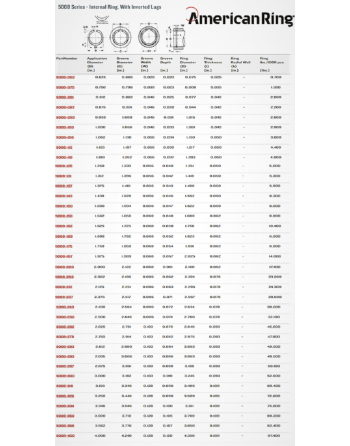
A retaining ring is a fastener that holds components or assemblies onto a shaft or in a housing/bore when installed in a groove. MS16625 series are internal retaining rings intended for use in different housing diameters. They are offered in different materials (Carbon Spring Steel, Corrosion Resistant Steel, Beryllium Copper) and surface finishes (Cadmium Plated, Phosphate Coat, Zinc Coat) depending on their part number.

AVIATIONEU NEW ERA Screw Extraction Kit is intended for use as a removal tool of stuck or broken screws, bolts or studs.
The kit consists of a 6-piece standard screwdriver set and a T Type steel single sided ratchet wrench adjustable to handle fasteners of M3 to M8 sizes.
It is a high quality, versatile, convenient, efficient and long service life kit that can be used for home and professional applications in bikes, cars, electronics, household appliances, mobile repairs and other uses.
The 6-piece standard screwdriver set and the ratchet wrench can be bought separately although the kit provides a cost effective solution.

National Aerospace Standard (NAS) machine bolts are commonly used in aircraft, space shuttles, military vehicles, drones, and other high-performance applications. They are offered in different series to meet application requirements.
Those of NAS 6203 through NAS 6220 series, superseding their NAS 11(xx) counterparts, are tension hexagon head high strength close tolerance short-thread alloy steel bolts with a minimum tensile strength of 160,000 psi and a minimum shear strength of 95,000 psi.
They are made from different steel alloys such as 4140 (UNS G41400) or 4340 (UNS G43406) with either Cadmium Plate Type II, Class 2 or Chromium Plate on shank only with all other surfaces cadmium plated.
Depending on the series they come in different nominal diameters in inches (e.g. NAS 6203 0.1875" (3/16"), NAS 6204 0.25" (1/4"), NAS 6205 0.3125" (5/16"), NAS 6206 0.375" (3/8"), NAS 6208 0.500" 1/2") or NAS 6210 0.625" (5/8") grips (in 1/16” increments beginning at 1/16”), thread and overall fastener lengths. They can be supplied undrilled or with drilled head and/or thread and with or without locking elements (nylon or equivalent). Sourced from quality manufacturers, these bolts are listed according to their series, and offered either as OEM parts or as parts of our own labelled (AVIATIONEU NEW ERA) product lines (see the respective listings). Sold in pieces or packs of specified number of bolts per pack designated by the number after the letters "PK" in the product reference code (SKU).
The following letters after the basic part numbers specify the material, finish, drilling condition, and self-locking capability of these bolts.
No Finish Code for Cadmium II plated bolts
"C" for Chromium plated bolts (shank only)
"L" for Self-locking bolts
"P" for Self-locking bolts with patch type locking element only
Grip Dash Number indicating grip in .0625 increments
"D" after the grip dash number for drilled thread bolts
"H" after the grip dash number for bolts with drilled head
More than one code letters may be used in sequence.
PN Examples:
NAS6204-10 - NAS 6204 Series Bolt, .2500-28 Thread, .625 Grip, Undrilled, Non-locking, Alloy Steel Cadmium II Plated.
NAS6204-10D - Same bolt as above with Drilled Thread.
For more information, please refer to the supplied documentation or contact us.

AVIATIONEU NEW ERA Brass plain washers are made of copper, nickel alloy with a natural color finish in accordance with DIN9021 standard. Sourced from certified manufacturers these washers are offered in competitive prices and they are available in different sizes on the basis of their Clearance (Hole) Diameter/Outer Diameter/Thickness in mm. Sold in packs of 250 or 50 pieces depending on the selected product. The number of pieces included in each pack is mentioned after "PK" designation.

Boeing & Airbus, the two leading airframe builders, have developed specifications for fasteners, hardware and other parts manufactured by different companies. Compliance with Boeing (aka BAC) and Airbus (aka ASNA) Standards is a prerequisite for installation or use of these parts on their respective aircraft. In many cases, Boeing & Airbus fasteners and other parts have the same fit, form, and function and they are considered as alternatives or substitutes to the respective parts designed and/or manufactured by industry leaders such as HI-SHEAR or HOWMET in the case of fastening products.They also conform to widely accepted Military & Aerospace Standards such as AN, MS, NAS and others. However, caution is required as, depending on their series & conforming standard, fasteners are offered in Imperial (in.), Metric (mm) systems, or both, with resulting variations in their dimensions and units of measurement of their properties.
As a result of the extensive portfolio of fastening products (including screws and bolts, nuts, washers, pins, rivets, clamps, and many others) from different leading suppliers, and those falling under Boeing, Airbus, Military and Aerospace Standards, these are listed separately in our Web Platform for Supplies. It must be noted that, depending on the intended application, usually more than one options are available to prospective buyers and selection is finally made, apart from specifications, on the basis of price or lead time required for non-stock parts. Whenever possible,correlation tables and other information and documentation is provided to facilitate the users' awareness on interchangeability of offered fasteners and the selection of the right parts for their intended application. For additional information please contact us.