Metals

Metals Category Image

This category includes a range of metals such as steel, aluminum and others, in different alloys and tempers, used for manufacturing products in different forms (sheets and plates, bars/rods, tubes, wires, etc.). They are widely encountered in aerospace, automotive and many other industrial sectors. Alloys are created by adding small amounts of metallic elements into the base metals to improve their characteristics. These “alloying” elements allow a base metal to improve its attributes and better respond to the requirements of specific applications. Alloy metals an be classified in a variety of different ways depending on their composition (e.g. carbon, low-alloy or stainless steel, in the case of steels), manufacturing methods, finishing method (such as hot rolling or cold rolling), product form (bar,sheet, tube, etc), heat treatment (such as annealing, quenching and tempering), required strength level  as specified in ASTM standards) and others. Because of the wide variety of chemical compositions possible and the fact that some steels are used in more than one heat-treated, condition, some overlap exists among the alloy steel classifications. 

In the case of aluminum alloys, each alloy has attributes such as high strength, conductivity, and even resistance to environmental effects.  A naming system using four-digit designators has been developed by the US Aluminum Association, to organize them. The first digit represents the specific alloying elements and general characteristics of the group, or the “series”.

In selecting an alloy, its mechanical properties should be carefully considered. The mechanical properties of different alloys differ based on how they are heat treated, or made stronger using the tempering process.

Some important measures when considering mechanical properties include the yield strength, ultimate strength, shear strength, fatigue strength, as well as the modulus of elasticity and shear modulus. The yield strength describes the maximum amount of stress needed to elastically deform the part in a given loading arrangement (tension, compression, twisting, etc.). The ultimate strength, on the other hand, describes the maximum amount of stress a material can withstand before fracturing. Before the fracture point, the material will undergo plastic (or permanent) deformation, and will not return to its original shape. For static applications, the yield strength is the more important design constraint as per industry standard design practices; however, the ultimate strength can be useful for certain applications where this kind of deformation is possible. The shear strength measures the maximum amount of “shearing” stress that a material can experience before it permanently deforms. Fatigue strength is the ability of a material to resist breaking under cyclical loading, where a small load is repeatedly imparted on the material over time. This value is useful for applications where a part is subject to repetitive loading cycles such as vehicle axles or pistons. The modulus of elasticity and shear modulus are measures of a material’s resistance to deformation.

Sourced from quality producrs, a wide range of metals are offered, most of them as part of our own branded (AVIATIONEU NEW ERA) product lines. They are available in pre-cut dimensions or cut-to-oder, meeting different specifications and in diferent units of sale, (pieces or tons) depending on the wanted order quantity and requirements. Please refer to the respective sub-categories and the individual product presentations for additional information.

Metals

There are 64 products.

Showing 49-64 of 64 item(s)

AVIATIONEU NEW ERA 4130...

Steel alloy 4130 (ST4130),aka Chrome Moly,after the 2 key composition elements,chromium & molybdenum,is a general-purpose alloy steel widely used by the aviation and motorsports industries due to its weldability, fabrication and mild hardenability in all offered forms (tubes, bars/rods, sheets and plates). Available in two material states (Normalized and Annealed) depending on the process of how the material is heated and cooled.The Normalized condition (aka "Condition N") is the harder and stronger condition, best used when forming is not needed while the Annealed condition (aka "Condition A") is the softer and formable condition.

4130 steel bars/rods in round, rectangullar (flat), square and hexagonal shapes (cross sections) are offered as part of our own branded (AVIATIONEU NEW ERA) product lines. Sourced from quality producers, most of these bars/rods are produced, unless otherwise specified, as “Cold Finished Normalized” (aka “Condition D4”), indicated by the letters "NRZ" and  "CF" in the product SKUs. They come in different dimesions in inches and cut to order (CTO) lengths in feet (*) and meet several AMS specifications, most common being AMS-S-6758 and AMS- 6348. They are widely used in a variety of applications due to their excellent strength to weight ratio,weldability by all conventional methods and resistance to scaling and oxidation. 

Unless otherwise mentioned, there is additional cost if manufacturing test reports are required. For additional information, please refer to the supplied documentation, the individual product presentations or contact us.

(*) As per vendors' requirements, certain 4130 steel bars/rods are ONLY SOLD in 3 feet increments, i.e. cut lengths can only be set to 3, 6, 9 feet etc. as mentioned in the respectivel product presentations. In this case, appearing prices are per 3 feet length and the Minimum Order Quantity (MOQ) is 3 pieces for each of selected rod/bar. Required cut lengths should be specified at the time of ordering.

AVIATIONEU NEW ERA 4130...

Steel alloy 4130 (ST4130),aka Chrome Moly,after the 2 key composition elements,chromium & molybdenum,is a general-purpose alloy steel widely used by the aviation and motorsports industries due to its weldability, fabrication and mild hardenability in all offered forms (tubes, bars/rods, sheets and plates). Available in two material states (Normalized and Annealed) depending on the process of how the material is heated and cooled.The Normalized condition (aka "Condition N") is the harder and stronger condition, best used when forming is not needed while the Annealed condition (aka "Condition A") is the softer and formable condition.

4130 steel bars/rods in round, rectangullar (flat), square and hexagonal shapes (cross sections) are offered as part of our own branded (AVIATIONEU NEW ERA) product lines. Sourced from quality producers, most of these bars/rods are produced, unless otherwise specified, as “Cold Finished Normalized” (aka “Condition D4”), indicated by the letters "NRZ" and  "CF" in the product SKUs. They come in different dimesions in inches and cut to order (CTO) lengths in feet (*) and meet several AMS specifications, most common being AMS-S-6758 and AMS- 6348. They are widely used in a variety of applications due to their excellent strength to weight ratio,weldability by all conventional methods and resistance to scaling and oxidation. 

Unless otherwise mentioned, there is additional cost if manufacturing test reports are required. For additional information, please refer to the supplied documentation, the individual product presentations or contact us.

(*) As per vendors' requirements, certain 4130 steel bars/rods are ONLY SOLD in 3 feet increments, i.e. cut lengths can only be set to 3, 6, 9 feet etc. as mentioned in the respectivel product presentations. In this case, appearing prices are per 3 feet length and the Minimum Order Quantity (MOQ) is 3 pieces for each of selected rod/bar. Required cut lengths should be specified at the time of ordering.

AVIATIONEU NEW ERA 4130...

Steel alloy 4130 (ST4130),aka Chrome Moly,after the 2 key composition elements,chromium & molybdenum,is a general-purpose alloy steel widely used by the aviation and motorsports industries due to its weldability, fabrication and mild hardenability in all offered forms (tubes, bars/rods, sheets and plates). Available in two material states (Normalized and Annealed) depending on the process of how the material is heated and cooled.The Normalized condition (aka "Condition N") is the harder and stronger condition, best used when forming is not needed while the Annealed condition (aka "Condition A") is the softer and formable condition.

4130 steel bars/rods in round, rectangullar (flat), square and hexagonal shapes (cross sections) are offered as part of our own branded (AVIATIONEU NEW ERA) product lines. Sourced from quality producers, most of these bars/rods are produced, unless otherwise specified, as “Cold Finished Normalized” (aka “Condition D4”), indicated by the letters "NRZ" and  "CF" in the product SKUs. They come in different dimesions in inches and cut to order (CTO) lengths in feet (*) and meet several AMS specifications, most common being AMS-S-6758 and AMS- 6348. They are widely used in a variety of applications due to their excellent strength to weight ratio,weldability by all conventional methods and resistance to scaling and oxidation. 

Unless otherwise mentioned, there is additional cost if manufacturing test reports are required. For additional information, please refer to the supplied documentation, the individual product presentations or contact us.

(*) As per vendors' requirements, certain 4130 steel bars/rods are ONLY SOLD in 3 feet increments, i.e. cut lengths can only be set to 3, 6, 9 feet etc. as mentioned in the respectivel product presentations. In this case, appearing prices are per 3 feet length and the Minimum Order Quantity (MOQ) is 3 pieces for each of selected rod/bar. Required cut lengths should be specified at the time of ordering.
AVIATIONEU NEW ERA Grade...

Grade 410 is a basic general-purpose hardenable martensitic stainless steel alloy for highly stressed requirements, providing good corrosion resistance. Martensitic stainless steels are fabricated using techniques requiring final heat treatment. These grades are less resistant to corrosion when compared to those of austenitic. Their operating temperatures are often affected by their loss of strength at high temperatures, due to over-tempering and loss of ductility at sub-zero temperatures. Quenching and tempering can harden grade 410 steels while their corrosion resistance can be further enhanced by hardening, tempering and polishing. 

410 is a very common grade used in many industries such as aerospace, power generation, and general industry. Generally used for applications requiring mild corrosion, heat resistance and high strength and ductility. Indicative examples include steam / gas turbine blades and buckets, bushings, valve components, fasteners, nuclear reactor control rod mechanisms, petrochemical equipment and machine parts.

Grade 410 round bars/rods are offered as part of AVIATIONEU NEW ERA product lines. Sourced by quality producers, these bars/rods are available in different diameters and pre cut lengths in inches. They meet AMS -QQ-S-763, AMS -5612, AMS -5613, AMS -2303, ASTM -A276, ASTM -A479 specifications. For additional information, please refer to the supplied documentation or contact us.

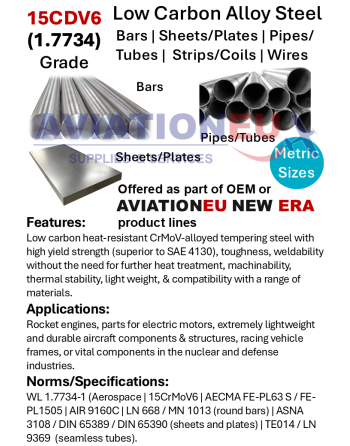
15CDV6 (1.7734) Low Carbon...

The 15CDV6 (1.7734) grade is a chromium-molybdenum-vanadium (CrMoV) heat treatable low carbon steel, a trully multifunctional material that excels in various areas such as mechanical strength, toughness, machinability, thermal stability, lightweight properties, and compatibility with a wide range of materials. Highly regarded & used in aerospace, motorsports and other industries due to its high tensile and compressive mechanical strength for structural components aimed to endure high stresses, its robustness and resistance to fracture or cracking under various load conditions for applications where safety cannot be compromised.Common uses in aerospace include aircraft chassis and fuselage structures, landing gear components (struts, wheel axles, and others) but also  for bolts, screws, and other fasteners like rivets. Also used for rocket engines, parts for electric motors, racing vehicle frames, pressure vessels, suspensions, or vital components in the nuclear and defense industries. 

The 15CDV6:

- combines a high yield strength (superior to SAE 4130) with good toughness and weldability with very little loss of its properties and without the need for further heat treatment. 

- is  low weight. For similar mechanical performance, it offers a more favorable strength-to-weight ratio than many other steels.

- has excellent machinability. Whether for cutting, forming, or welding, 15CDV6 suitability to various processing methods, results in ease of handling and reduces production costs.

- has excellent thermal stability making this alloy a material of choicel in aerospace, where components are subjected to extreme temperature ranges, from very cold to very hot, without compromising their performance.

- is compatible with other metals and composite materials frequently used in the aerospace industry. This compatibility facilitates its integration into complex systems, making it a preferred choice for engineers and aircraft designers. 

Metal products from 15CDV6 (1.7734) grade alloy steel are now offered in different forms/shapes (bars, sheets/plates, pipes/tubes, strips/coils, wires) for use in aerospace and industrial applications as part of OEM or our own labelled (AVIATIONEU NEW ERA) product lines. Depending on the selected product, they are available in different diameters, thicknesses, widths and pre-cut or cut-to order lengths in Metric system and specifications  (*)  to meet the application requirements. Priced per piece or unit weight (kg or ton for substantial quantities). Please refer to the supplied documentation or send us your RFQ for a quotation.

(*) Indicative Norms/Specifications: DIN WL 1.7734-1 (1982) Aerospace | 15CrMoV6 | AECMA FE-PL63 S / FE-PL1505 | AIR 9160C | LN 668 / MN 1013 (round bars) | ASNA 3108 / DIN 65389 / DIN 65390 (sheets and plates) | TE014 / LN 9369  (seamless tubes).

AVIATIONEU NEW ERA ASTM...

These AVIATIONEU NEW ERA hexagon locking nuts comform with ASTM A194 standard specification for carbon, alloy and stainless steel nuts used in high pressure, temperature or other special-purpose applications. They can be indicatively used in the process industries, such as petroleum and chemicals for pressure vessels, valves, flanges, and fittings. Sourced by certified manufacturers these nuts are competitively priced and offered in metric (M3 - M36 diameter) or inch (3/16" - 1.1/2") sizes, different thread types and grade range to meet respective design, service conditions, mechanical properties, and high temperature requirements. Please refer to ASTM A194  specification table for additional information. Sold in packs of 100 pcs each.  Appearing price is for reference only per pack. Please contact us for a quotation.

AVIATIONEU NEW ERA INCONEL®...

Inconel® is a registered trademark of Special Metals Corporation (SMC) for a family of austenitic nickel-chromium-based superalloys. Inconel® suitability for extreme pressure and heat environments and corrosion resistance allow its use in most demanding operating conditions. Even compared to stainless steel, Inconel® has an incredibly high tolerance for extreme heat, and doesn’t lose as much tensile strength at 2,000°F as most steel alloys.  Inconel® alloy comes in different grades (variations) such as 600, 601, 617, 625, 686, 690, 693, 718, 725, 751, 783 and others. It also used in the production of pipes, tubes, sheets, strips, plates, round and flat bars, etc. but also in the manufacturing of other products including fittings, flanges or fasteners. Some typical sectors/fields of use of Inconel® alloy include:

Oil and gas extraction industries due to its high temperature resistance and oxidation resistant properties,

Heat treat applications, due to its resistance to extreme temperatures,

Saltwater (Marine) Applications, because of its extraordinary resistance to sodium chloride (salt) at a variety of temperatures,

Jet engines and turbines where they need to withstand extreme temperatures (low or high). At a passenger jet’s standard cruising altitude of 36.000 ft., the average air temperature is -56.3°C (-69.3°F), but the combustion process can exceed temperatures of 1.150°C (2120°F).

AVIATIONEU NEW ERA Inconel® strips are intended for use in different industrial applications. They are offered in strips/strip coils in different Inconel® variations  in a range of  thicknesses, widths and pre-cut or cut to order lengths meeting application requirements. Sourced from quality producers these strips are competitively priced. Unit of measurement for pre-cut strips is each (ea.) while for the cut to order strips is 1 kilogram (kg) unless otherwise stated. Appearing prices are  per unit of sale. Sea/sea-surface transport to customer destination is most commonly used. Appr. time for shipping: within 3 months from the time of order payment, depending on the ordered quantity. Please refer to any attached documentation  and contact us for additional information/clarifications and quotation.

AVIATIONEU NEW ERA INCOLOY®...

Incoloy® is a registered trademark of Special Metals Corporation (SMC) for a family of super austenitic stainless steels.They do not have to be heat treated after welding to restore the corrosion resistance. Like other SMC superalloys,  Incoloy® alloys come in different grades (variations) listed in the Product Description and are used in the manufacturing of different products such as pipes, tubes, sheets, strips, plates, round and flat bars, etc. Incoloy® products are mostly chromium-based and mostly nickel-based, and designed for corrosion resistance as well as strength at high temperatures.

AVIATIONEU NEW ERA Inconel® strips are intended for use in different industrial applications. They are offered in strips/strip coils in different Incoloy® variations  in a range of  thicknesses, widths and pre-cut or cut to order lengths meeting application requirements. Sourced from quality producers these strips are competitively priced. Unit of measurement for pre-cut strips is each (ea.) while for the cut to order strips is 1 kilogram (kg) unless otherwise stated. Appearing prices are  per unit of sale. Sea/sea-surface transport to customer destination is most commonly used. Appr. time for shipping: within 3 months from the time of order payment, depending on the ordered quantity. Please refer to any attached documentation  and contact us for additional information/clarifications and quotation.

AVIATIONEU NEW ERA...

Stainless steel strips feature high hardness, toughness, corrosion resistance and low maintenance making them suitable in different industries. AVIATIONEU NEW ERA stainless steel strips are offered in strips/strip coils in different grades (201,202,301,304/304L, 309S,310S,316L,316Ti,317L,321,347,444,904L & 2507) in a range of  thicknesses, widths and pre-cut or cut to order lengths meeting application requirements. A brief description of each grade and respective applications is included in the Product Description section.

AVIATIONEU NEW ERA stainless steel strips are sourced from quality producers and they are competitively priced. Unit of measurement for pre-cut strips is each (ea.) while for the cut to order strips can be kilograms or tons as specified by our suppliers. Appearing prices are  per unit of sale. Sea/sea-surface transport to customer destination is most commonly used. Appr. time for shipping: within 3 months from the time of order payment, depending on the ordered quantity. Please refer to the attached documentation of the various offered grades or contact us for additional information.

AVIATIONEU NEW ERA Honed...

Honed tubes/pipes are also known as  hydraulic or pneumatic cylinder tubing due to their primary uses for their production or repair. They are tubes with their inside diameter either honed or skived & roller burnished resulting in extremely precise inside diameter (ID) dimensions and smooth ID surfaces. Honing is an abrasive machining process involving the use of abrasive polishing stones and abrasive paper to remove small amounts of material and improve surface geometry and surface texture.The manufacturing process is determined upon the tube dimension, mold availability and customer ewquirements. Honed tubing is used in applications where a high precise inside diameter dimension and a smooth inside surface are required.

As honed tubes are the most important materials for manufacturing and repairing hydraulic and pneumatic cylinders, the quality of the honed tube is of critical importance. Honed  tubes/pipes are offered as part of our own branded (AVIATIONEU NEW ERA) product lines in different materials, such as steel, stainless steel and aluminum alloys in various grades and tempers depending on the intended application. Sourced from quality producers, the AVIATIONEU NEW ERA honed tubing is available in different size ranges in imperial  (in.) and metric systems and pre-determined or cut to order lengths. Depending on the producer, they comply with different standards/specifications. Manufacturing test reports can be supplied upon request additional cost, unless otherwise mentioned.

For additional information, please refer to the Product Description section, the supplied documentation or contact us.

AVIATIONEU NEW ERA Aluminum...

Extending our present product range, our new AVIATION NEW ERA extruded aluminum alloy angles are offered in Metric (mm) dimensions and cut to oder lengths in meters to cover a wide range of application requirements.These angles are sourced mostly from Asian producers with a ISO9001:2008 quality management system and production process control while some are also holders of Approved Supplier Certificates from major aerospace companies. They comply, according to the selected angle,  with SAE AMS-QQ-A-200/3  (*) or ASTM B211M specifications (**).

Like the other AVIATION NEW ERA extruded aluminum profiles, these angles are offered in different aluminum alloys and tempers and are competitively priced to provide aviation quality but also economical solutions to our angles in inches produceed as per SAE AMS-QQ-A-200/3 specifications (**).

Aluminum Alloy Options: 2011,2014,2017,2024,5052,5083,5086,5454,5754,6061, 6063,6082,7003,7022,7050,7055,7075. 

Temper Options: T3,T351,T4,T451,T5,T6,T651,T6511,T7351,H111,H114,O.

Wide range of dimensions (mm). Custom dimensions also possible with an additional mold charge

Cut To Order (CTO) Lengths (m). Range: 1000mm - 6000mm.

Standard sizes in stock for quick deliveries. Custom dimensions also possible with an additional mold charge

 Manufacturer Test Reports (MTRs) can be supplied at additional charge

Applications: widely used to contain, protect, reinforce and support various surfaces whether in ceramic, glass, plaster, plastic, stone, wood or other metals.

For more information please refer to the supplied documentation or contact us.

(*) AMS stands for Aerospace Material Specifications established by the SAE International (formerly, the Society of Automotive Engineers or SAE). AMS specifications are compiled in a comprehensive database of individual directives that standardize procedures, equipment and processes related to aerospace material processing. These are continuously updated and revised to stay up-to-date with advances in material science and processes technologies.

(**) ASTM International is a standards organization developing and publishing “voluntary consensus technical standards for a wide range of materials, products, systems, and services.”ASTM’s aerospace material standards are instrumental in evaluating materials, components, and devices primarily used in aerospace and aircraft industries.

AVIATIONEU NEW ERA MS14144...

A castellated nut, also referred to as a castle nut or slotted nut, is a nut with slots (notches) cut into one end. Although castellated nuts are frequently referred to as slotted nuts, there are slight differences. Castellated nuts are formed with a round section at the top where the slots are located. Slotted nuts do not have this rounded modification. The flat sides of slotted nuts extend fully from the top to the bottom of the nut. Both castellated and slotted nuts are designed to use a pin (usually a split pin) that fits through the slots and through a hole in the screw to which the nut is attached. This pin prevents the nut from turning and loosening. Compared with slotted nuts, castellated nuts allow the cotter pin to be confined closer to the margins of the nut itself, providing added secureness.

MS14144 Series nuts are slotted hexagon style lightweight castellated self locking nuts manufactured from steel and cadmium plated. They are offered as part of our own labelled (AVIATIONEU NEW ERA) product lines in different sizes with right-hand thread direction and a dry film lubricant as applicable, specified by the letter "L" in the part number.

Note: Depending on availability,these parts part may be supplied without or with Dry-Film Lubricant indicated by letter "L" in the SKU.

AVIATIONEU NEW ERA Aluminum...

Aluminum alloy products consist a significant product cateory within our AVIATIONEU NEW ERA offered portfolio of metal products.

Sourced from quality producers worldwide, they are widely used in different applications in Aerospace & Defense as well as many other industries. Extending our Aerospace quality aluminum product portfolio, (separately listed) manufactured from premium materials, through rigorous processes & extensive testing under strict quality management systems, our new Commercial quality product lines  for industrial applications emphasize on cost-effectiveness. Without sacrificing quality, they conform to industrial standards (many of which are the same with those of their Aerospace quality counterparts) and can be supplied in different aluminum alloys and tempers to select for specific project requirements. Produced through extrusion, cold rolling (aka cold drawing or cold finishing) or hot rolling  manufacturing processes (*), they are competitively priced and offered in different finishes (mill finish, polished, etc.) in a wide range of dimensions in inches or millimeters (Metric system) with pre cut or cut to order lengths in feet or meters. Custom dimensions also possible with an additional mold charge. Standard sizes are maintained in stock with our suppliers for quick deliveries. Available shape options include round, rectangular, hexagonal, square bars/rods, angles, and different profiles for architectural and other applications. They are typicaly  used in automotive industry (vehicle body building), transport equipment, equipment components, frame building and general constructions, reinforcement and support of various surfaces (in the case of angles) and many others.

For further information please refer to the Product Description section and the respective documentation.

(*) Extrusion is a common forming process for producing a variety of metal parts and other materials. Extruded aluminium is made by heating the aluminium and pushing it through a die to form the finished product, and subsequently cooled, stretched, and hardened at room temperature or in heated spaces for rapid tempering. A common product example for this process is aluminium tubing. In cold drawing or cold rolling forming process (sometimes referred as cold finishing) the aluminum material is pulled into a draw die or rollers, shaping the metal at room temperature. In hot rolling, the material is heated before shaping. Cold drawing improves the metal’s mechanical properties and gives a captivating finish to the finished product.

In general, the extrusion process is considered of lower cost to cold processing which involves a greater set of instruments and materials to finish.

AVIATIONEU NEW ERA DIN 980...

Self-locking nuts (aka lock nuts) are widely used in applications in which motion or vibration can cause fasteners to become loose. Lock nuts conforming to DIN 980 stanard are all metal prevailing torque, hexagonal nuts and they  are available in two types, DIN 980 V-type (DIN980/V) with a distorted thread and DIN 980 M-type ((DIN980/M) with an embedded metal locking plate.

In DIN 980 V-type distorted thread nuts, certain teeth of the nut thread are deformed through die stamping resulting in the inner diameter of the nut thread being slightly smaller than the outer diameter of the bolt thread. Therefore, the friction force between the threads after the nut is tightened is far greater than that of the common thread, which can play an effective role in preventing loosing. 

In DIN 980 M-type nuts, the nut is embedded with a metal locking plate after heat treatment. The inner diameter of the metal plate is slightly smaller than the outer diameter of the bolt thread. After the nut is tightened, the metal plate blocks the bolt thread, thus preventing loosening.

DIN 980 lock nuts must be tightened with tools (such as ratchet spanner) during installation. Although they can be can be used repeatedly, frequent disassemblies and installations are not recommended as the locking torque of the nut will decrease significantly.

Depending on the producer, DIN 980 lock nuts are manufactured in different metric thread sizes (M3 ~ M39) from carbon steel in various strength classes (such as  4, 6, 8, 10 and 12) or stainless steel in grades 70 and  80. They are offered in various finishes such as plain, black, zinc/yellow plated, H.D.G, and chrome plated.

Both DIN980/V and DIN980/M lock nuts are offered as part of our own (AVIATIONEU NEW ERA) product lines. Sourced from quality manufactuurers they are competitively priced and can be supplied in carbon steel or stainless steel, in different grades, metric thread sizes  and finishes .

For additional information please consult the supplied documentation.

Notes:

Different metric thread sizes are designated by the letter "M" indicating the nut's clearance diameter in mm.

Nut thread pitch indicates the distance between threads measured along the length of the nut expressed in mm.

In the case of stainless steel lock nuts, the stainless steel grades are denoted with codes such as A2 or A4 and dash numbers indicating the minimum tensile strength to be met by the material. For example, A2-70 relates to a lock nut made from 304 stainless steel with a minimum tensile strength of 700N/mm² (MPa).

J.LANFRANCO & CIE Self...

J.LANFRANCO & CIE is a manufacturer of high performance fasteners including all-metal and nylon insert locknuts, clinch nuts and inserts, modular fixtures, bolts and washers.

J.LANFRANCO all-metal locknuts have no plastic inserts. They are suitable for applications under extreme temperatures, corrosive environments effective or those under high levels of vibration. J.Lanfranco all-metal locknuts come in different versions (types) outlined below:

ESL: Dual-slotted, all-metal, reusable slotted self-locking hexagon nuts. Extremely reliable with consistent prevailing torque, and no galling.

ERM: All-metal, reusable self-locking hexagon nuts with double slots & UNC/UNF or Metric moving washer. Time saver nuts with integrated disc spring washers for quick installations and absolute tension maintained under dynamic loads.

THU: Full-height, heavy hex industrial version of the ESL nuts. Feature a robust industrial design and superior resistance to vibration, corrosion, and temperature.

Single Slot Self-locking Hexagon nuts HCB, HCE & HCT. All supplied with ISO 965-2 standard threading. All offered in steel ISO 898-2/ISO 2320 & stainless steel ISO 3506-2/NF E 25-035-2 in different metric diameters, fine pitch, special height, non-standard hexagon on request.

HCB: Single-slotted, extra low height, locking jam nuts.

HCE: Single-slotted, normal self-locking hexagon nuts.

HCT: Reusable one-piece, full-height locknuts ideal for high temperature areas.

GSL: ISO 7042 locknuts offered in metric steel class 8, 10, 12 and stainless steel A2-70 & A4-80

HUS Starnut: Standard deformed thread locking nuts also known as a “top locking” type nuts.

SPR: Hex nuts with crimped, deflected metal ring.

SRF: Top locking style flange nuts in which locking is achieved by deformation of the last thread.

J.LANFRANCO nylon Insert locknuts are self-locking hex nuts with a standard or high temperature nylon ring to generate prevailing torque. Product portfolio includes a full line of metric nylon insert nuts as well as imperial NE, NU, NTU patterns in UNJC & UNJF thread form MIL-8879 or MIL-S-7742. Nylon Insert locknuts come in the following versions (types):

HMP ISO 10511: Low-height metric nylon insert locknuts to ISO 10511.

HUP ISO 7040: Nylon insert locknuts made to all major metric and imperial standards (ISO 7040, IFI 100/107). Available in carbon steel, stainless steel, and exotics. UNJC & UNJF threads are also available.

EUM: Nylon insert self-locking nuts with a free spinning conical washer.

J.LANFRANCO & CIE fasteners are widely used in different industries for automotive/bodywork, vehicle substructures, transportation plant construction, rail vehicles/bogies, energy supply/power plant construction, shipping but also for aerospace and defence applications.

For additional information please consult the Product Description section & the supplied documentation.